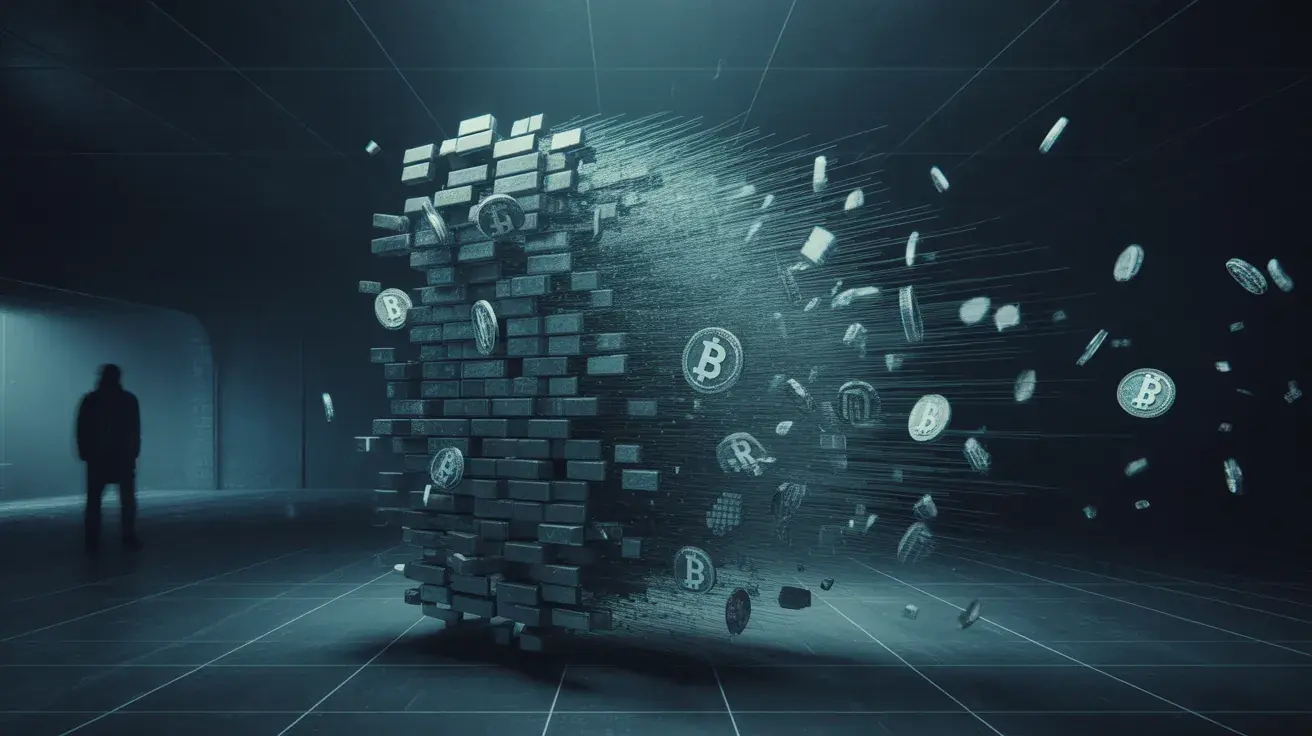

Opening your crypto portfolio on April 5, 2026 takes a strong stomach. Bitcoin is trading around $67,000 — nearly half the all-time high of $126,272 reached just last October 6.
The Fear & Greed Index sits at 8 out of 100 — a level of "extreme fear" that hasn't persisted this long since the Terra-Luna collapse in June 2022 — with 46 consecutive days in critical territory. The question is no longer just "when does this correction end," but what truly triggered it and where we stand now. The answers are more complex than the sensational headlines suggest.
Tariffs and the Return of Risk-Off Sentiment
The primary driver of the market deterioration has a clear name: the trade tariffs imposed by the Trump administration.
In February, the announcement of a sweeping 15% increase on global imports sent crypto down more than 5% within hours, with forced liquidations burning through $2.56 billion in a single weekend. Jeff Mei, Chief Operating Officer of BTSE, explained it plainly to CoinDesk: "We believe the sharp increase in tariffs is pushing investors to sell crypto assets in anticipation of a more severe market downturn.
The mechanism is as simple as it is brutal: high tariffs fuel expected inflation, expected inflation delays rate cuts, and high rates compress the valuation of speculative assets. Crypto — which many had painted as a macro-risk hedge — behaved in precisely the opposite way, falling in lockstep with tech equities.
Worst First Quarter Since 2018
The numbers are stark: Bitcoin closed Q1 2026 at -23.8%, its worst quarterly performance since 2018, when it fell -49.7%. Ethereum shed more than 60% from its peak, trading around $1,870. Total crypto market capitalization settled at $2.38 trillion. Standard Chartered revised its year-end targets downward, cutting its Bitcoin forecast to $100,000 (from $150,000), with a possible intermediate dip toward $50,000 before any recovery.
Tom Lee of Fundstrat, speaking on CNBC's The Exchange, framed the current situation as a "crypto squall" — a passing storm, not a structural breakdown: "2026 will be a tale of two halves. The first half can be painful, but that is exactly what sets up the big rally in the second half."
Fundstrat had already warned its institutional clients that a deep pullback in the first half was expected, with a BTC target range of $60,000–$65,000.
The Biggest Hack of 2026: Drift Protocol Drained
Amid the macroeconomic chaos, April 1, 2026 delivered another blow: the Drift Protocol hack, the largest DeFi exploit of the year. The Solana-based protocol, which managed over $550 million in total value locked, lost $285 million in just twelve minutes.
The attack did not exploit a code bug — Drift had been audited twice, most recently in February by ClawSecure — but a governance vulnerability: with just 2 of 5 multisig signatures, the attackers seized control of the administrative keys and drained three main vaults. Elliptic and TRM Labs attributed the attack to North Korea's Lazarus Group.
The team posted a statement on X that went instantly viral: "This is not an April Fools joke." The DRIFT token crashed 40% in the following hours, and eleven protocols across the Solana ecosystem suffered collateral damage.
Drift Protocol is experiencing an active attack. Deposits and withdrawals have been suspended. We are coordinating with multiple security firms, bridges, and exchanges to contain the incident. This is not an April Fools joke. We'll provide additional updates from this account as… https://t.co/03SRPq4fHj
— Drift (@DriftProtocol) April 1, 2026
ZachXBT Accuses Circle: Six Hours of Silence That Cost Everything
What happened after the hack added a layer of controversy the industry will not soon forget. Blockchain investigator ZachXBT documented how the attacker used Circle's Cross-Chain Transfer Protocol (CCTP) to move over $232 million in USDC from Solana to Ethereum across more than one hundred transactions spread over six hours — all during normal US business hours.
Circle did not intervene. "Circle was asleep while many millions of USDC was swapped via CCTP from Solana to Ethereum for hours," ZachXBT wrote on X on April 2, addressing Jeremy Allaire directly. The paradox he exposed is glaring: days earlier, Circle had frozen 16 legitimate business hot wallets as part of a sealed civil case, disrupting exchanges and payment processors. During a nine-figure hack: complete silence.
Circle was asleep while many millions of USDC was swapped via CCTP from Solana to Ethereum for hours from the 9 figure Drift hack during US hours.
— ZachXBT (@zachxbt) April 2, 2026
Value was moved and nothing was done yet again.
Comes days after you froze 16+ business hot wallets incompetently which is still… pic.twitter.com/T0Xwg1HIfO
On April 3, ZachXBT published a broader dossier: over $420 million in alleged compliance failures by Circle since 2022, covering at least fifteen cases in which the stablecoin issuer took minimal or no action against illicit funds in transit.
1/ Welcome to the Circle $USDC files.
— ZachXBT (@zachxbt) April 3, 2026
$420M+ in alleged compliance failures since 2022, including fifteen cases of the US-regulated stablecoin issuer taking minimal action against illicit funds. pic.twitter.com/OiWZz5MrVM
Beneath the Fear, Whales Are Moving
Yet beneath the surface of this collective fear, signals are emerging that bulls are not ignoring. Over the past month, so-called large wallets have accumulated 270,000 BTC despite sentiment at historic lows.
Spot Bitcoin ETFs maintain $165 billion in assets under management. The CLARITY Act — the legislation that could finally bring regulatory clarity to the US — has a 72% probability of passing according to Polymarket, with a Senate Banking Committee markup expected by mid-April. Charles Schwab, with nearly $12 trillion in client assets, is preparing to launch spot trading of Bitcoin and Ethereum in the first half of the year.
Ethereum's Glamsterdam upgrade is expected in June. Pedro Lapenta, Head of Research at Hashdex, is cautious: "From a risk management perspective, it makes sense for the market to stay on the sidelines." But whales, evidently, are not waiting for consensus before acting. And crypto history suggests that those who accumulate during periods of extreme fear rarely regret it.