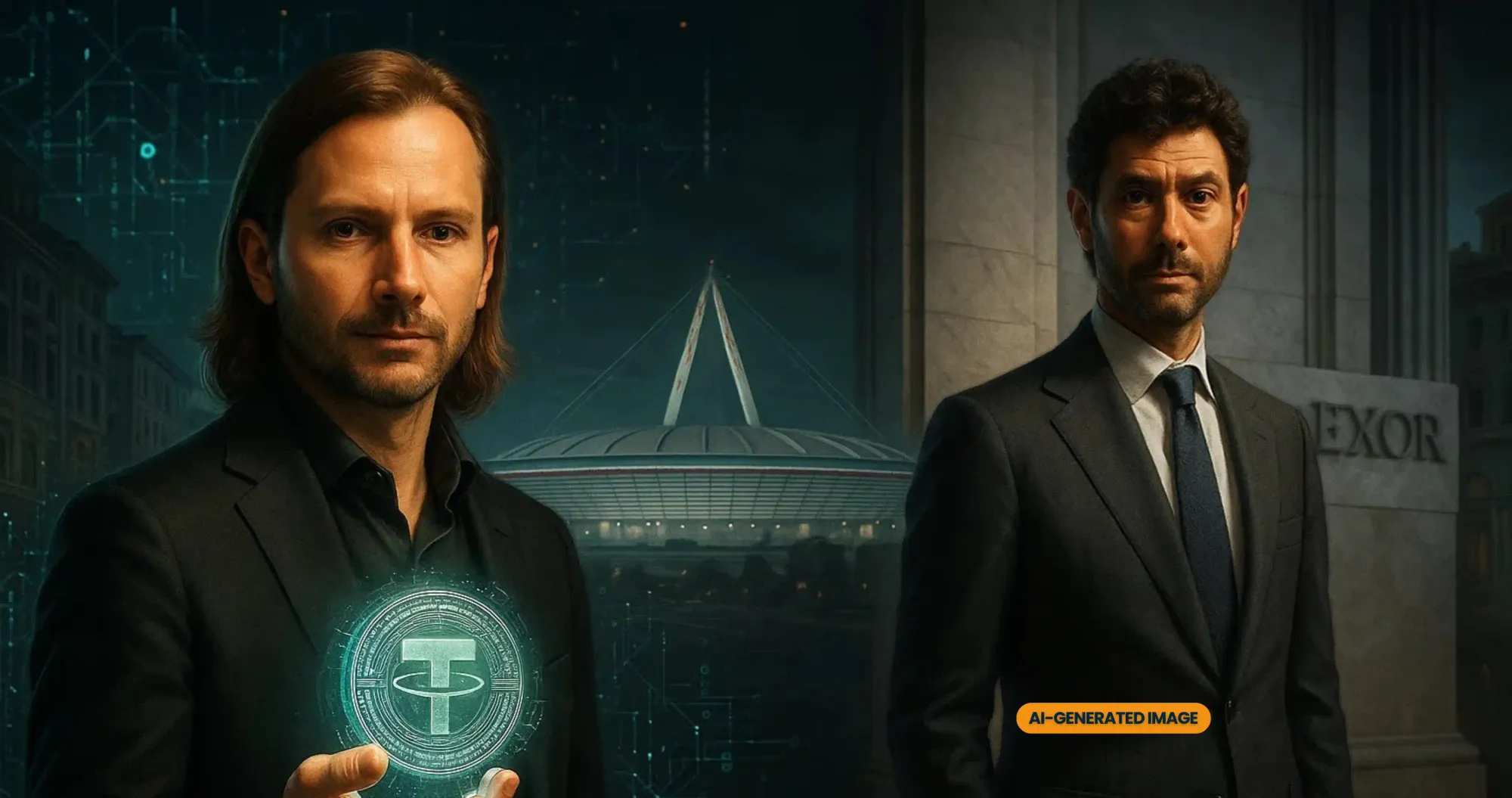

Five years ago, almost no one outside the crypto world knew their names. Today, Giancarlo Devasini and Paolo Ardoino rank among Italy's four wealthiest individuals — and they want to buy Juventus FC.
From Turin and Liguria to the Global USDT Empire
Devasini was born in Turin in 1964. A former plastic surgeon turned electronics reseller, he co-founded Tether — the company behind USDT, the world's most widely used stablecoin. As of early 2026 Forbes data, his net worth places him among Italy's top three richest individuals, a position he has climbed to with remarkable speed.
Ardoino is from Cisano sul Neva in Liguria, born in 1984. He studied applied mathematics at the University of Genoa, launched a startup in London, then joined Bitfinex in 2014. Since October 2023, he has served as CEO of Tether. His name became a fixture in mainstream European media once news broke of his bid to acquire Juventus.
Tether recorded profits of over $13 billion in 2024, driven primarily by yields on the US Treasury securities backing USDT reserves. With more than 400 million users globally, USDT has become core financial infrastructure across emerging markets — Argentina, Nigeria, Turkey, and Egypt among them. For readers outside Europe, that scale dwarfs most traditional payment networks.
USDT is the People's digital dollar.
— Paolo Ardoino 🤖 (@paoloardoino) April 2, 2026
People and institutions will always gravitate towards solutions that protect them in difficult moments like these security breaches.
Well done @USDT0_to team ❤️ https://t.co/88WmWgmkoE
The 11.5% Stake and the Rejected Billion-Euro Bid
The Tether-Juventus story starts quietly. Tether first acquired a 5% stake in February 2025, pushed past 10% in April, then participated in a €100 million capital raise. Then on December 12, 2025, Ardoino sent a formal binding offer — entirely in cash — to acquire the controlling stake held by Exor, the Agnelli-Elkann family holding company. The offer was valued at €1.1 billion.
Exor's chair John Elkann responded within hours. His reply was blunt: “Juventus has been part of my family for 102 years.” The board rejected the offer unanimously. Tether did not get the club.
Today Tether holds 11.5% of Juventus — the second-largest position behind Exor's 64.5%. That is not a passive investment. Tether already has a seat at the table: Francesco Garino was appointed to the Juventus board at the November 2025 shareholders' meeting.
The Offer Is Still on the Table
Ardoino has not walked away. In a February 2026 interview on the program “Black Box,” he stated clearly:
“We believe Juventus can do much better and we would like to contribute to a positive change, even without necessarily controlling it entirely. Giancarlo and I are big fans, but we believe the club today has enormous untapped potential — 200 million fans worldwide, many in the emerging markets we serve with Tether. We are not withdrawing the offer.”
By March 2026, Devasini ranked 1st and Ardoino 4th among Italy's richest individuals according to the latest rankings. Their combined financial firepower is considerably greater than when the initial €1.1 billion offer was submitted. That matters.
What This Means for Crypto and European Football
This story is not really about football. It is about what happens when crypto-native wealth — built on stablecoin infrastructure used by hundreds of millions — starts intersecting with legacy European institutions that have resisted outside capital for generations.
Tether operates under no single national regulator. It is incorporated in the British Virgin Islands and has faced longstanding scrutiny over reserve transparency, including a 2021 settlement with the New York Attorney General. Under the EU's MiCA regulation, which fully applies from December 2024, stablecoin issuers operating in European markets face new reserve and disclosure requirements — a framework Tether has navigated carefully.
Exor is not selling — that much is settled for now. But Ardoino holds a board seat, a significant minority stake, and an unretracted offer. In high finance, “never” tends to come with an expiry date.