
The Bitcoin network is undergoing one of the most significant structural shifts in its recent history. At block 941,472 — mined on March 20, 2026 — the network recorded a mining difficulty drop of nearly 8%, bringing it down to 133.79 trillion. According to data from CloverPool, this is no routine technical adjustment: it signals a genuine wave of economic capitulation among mining operators.
Hashrate Drops Below the Critical Threshold
For the second time in 2026, the Bitcoin network has suffered a massive contraction, pushing the total hashrate below the psychologically and technically significant level of 1 zetahash per second (ZH/s). Global computational power currently sits at 933.51 exahashes per second (EH/s).
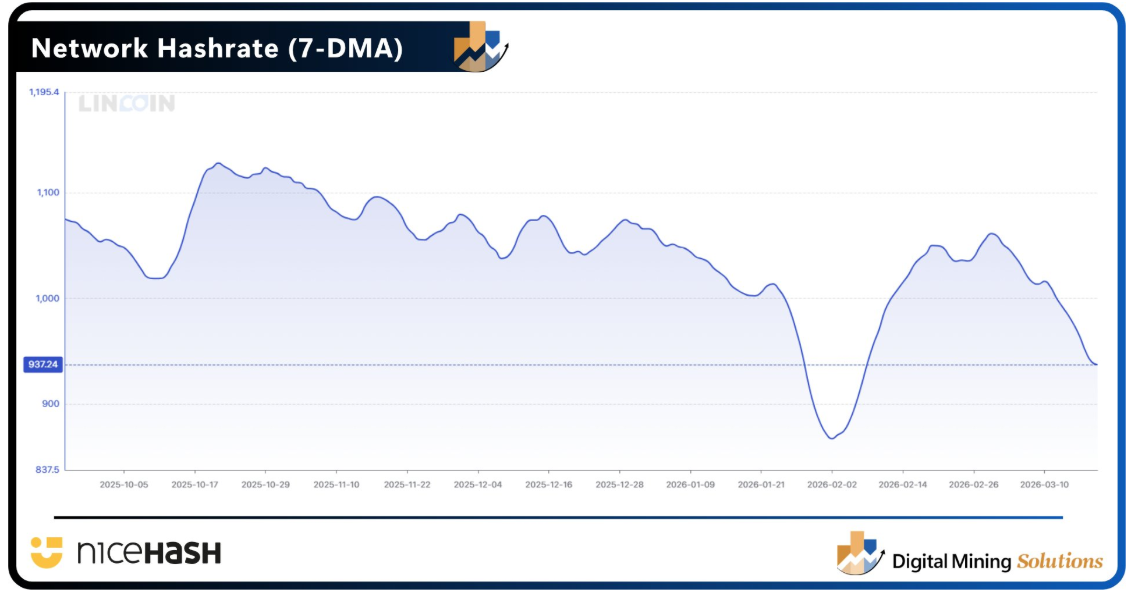
While a modest rebound in hashprice to $33.37 over the past 24 hours offers temporary relief to surviving operators, the long-term outlook remains strained. Market forecasts point to further margin compression, with difficulty projected to fall an additional 0.52% — to 133.10 trillion — at the next adjustment cycle.
Not the Weather: A Structural Shift
Unlike the hashrate collapse in early February 2026 — triggered by severe winter storms across the United States that forced miners to temporarily cut power consumption — the current decline has a fundamentally different cause. Industry analysts broadly agree that this is a structural change, not an isolated weather event.
Nico Smid, founder of Digital Mining Solutions, explained that the current economic environment is forcing operators running older hardware and carrying high energy costs to shut down permanently. Extreme competition and Bitcoin's recent price weakness have made operations unsustainable for anyone without next-generation mining equipment.
"This time it looks like a genuine economic capitulation. What we're seeing may not be just a temporary dip, but a broader stress test for the entire mining industry. The miners that survive this phase will likely emerge leaner, more efficient, and structurally stronger," said Smid.
Network Hashrate Drops Below 1 ZH, But This Time It's Different 👇
— Nico Smid (@Smidnico) March 20, 2026
The Bitcoin network hashrate is back below the 1 zetahash level and trending toward the lows we saw earlier this year.
But unlike the sharp drop in late January which was triggered by a winter storm in the… pic.twitter.com/JhQAj4n782
The Pivot: From Mining to Artificial Intelligence
The most telling signal to emerge from this crisis is the radical capital reallocation underway among the industry's largest players. Companies such as Core Scientific and Riot Platforms are aggressively rethinking their business models. Rather than solely mining Bitcoin, these giants are repurposing their energy infrastructure and data centers to host Artificial Intelligence (AI) workloads.
This pivot reflects a stark economic reality:
- Volatility vs. Stability: While Bitcoin mining revenues fluctuate with speculative market cycles, AI computing services offer long-term contracts and far more predictable cash flows.
- Infrastructure Efficiency: Miners' vast energy reserves and pre-built cooling systems represent a highly valuable asset for the rapidly growing market for large language models and machine learning.
Conclusion: A New Era for the Bitcoin Network
The 8% difficulty drop is a symptom of natural selection playing out in real time. As smaller operators are pushed out of the market, larger players are evolving — transforming the face of the industry. The Bitcoin network is becoming leaner, but the central question remains: how much of the world's energy capacity will stay dedicated to securing the blockchain — and how much will be sacrificed on the altar of the AI revolution?
The next difficulty adjustment to 133.10 trillion will be the definitive indicator of whether this global hashrate reshuffle is only just beginning.