

A Japanese startup claims it can match the world's best AI models without building one. On June 22, Sakana AI launched Fugu, a system designed not to be the smartest model in the room, but the best conductor of other models. Its promise carries a sharp edge: frontier-level capabilities, the company says, without the exposure that comes from export controls.
Why the Idea Matters
Fugu challenges the “bigger is better” orthodoxy. Rather than a monolithic giant with hundreds of billions of parameters, Fugu centers on a 7-billion-parameter orchestrator called Conductor. It is trained to do one thing: parse a request and decide whether to answer directly or delegate to a team of specialist models, then combine and verify the outputs. The user sees none of this complexity. Everything surfaces through a single OpenAI-compatible API, as if they were talking to one model the whole time.
The pedigree behind Sakana AI is serious. Co-founder Llion Jones is one of the original authors of the Transformer research that underpins virtually all modern AI. The company, valued at over $2.5 billion according to Bloomberg, counts NVIDIA and Google among its backers. Fugu ships in two versions: a standard build for everyday use, and Fugu Ultra for the most demanding tasks.
The Numbers, and Why Caution Applies
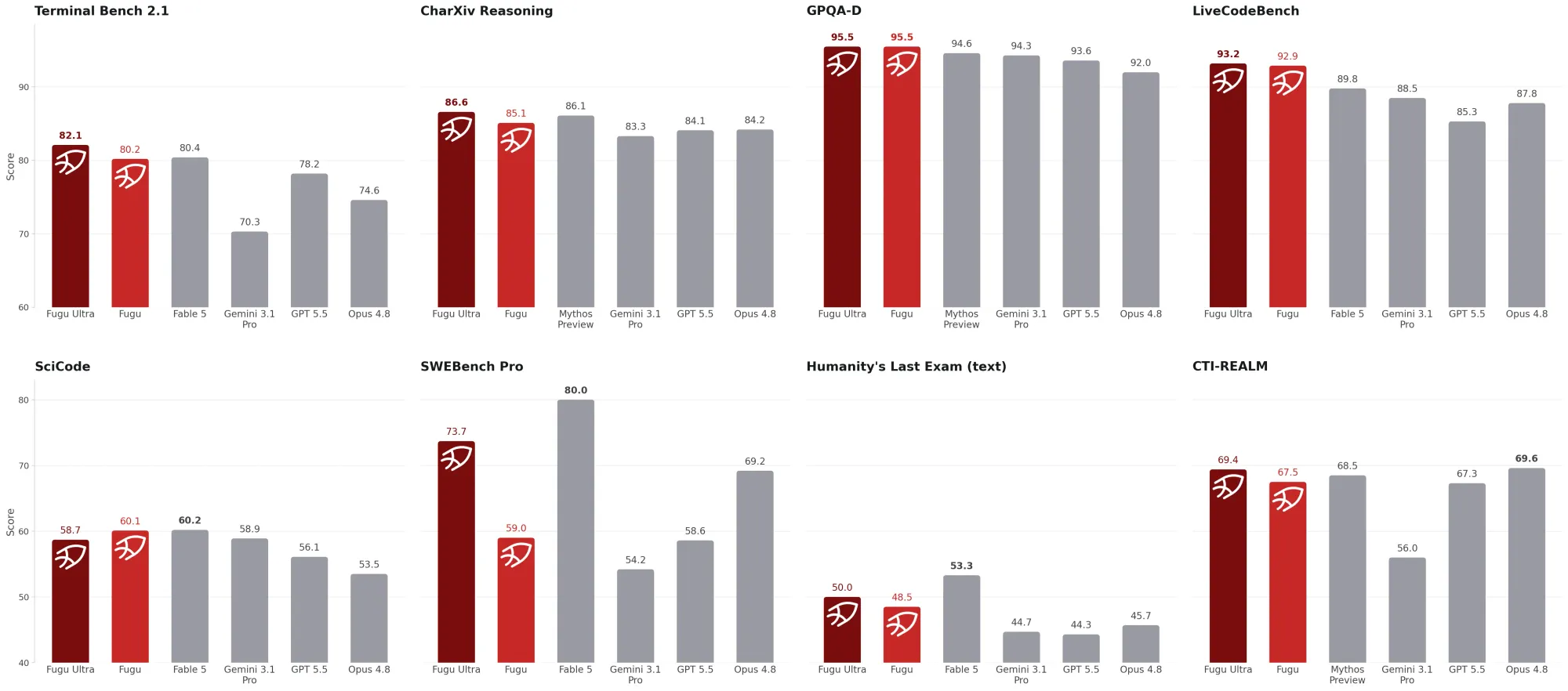
Functionally, sakana is not shy on benchmarks. Fugu Ultra reportedly leads several coding and reasoning tests, scoring 73.7 on SWE-Bench Pro and 82.1 on TerminalBench, with the company claiming the model stands level with Anthropic's Fable 5 and Mythos Preview. Honesty is required here, though. These figures are self-reported by Sakana and have not been independently verified, and the competitor scores cited are those published by the competitors themselves. Worth noting: on SWE-Bench Pro specifically, Fable 5 still sits ahead of Fugu. The picture is one of a genuinely competitive model, not a category leader.
Fugu Ultra vs. Top Models (LiveCodeBench)
Scores self-reported by Sakana AI, not independently verified. June 2026
The Strategic Play: Routing Around Export Controls
The real story isn't the benchmark score. It's the strategy. Fugu's core design feature is that its model roster is interchangeable: if one provider becomes unavailable, whether through a policy decision or an access block, the system routes the request to another. Sakana says this openly, pointing directly to the recent suspension of Anthropic's Fable and Mythos models following a U.S. government export directive.
The company's argument is blunt: for any organization or nation that relies on a single vendor's API for critical infrastructure, that dependency is a real vulnerability, not a theoretical one. For countries cut off from the best American models by export controls, a system that routes around the obstacle becomes an exit ramp. Anyone following the crypto space will recognize the logic immediately. It's the same distrust of single points of control, the same resilience that comes from distributing across nodes, that drives AI agents and their payment infrastructure.
The Skeptical Case
Reception has been far from unanimous, and that's the other half of the story. The question dominating online discussion is pointed: is Fugu genuinely a new model, or a sophisticated router that calls other people's models? Critics note that Fugu still depends on American APIs to function, which limits its independence. They also raise legitimate concerns about latency, cost, and the fairness of the benchmark comparisons Sakana has drawn.
On the other side, voices like Box CEO Aaron Levie see real value in the routing layer itself, the piece of infrastructure that sends a query to whichever model handles it best at that moment. Professor Ethan Mollick, writing on the topic, described Fugu as slow but ultimately valid. Both assessments point in the same direction: a genuinely interesting idea that still carries significant open questions.
What actually changes? Fugu's bet is that the future of AI lies not just in building the biggest model, but in orchestrating the best ones. For a country like Japan, which lacks the raw compute budgets of the U.S. or China, this approach offers a credible path to staying competitive. Whether Fugu proves to be a genuine shift or a refined wrapper, it marks a real redistribution of where value sits: moving from the layer that generates intelligence to the layer that routes it. That's the same logic that makes a distributed network more resilient than a single point of control. Full product details are on the Sakana AI official page, and independent coverage is available at Nikkei Asia. SpazioCrypto covers ongoing developments in the artificial intelligence section.