

The new network enters the open phase: what this means for developers and users
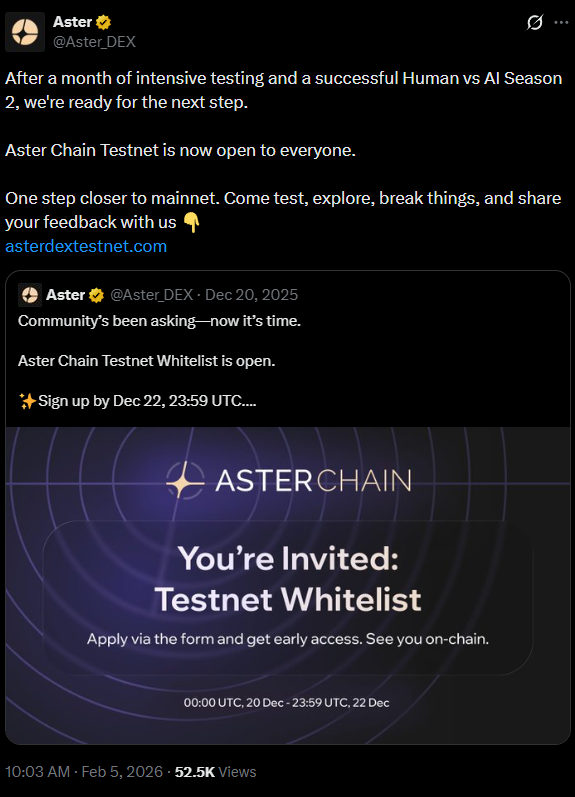
Aster's new top-level blockchain officially enters its public testing phase. With the launch of the testnet open to all, Aster aims to involve developers, validators and ordinary users in a crucial testing phase, with the goal of putting the infrastructure to the test before the final debut in mainnet.
The public testnets are not simply test versions: they represent real operating environments where performance, security, application compatibility and network behaviour under load are tested. Opening access to the entire community means drastically increasing the number of real-world scenarios that can be observed. The expected result is twofold: on the one hand to discover vulnerabilities and bottlenecks, and on the other hand to build an active ecosystem right from the start.
Why a public testnet is a strategic move
Stress testing on real scale
When a Layer 1 network moves from internal to public testing, the quality of the data collected completely changes. Real users interact in unpredictable ways, generate erratic traffic and test components that may seem stable in the lab.
In this phase, the following are observed in particular:
- consensus stability and node synchronisation;
- finalisation times of the transactions;
- under-load fee behaviour;
- compatibility with wallets and development tools.
The goal is to arrive at the official launch with as many variables already tested as possible.
Early community involvement
Opening the testnet to everyone also serves to create involvement. Developers can start building applications, validators can configure nodes, and users can familiarise themselves with the network's tools.
This approach anticipates the formation of the ecosystem, avoiding the classic 'initial desert' that affects many newly launched blockchains.
The technical features Aster is aiming for
Performance and scalability as a priority
Aster is positioned in the blockchain Layer 1 high-performance segment, where competition is intense. In this space, it is not just theoretical speed that makes the difference, but the ability to maintain consistent performance even with real usage.
The network is designed to support complex applications and high volumes, with an architecture geared towards optimising throughput and reducing latency. The test phase will test how well these promises hold up under pressure.
The CEO's voice: "The open testnet is the real test bench"
Aster's CEO says the full openness of the testnet marks the most important moment before the official launch.
"As long as you only test in controlled environments, you only see a part of reality," he explained. "When you open the network to everyone, the real behaviours, the real limitations and also the unexpected opportunities emerge. It is the step that transforms a technical project into a living ecosystem."
Incentives and participation: how to build the network
Many new blockchains also use the testnet phase to incentivise active participation. Bug reporting, node execution, application development and load testing become rewarded activities with dedicated programmes. This model has two effects: it increases the quality of testing and creates an initial base of experienced users ready for the mainnet.
A public testnet, by definition, is unstable. Interruptions, data resets and parameter changes are normal events. For this reason, it is not intended for productive use, but exclusively for experimentation. Users must expect frequent changes in network rules, tools and configurations. It is precisely this controlled instability that allows developers to intervene quickly before the system becomes final.
At the same time, uncoordinated management of the test phase can lead to confusion and discourage the community, making clear and continuous communication essential.
From testnet to mainnet: the decisive step
The success of a Layer 1 is not only measured by the technology, but also by the ability to successfully pass the public test phase. It is here that we test whether the network is ready to support real applications, economic value and constant traffic.
If Aster's testnet succeeds in demonstrating stability, good performance and interest on the part of developers, the transition to the mainnet could take place on a solid footing. If not, points to be corrected before the official debut will emerge. Either way, the phase that has just begun represents the real moment of truth: the one in which a blockchain stops being a promise and starts becoming an infrastructure.