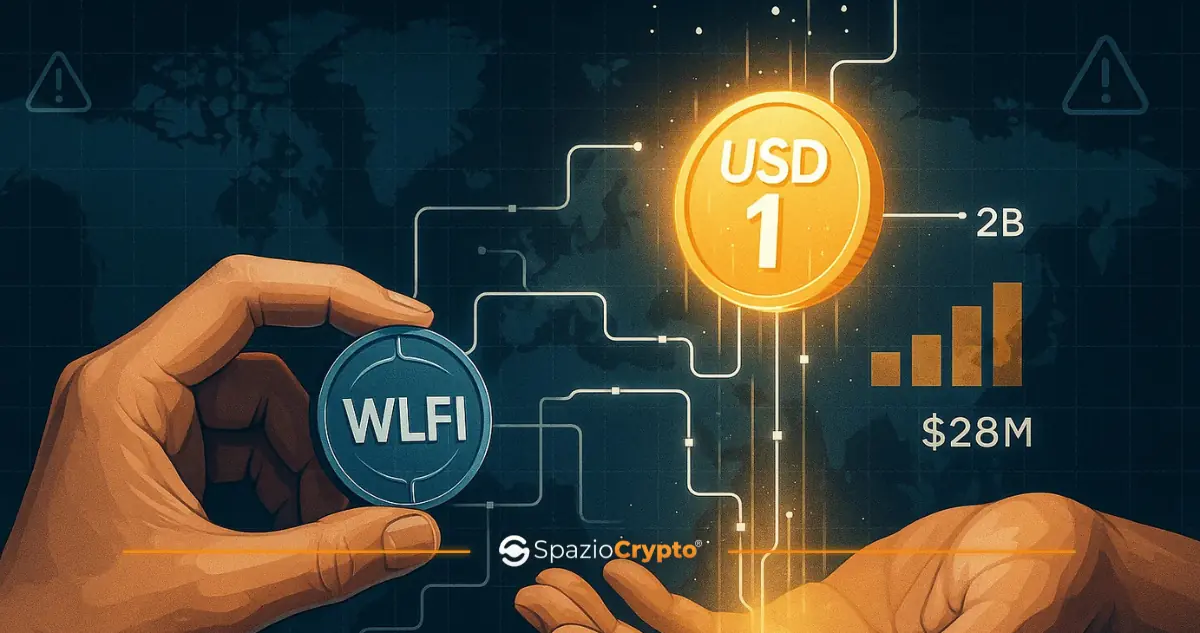

The decentralised finance landscape is witnessing a significant shift with the latest proposal from World Liberty Financial (WLFI). The project presented a new governance model based on staking that promises to redefine the relationship between token holders and platform development. The proposal does not merely change the voting dynamics, but introduces a reward system closely interlinked with USD1, the ecosystem's native stablecoin.
The Governance Turn: No Voting Without Lock
The heart of the proposal lies in a radical change of participation rights. Under the new terms, 'unlocked' WLFI holders will lose their voting rights on future proposals. To retain their decision-making influence, users will have to submit their tokens to a staking with a lock-up period of 180 days.
This move aims to ensure that only long-term committed participants have a say. Voting power will not be uniform, but will be weighted according to two key variables: the amount of tokens in stakes and the actual duration of the lock-up. In addition, to incentivise activism, there will be a target APR of around 2%, provided by the WLFI treasury, but with a strict condition: rewards will only be distributed to those who actively participate in voting.
Level Structure: Nodes and Super Nodes
In order to attract institutional capital and large investors, WLFI has introduced a hierarchy of participation divided into two main tiers:
- The "Node" Tier: Requires a staking of 10 million WLFIs. Traders at this tier will gain access to licensed market makers for OTC (Over-the-Counter) 1:1 conversions between USDT/USDC and USD1, subject to KYC verification. The first 1,000 nodes will also receive additional rewards in governance tokens linked to USD1 conversion volumes.
- The "Super Node" Tier: Requires massive staking of 50 million WLFIs. In addition to the benefits of the previous tier, Super Nodes will have a guaranteed channel of communication with the WLFI team for discussions on partnerships and potential exclusive economic incentives.
Strategic Objectives and Arbitrage
The stated objective of the proposal is structural in nature: to redirect arbitrage profits from institutional intermediaries to long-term participants. This mechanism is designed to increase the organic demand for USD1, stabilising the entire ecosystem. Instead of letting the gains remain in the hands of external actors, WLFI aims to create a virtuous circle that rewards the loyalty of its users.
The Market and the Quorum Challenge
The news has already generated a positive impact on the market: in the last 24 hours, the WLFI token has risen by 2.3%, following the general upward trend of the altcoin sector. However, the implementation of the proposal is not without its challenges.
The Snapshot vote will last seven days and will require a quorum of 1 billion WLFI eligible tokens. This is a very high threshold, representing a real test of strength for the community. If passed, this reform would mark a decisive step towards mass adoption of USD1, signalling to the market that World Liberty Financial is ready to compete on an institutional scale.