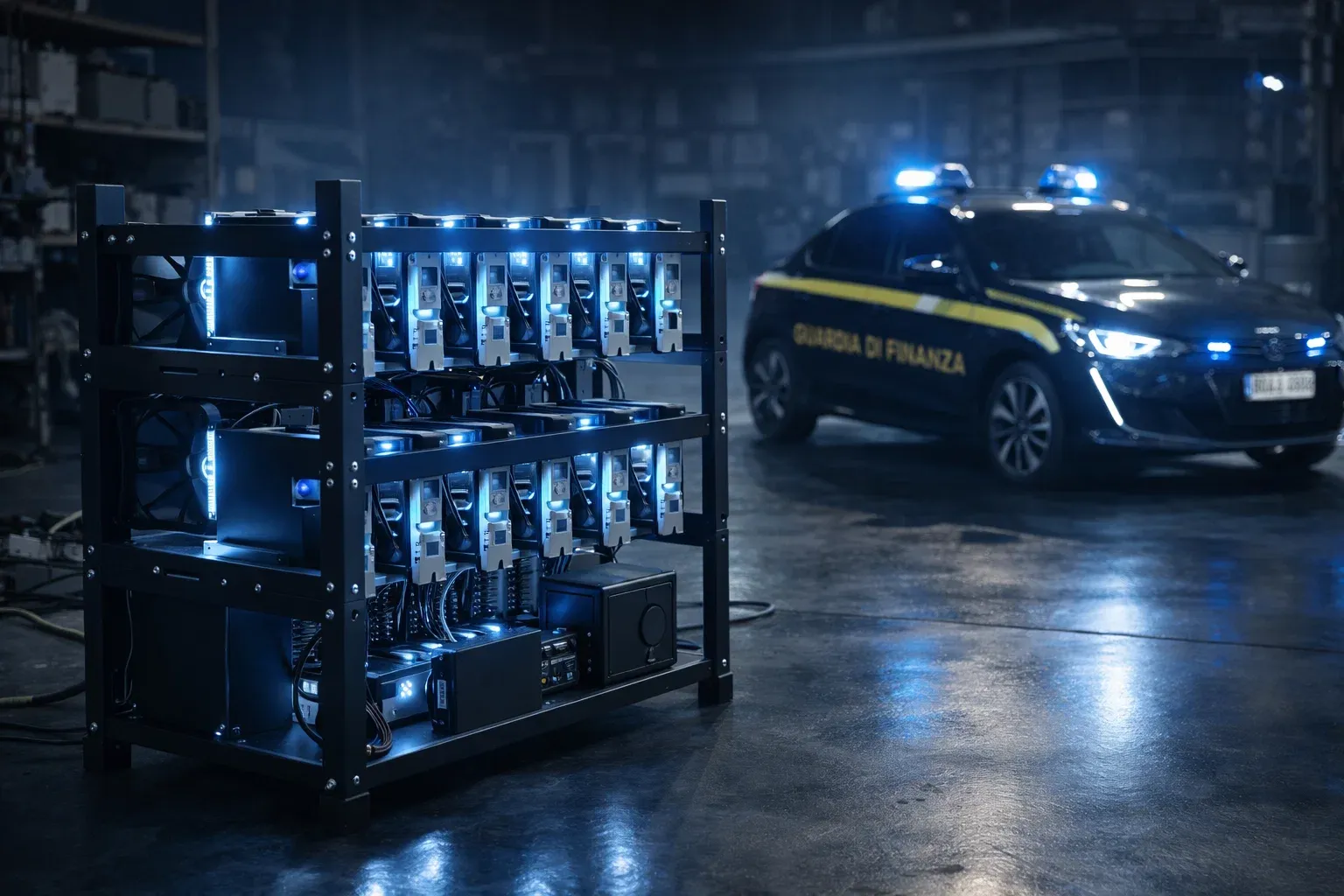

The Guardia di Finanza of Piacenza, during an operation carried out in recent weeks, uncovered a tax evasion of around half a million euro linked to the world of cryptocurrencies.
The investigation had started following suspicions linked to the mining activity of a trader, who had always kept quiet about the proceeds of the operation of a powerful computer, switched on day and night, that created virtual currency. The military from Piacenza, supported by a special department in Rome, expert in technological crimes, uncovered digital accounts containing Bitcoin and Ethereum that had never been reported to the tax authorities.
The equipment seized
The law enforcement blitz led to the discovery of a company warehouse that had been repurposed as a mining rig and equipped with a computer specially assembled to work, non-stop, on generating cryptocurrencies. Alongside the rig were numerous high-performance graphics cards, components common in arcades and normally used to reproduce advanced graphics at their best, but which, in this case, had the task of exponentially increasing the machine's calculation capacity, so that it would be able to operate on the blockchain.
A number of digital wallets were identified. Their economic value was not disclosed, but il Resto del Carlino described it as significant. Everything was immediately placed under seizure.
Finanza's investigation
The Guardia di Finanza used state-of-the-art software to analyse the blockchain and reconstruct the money movements linked to the owners of six e-wallets, residing in Emilia-Romagna, Lazio, Marche and Sicily. The certain attribution, due to the registration of transactions, put law enforcement on the trail of investors who had not declared their operations.
The group routinely made trades on exchanges, especially in high-value cryptocurrencies such as Bitcoin and Ethereum. Of course, there is nothing illegal about this. The six are accused of not complying with tax rules. None of the persons involved had in fact indicated in their tax returns the possession of cryptocurrencies held abroad. The tax monitoring regulations in force in our country, however, oblige them to do so. In addition, the capital gains obtained from the resale of the mined cryptocurrencies had not even been disclosed. Substitute tax has to be paid on such profits.
An exemplary sanction
The total amount of unpaid taxes amounts to approximately EUR 500,000, which the evaders will have to repay in full. To this figure, all the administrative penalties provided for by law will then be added.
Digital Economy and Tax Evasion
The Guardia di Finanza is also active in the fight against tax evasion in the digital economy sector, which is becoming increasingly important. The field is also growing in our country, as shown, for instance, by the possession of almost 100 million Bitcoin ETFs by Italy's largest banking group, Intesa Sanpaolo, and law enforcement agencies have equipped themselves to counter the ill-intentioned also in this field.
The new technologies can be deceptive, giving the idea of anonymity that in reality does not exist, since the transactions recorded on the blockchain, by definition, can be reconstructed and traced back to the perpetrators.