
At the beginning of this week, a violent winter storm that hit the US put a strain on the energy infrastructure, pushing Bitcoin miners into a massive 'curtailment'.
The data speak for themselves: between 23 and 25 January, the network experienced a 40 per cent drop in hashrate, with some 455 EH/s going offline in a very short window of time.
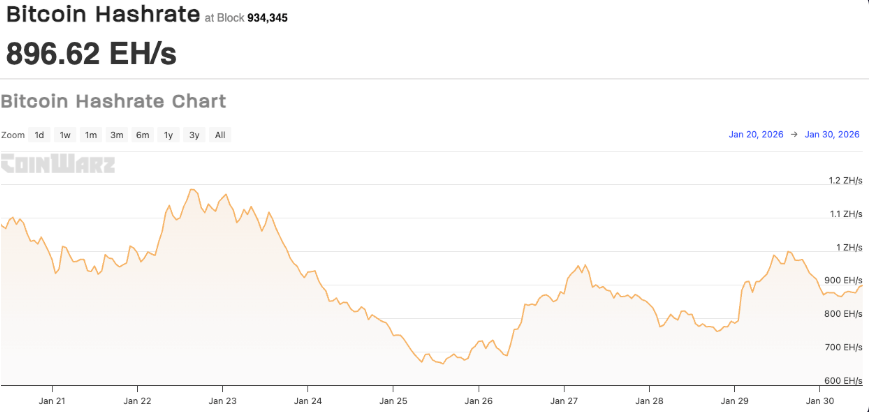
The clearest indication of the voluntary nature of this decline came from Foundry USA, the world's largest mining pool with a heavy concentration in the US, which suffered the sharpest contraction. This slowdown brought block production to an average of around 12 minutes, well beyond the canonical 10 minutes stipulated by protocol.
Curtailment 101: Miners as Flexible Load
Why can so many miners shut down instantly? The answer lies in the fact that modern mining is no longer seen as a 'fragile infrastructure', but as a flexible load. In Texas, the network operator ERCOT has created specific mechanisms for 'flexible large customers', identifying the Bitcoin miners as the ideal example. In practice, mining acts as an escape valve: when energy is scarce or too expensive, the miners switch off, freeing up megawatts for heating homes.
There are three main reasons behind this choice:
- Pure economics: When electricity prices skyrocket due to demand, it is more profitable to switch off machines than to continue mining at a loss.
- Contractual obligations: Many companies sign demand-response agreements. For example, Riot Platforms in its November 2025 update has reported $1 million in curtailment credits and $1.3 million in demand-response credits. Iris Energy also reported $2.3 million in revenue from energy sales in 2023 from similar strategies.
- Operating contingencies: In Texas, curtailment readiness is now a necessary condition for new industrial interconnections to the grid.

The ‘Storm Tax’: Security and Transaction Flow
A hashrate collapse often raises security concerns. While it is true that less computing power reduces the theoretical cost of an attack, Bitcoin's structure is designed to withstand regional shocks.
The main problem is operational: the storm tax. Since Bitcoin adjusts the difficulty every 2,016 blocks (about two weeks), a sudden drop does not lead to an immediate adjustment. The result is slower block production, which causes late confirmations and a build-up of transactions in the mempool. However, this is a temporary situation: the internal recalibration mechanism will reset the cadence to 10 minutes as soon as the next adjustment takes place.
Conclusion: A New Business Model
What we are observing is the evolution of the miner from a simple 'compute warehouse' to a hybrid of data centre and energy trader. This week's storm shows that incentives are aligned: shutting down is not an act of charity, but a rational response to a market that, in times of crisis, values a megawatt more than a terahash.