
Here is a proposal for an article based on the data provided, written in Italian and structured from a journalistic perspective.
In recent days, the digital information landscape in Russia has been shaken by what appears to be a systematic, albeit silent, campaign of technological repression. The Roskomnadzor, the Federal Service for the Supervision of Communications, seems to have intensified its monitoring and blocking of portals dedicated to the world of cryptocurrencies and digital finance.
All over the country, numerous users have reported sudden interruptions in access to various sector newspapers, all without any official explanation from the authorities. To shed light on the issue, a team of analysts from Outset PR conducted a series of diagnostic tests at the network level to determine whether these disruptions followed a predefined pattern.
Block analysis: ISP-level interference
The tests conducted revealed a clear dynamic: numerous websites were unreachable when accessed via Russian home Wi-Fi networks. However, the same portals loaded correctly when using alternative connections or circumvention tools. This categorically rules out the possibility of server failures or offline platforms, pointing firmly towards network-level interference.
The sample analysed for the study included major international publications such as Benzinga, Coinness, FastBull, FXEmpire, CoinGeek, Cryptonoticias, Cointelegraph, CoinEdition, The Coin Republic, AMBCrypto and Nada News. According to estimates cited by experts, these restrictions could already affect around one in four publications in the financial and crypto sectors.
The Deep Packet Inspection (DPI)
The technological heart of this new wave of censorship lies in Deep Packet Inspection (DPI). Unlike simple DNS blackout, DPI technology allows Internet Service Providers (ISPs) to inspect traffic and selectively restrict it.
During the technical tests, the activation of tools to circumvent DPI allowed immediate access to previously blocked sites. This is 'smoking gun' proof that the restrictions do not depend on technical failures, but on active and targeted filtering applied by Russian operators on (also non-public) input from the authorities.
A distributed application model
Despite the general trend, the enforcement of the blocks does not appear centralised or uniform. A test of 10 users in different regions of Russia showed varied results: while most could not access any of the selected sites without a VPN, two participants reported little or no difficulty.
This suggests a 'distributed enforcement' model: authorities impose restrictions, but individual providers enforce them using their own technical systems and following different timelines. However, where the blocking is active, the behaviour is identical, with the systematic appearance of 'connection reset' errors.
The shadow of Roskomnadzor and the absence of official registers
The most disturbing aspect of the affair is the absence of these domains from Roskomnadzor's public register of blocked sites. Normally, a blocked site is placed on an official searchable 'blacklist'. In this case, the restrictions appear to operate in a legal grey area.
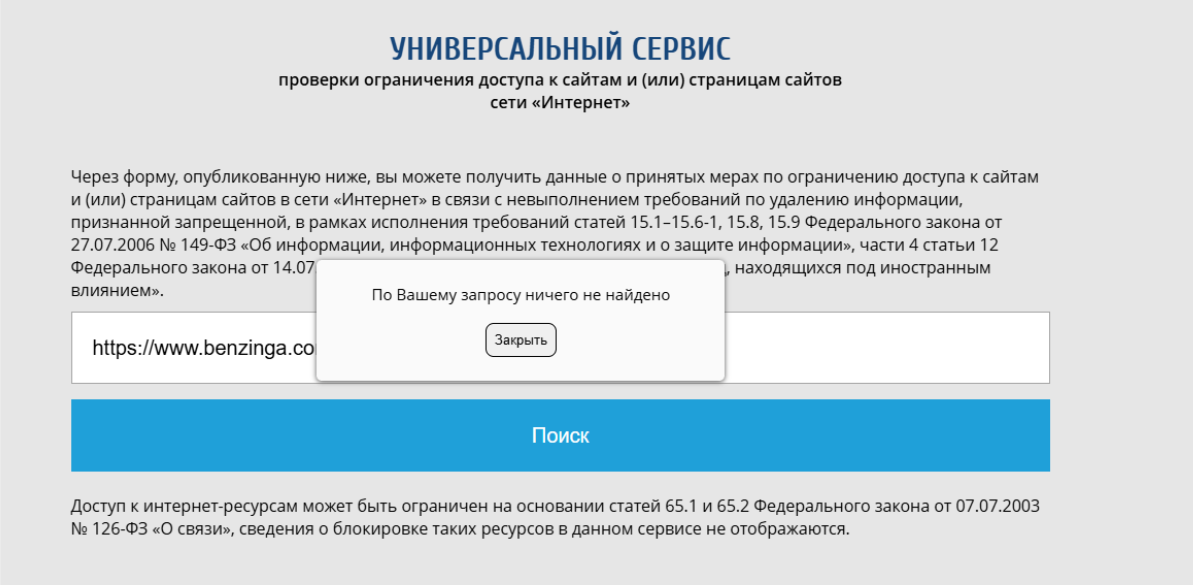
Roskomnadzor himself has admitted in the past that some access restrictions do not necessarily require public disclosure. This approach allows for a more flexible censorship that is less subject to international public scrutiny, just as Russia is officially attempting to evolve its regulation of cryptocurrencies, paradoxically loosening some restrictions on personal trading.
In conclusion, the evidence gathered paints a picture of widespread and technologically advanced control, where access to independent financial information is silently filtered, leaving Russian investors in a position of informational vulnerability.