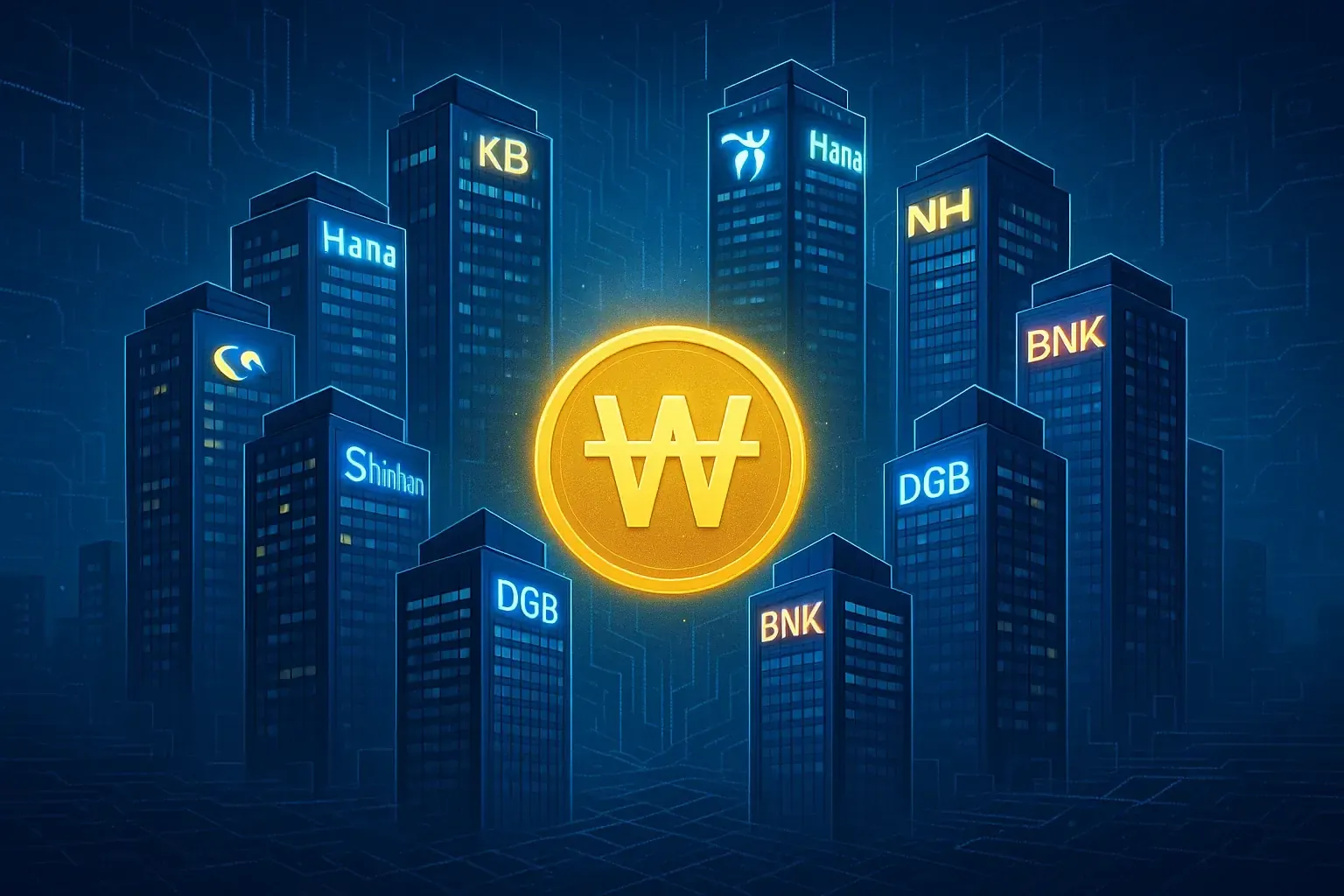

South Korea's eight major commercial banks have joined together to create a consortium that will launch a stablecoin pegged to the Korean won.
This is an important step in regaining control over the national currency and countering the growing power of foreign stablecoins.
Leading this unique collaboration is the Open Blockchain & DID Association, under the supervision of the Financial Supervisory Service (FSS). The aim is to launch a pilot issuance by early 2026.
Stablecoin Anchored To The Won Ready For Market
The banks involved - KB Kookmin, Shinhan, Woori, NH Nonghyup, Industrial Bank of Korea, Suhyup,Citibank Korea and Standard Chartered First Bank - hold a significant share of the country's retail deposits.
Their collaboration comes after a sharp rise in the use of foreign stablecoins. In the first quarter of 2025, dollar-anchored currencies such as USDT and USDC recorded a trading volume of 56.95 trillion won (approximately $41.6 billion), tripling compared to the third quarter of 2024.
The consortium proposes two modes of issuance: one based on customer funds held in trust and the other tied directly to the issuing banks' balance sheet deposits. This approach aims to win the public's trust and ensure stability, especially after the disastrous collapse of Earth-Moon in 2022.
The Bank of Korea (BOK) expressed cautious favour towards this bank-led initiative. On 24 June, Senior Deputy Governor Ryoo Sang-dai said that "it is better to let banks issue won-pegged stablecoins first, rather than non-bank entities, and then gradually expand the market."
This reflects the willingness of the more regulated players to lay the groundwork for digital currency issuance before wider dissemination.
South Korea's push for a domestic stablecoin highlights its desire to regain control of its currency in the digital age. If the growth of foreign stablecoins continues, the won risks losing relevance in domestic digital transactions. With this initiative, Korea aims to catch up with Japan, which launched the Progmat Coin, and the EU, where euro-pegged stablecoins are regulated by the MiCA framework.
Some see this move as a defensive measure, others as an opportunity to turn won-pegged stablecoin into a regional clearing asset, particularly for sectors such as gaming, K-pop merchandising and international money transfers.
The forthcoming Digital Asset Act will include a fully guaranteed model and transparent mechanisms designed to restore investor confidence after the Terra crisis.
Risk assessments by the FSS and ongoing talks with the Bank of Korea will determine whether the project receives final approval. Initially, the won-anchored stablecoin could be used in digital banking apps and payment systems for money transfers, peer-to-peer exchanges and settlements between banks.
If the model proves successful, it could have a significant impact on the long-term roadmap of the central bank's (CBDC) South Korean won, ensuring that the won remains a major player in the digital ecosystem.