

The stablecoin landscape is experiencing an unprecedented moment of regulatory enforcement. In a coordinated move that highlights the growing pressure of international compliance, Tether and Circle simultaneously blacklisted an Ethereum hot wallet belonging to Wallex, one of the largest cryptocurrency exchanges operating in Iran.
The incident, which occurred on March 25, 2026, was uncovered by blockchain investigator ZachXBT. The freeze targeted address 0x6926…43df, which held approximately $117,000 at the time of the sanction, split between Tether (USDT), USD Coin (USDC), and other minor tokens. The rarity of a coordinated action between the two largest stablecoin issuers signals an unprecedented level of vigilance and cooperation in the sector — a clear sign that Western stablecoin infrastructure is increasingly being used as a sanctions enforcement tool.
The Consolidation Attempt and the BSC Block
The enforcement action was triggered just hours after Wallex had begun a large-scale asset consolidation operation. The exchange was attempting to move funds from various hot wallets on the Tron and Ethereum networks to BNB Smart Chain (BSC), using multiple cross-chain bridges.
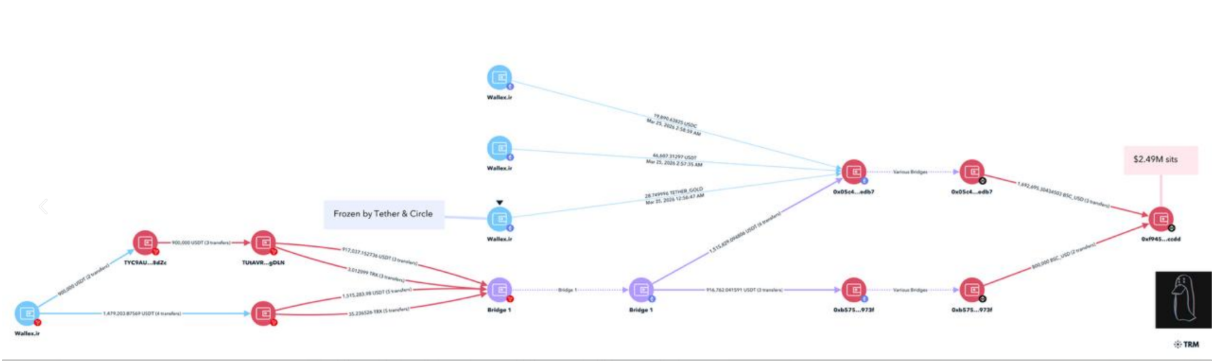
While part of the operation succeeded — with approximately $2.49 million in Binance-Peg BSC-USD reaching address 0xf945…ccdd — the maneuver attracted the attention of on-chain monitors. Since the funds arrived on BSC, the address has recorded only three minor BNB transactions for gas fee payments. As of today, the entire $2.49 million remains frozen and unusable, pending further regulatory developments.
An Expanding Sanctions Framework
Although Wallex has not yet been formally designated by OFAC (the U.S. Office of Foreign Assets Control), all crypto activities linked to Iran are subject to extremely broad sanctions exposure. The freeze reflects an escalating pattern against Tehran-linked platforms.
In January 2026 alone, OFAC sanctioned the UK-based exchanges Zedcex and Zedxion, accused of facilitating over one billion dollars in transactions for the Islamic Revolutionary Guard Corps (IRGC). Against this backdrop, Tether has demonstrated an aggressive stance, blacklisting over $3.3 billion in USDT across more than 7,000 wallets since 2023.
Internal Pressures and Geopolitics
The Wallex situation unfolds against a backdrop of internal economic crisis in Iran. In early March, the Central Bank of Iran ordered major domestic platforms — including Wallex and Nobitex — to suspend trading of the USDT-toman pair.
This emergency measure was introduced to curb massive capital flight triggered by military tensions with the United States and Israel. Iranian exchanges now find themselves caught between two forces: internal restrictions from Tehran and constant monitoring by Western stablecoin issuers.
Uncertain Future for the Exchange
At present, Wallex's website remains operational, but the company has yet to release any official statement regarding the asset freeze. With over $2 million locked on BSC and the threat that other wallets linked to the exchange could face the same fate, the platform's operational stability is seriously compromised. The March 25 incident marks a point of no return in the ability of authorities and private issuers to intervene in real time against unauthorized cross-border financial flows.