

Three frontier models, though three labs. Three separate “number one” claims, all technically accurate. OpenAI says GPT-5.5 leads on autonomous agents. Anthropic points to Claude Opus 4.7 topping SWE-bench at 64.3% for coding. Google claims Gemini 3.5 Pro on multimodal tasks and cost efficiency. Nobody is lying. The uncomfortable truth is that all three sit within 5% of each other on the same standardized tests.
TL;DR: According to Mimír AI data from March 2026, GPT-5.5, Claude Opus 4.7, and Gemini 3.5 Pro score within 5% on virtually every standard benchmark. The real competitive edge in 2026 is no longer which model you pick, but how well you orchestrate multiple models for different tasks.
The transformer plateau has arrived. At minimum, the first one. The convergence of raw intelligence scores across the three leading architectures signals that general-task differentiation through model choice alone is running out of road. Competition has moved to a different field entirely.
The Thesis: Best Model Wins Everything
Functionally, for three years, the dominant narrative in AI ran like this: one model is objectively better, and using it gives you a real competitive edge. GPT-4 in 2023 was genuinely ahead of the pack. Claude 3 Opus in 2024 held meaningful margins on certain reasoning tasks. That logic shaped adoption decisions, enterprise contracts, and entire technology stacks across industries.
The reasoning was sound at the time. But the April 2026 landscape tells a different story.
Main Benchmark Comparison: GPT-5.5 vs Claude Opus 4.7 vs Gemini 3.5 Pro (April 2026)
Source: BuildFastWithAI · Mimír AI · Artificial Analysis · April 2026
The Data That Dismantles the Single-Model Myth
The comparison published by Mimír AI on March 2026 data makes one precise point: GPT-5.5, Claude Opus 4.7, and Gemini 3.5 Pro all fall within a 5% margin on nearly every standard test. When the gap is that narrow, model selection becomes secondary to other factors: speed, cost, integration, latency, and available context window. GPT-5.5 launched on April 23, 2026. Claude Opus 4.7 preceded it by roughly a week, around April 15, a deliberate timing call by Anthropic. Gemini 3.5 Flash (not Pro) is the fastest of the group, with token output roughly four times faster than comparable models, according to Artificial Analysis benchmarks.
Follow the debate in real time: Updates from @AnthropicAI on X and updates from @OpenAI on X for official post-launch comparisons.
Where real differences persist: GPT-5.5 leads on action-oriented tasks (terminal, browser automation, multi-step workflows). Claude Opus 4.7 leads on code-quality tasks (deep refactoring, code review, expert reasoning). Gemini 3.5 Pro is the strongest on price-to-performance and multimodal capability. If you're using AI for business automation, the choice depends on the task, not the brand name.
If They're Equal, Who Actually Wins in 2026?
The Mimír AI paper frames the answer with a direct implication: investing deeply in mastering a single model yields diminishing returns compared to building the capacity to orchestrate multiple models by task. Practically: teams that build AI systems selecting the right model for each specific task outperform teams that always use the same model, even the most expensive one.
Three axes of real differentiation survived the benchmark convergence. First, vertical specialization: GPT-5.5 has a dedicated Codex version for agentic coding; Claude Sonnet (not Opus) is optimized for high-speed productive workflows; Gemini Flash targets high-volume, low-cost tasks. Second, infrastructure: Gemini 3.5 Pro's 1-million-token context window, Flash's inference speed, and Gemini Flash pricing at roughly half the cost of Opus create concrete differences at scale. Third, ecosystem integration: Google has Workspace. Microsoft has Office and Azure. Anthropic holds a strong position on agentic coding and, notably, a growing footprint in the European enterprise market under the EU AI Act.
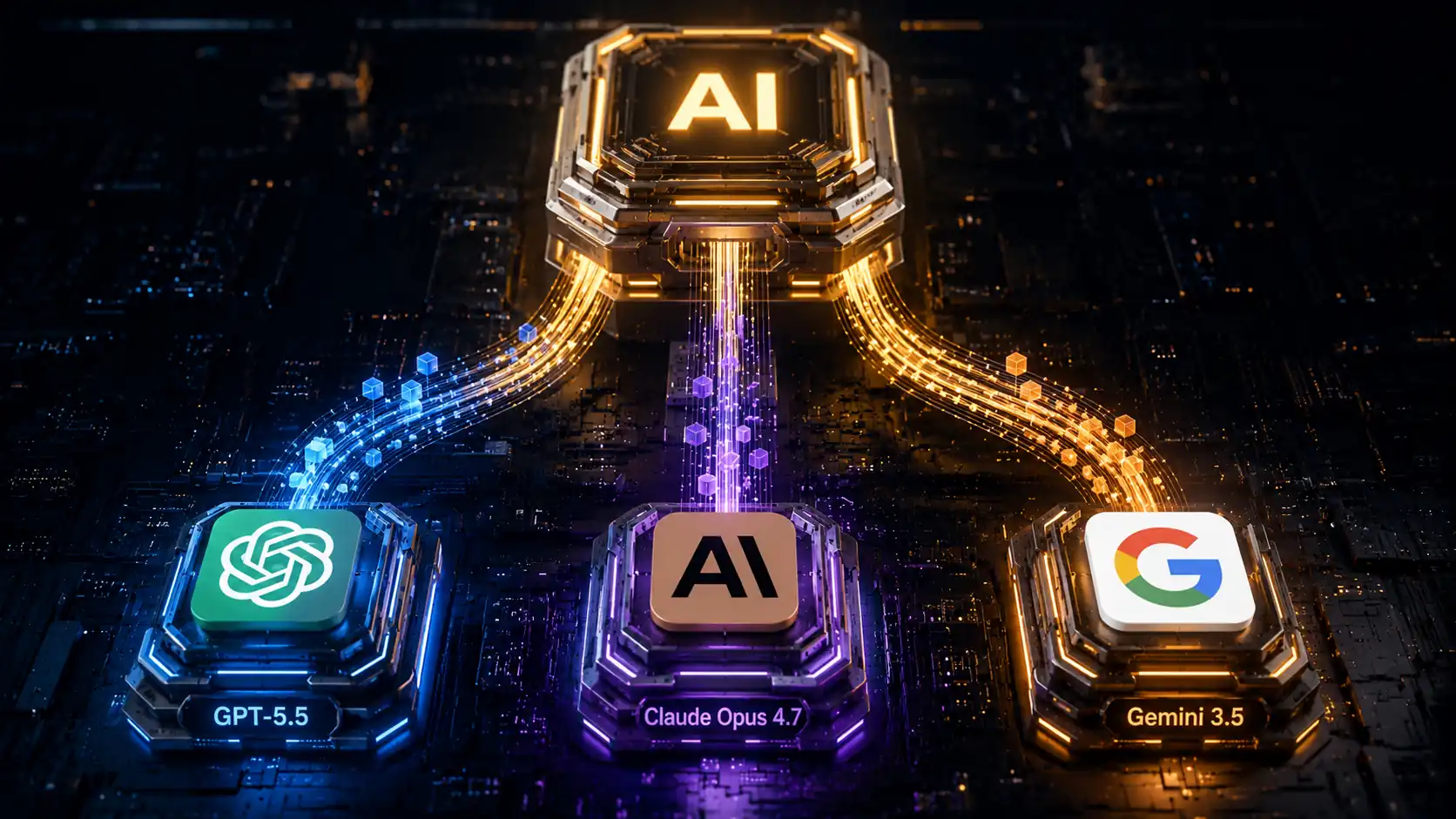
For anyone following AI strategy closely, the practical takeaway is clear: if your organization relies on a single model for every task, you're trading efficiency and cost savings for brand familiarity. The next generation of AI tooling (Google's Gemini Spark agentic layer, Claude Code, GPT-5.5 Codex) moves squarely in this direction, with multi-model agents selecting the optimal model per subtask. Benchmark convergence isn't the end of the race. It's the beginning of a phase where competitive advantage is built in architecture, not in buying the most expensive model.
One figure worth watching: Sam Altman has described GPT-6 as focused on “long-term memory, expanded agentic capabilities, and improved reasoning.” Prediction markets currently place the launch window between May and July 2026, with a 45-72% probability of release by June 30, according to aggregated forecast data. If GPT-6 breaks the plateau, the differentiation cycle restarts. If it doesn't, multi-model orchestration becomes the definitive industry standard.