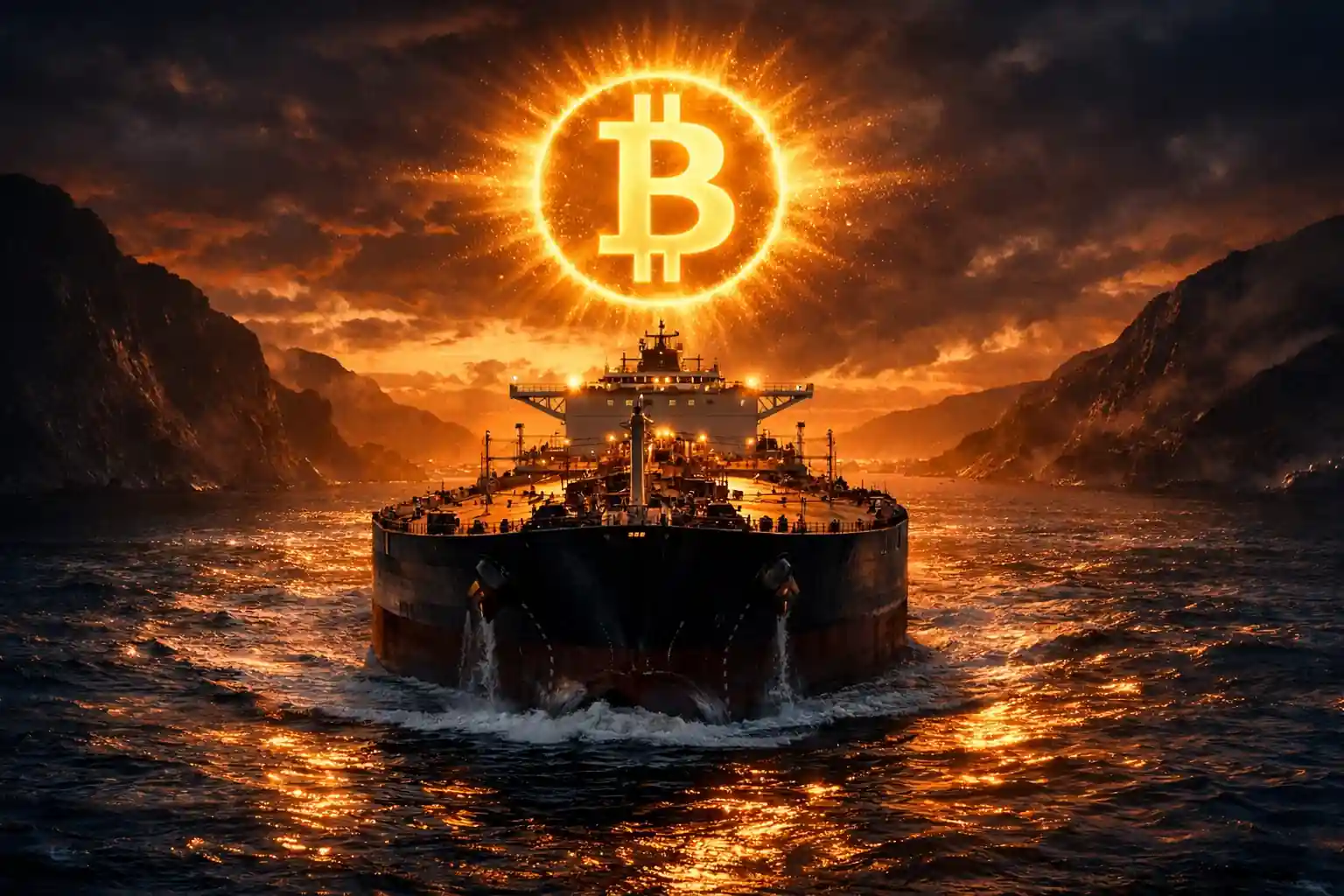

April 8, 2026 may go down as one of the most consequential dates in Bitcoin's history. As the world was still processing news of a US-Iran ceasefire, Tehran announced a toll system that sent markets surging and reignited a debate many thought settled: Bitcoin as a neutral, sanctions-resistant instrument of international commerce.
Iran's Bitcoin Toll at the Strait of Hormuz
Hamid Hosseini, spokesperson for the Iranian Union of Oil, Gas and Petrochemical Product Exporters, told the Financial Times that every tanker wishing to transit the Strait of Hormuz must pay $1 per barrel of crude carried — in Bitcoin. The reason, in Hosseini's own words: "to ensure funds cannot be traced or seized due to sanctions."
The mechanism is operationally simple but geopolitically explosive. Ships must email Iranian authorities with cargo details. After assessment, they receive a window of just a few seconds to complete the BTC payment to a Tehran-controlled wallet. Empty vessels may pass freely.
The Strait of Hormuz handles roughly one-fifth of the world's oil and liquefied natural gas supply. A fully loaded tanker carries between 500,000 and 2 million barrels — meaning a single transit toll could reach $2 million, or approximately 28 BTC at current prices.
Bitcoin's Immediate Market Reaction
The market responded within hours. Bitcoin jumped from around $68,000 to above $72,700 following the ceasefire announcement, before consolidating near $71,700. Solana and Ethereum posted gains of 7% and 8% respectively over the same period.
The "digital gold" narrative had been under pressure in recent months — Bitcoin underperformed during the Greenland geopolitical tensions earlier this year. Tehran's move revives an argument central to the Bitcoin thesis: that BTC functions as a censorship-resistant payment network capable of operating where the traditional banking system is either blocked or absent.
Sanctions, Stablecoins, and Why Iran Chose Bitcoin Over USDT
Iran has used cryptocurrency to circumvent sanctions before. Chainalysis data reveals a growing network of wallets facilitating cross-border Iranian oil trade. Andrew Fierman, Chainalysis's head of national security intelligence, commented: "It is highly predictable that this type of commerce would occur via cryptocurrency."
The stablecoin angle is revealing. Bloomberg initially reported Iran's preference for USDT or USD1 — the stablecoin associated with the Trump family. The Financial Times, however, confirmed Bitcoin as the preferred vehicle, precisely because it has no backdoor: USDT and USDC can be frozen by Tether and Circle at the request of US authorities. Bitcoin cannot.
Trump, Saudi Arabia, and an Unresolved Standoff
The geopolitical picture remains volatile. After Tuesday's ceasefire, renewed Israeli raids in Lebanon prompted Iran to suspend transits again. Murban crude oil prices climbed back toward $103 per barrel.
Trump floated the idea of a "joint venture" with Iran to manage Strait tolls, though the White House quickly clarified that the President wants the passage "open, without restrictions, including tariffs." Saudi Arabia drew a hard line: "Allowing Iran any form of control over the Strait would cross a red line," Riyadh stated.
What This Changes for Bitcoin — and What to Watch Next
Strip away the politics, and what remains is a structural first. For the first time, a sovereign state actor has deployed Bitcoin not as a reserve asset or speculative instrument, but as live payment infrastructure for high-stakes international trade.
This is precisely the use case Satoshi Nakamoto described in the 2008 white paper: a peer-to-peer electronic cash system requiring no trusted intermediary, with no mechanism for freezing or seizure.
Whether you endorse Tehran's application or not, the signal is unambiguous. Bitcoin performs exactly as designed when legacy financial systems are unavailable, unwilling, or weaponized. Traders and institutions alike should watch whether other sanctioned states follow Iran's lead — that would represent a structural demand shift for BTC, not just a news-cycle price spike.