


The Security Alliance (SEAL), an influential cryptocurrency crime investigation group, has launched a new tool designed to make phishing detection faster and more reliable.
The system, dubbed Verifiable Phishing Reporter, allows users to confirm suspicious websites exactly as a potential victim would see them, offering a crucial defence in an increasingly insidious digital landscape.
While attacks from phishing continue to evolve, becoming increasingly sophisticated, the organisation has introduced cryptographic verification methods to ensure that investigation reports are both reliable and verifiable.
We needed a way to see what the user was seeing," SEAL said in its blog post announcing the launch.
This initiative follows months of private beta testing and builds on SEAL's pre-existing programmes, including SEAL-911, a Telegram channel dedicated to crypto crime reporting, and SEAL-ISAC, a collaboration hub connecting victims with security researchers.
🔏 SEAL has been working on a new tool to enable advanced users and security researchers to join the fight against crypto phishing, and we're excited to release it to the public pic.twitter.com/6denBjlO1L
- Security Alliance (@_SEAL_Org) October 13, 2025
The non-profit organisation, which focuses on transparency and fraud prevention in the digital asset ecosystem, is supported by prominent entities such as a16z crypto, the Ethereum Foundation and Paradigm.
The Answer to "Cloaked"
SEAL's Verifiable Phishing Reporter, officially unveiled on Monday, aims to expose fraudulent websites that display seemingly "clean" versions to automated scanners, a technique known as "cloaking".
The tool employs a state-of-the-art cryptographic protocol called TLS attestations, which allows ethical hackers to confirm with certainty that reported sites do indeed contain malicious content.
Crucial to its operation is the assurance that each phishing report includes verified session data. This prevents attackers from falsifying content or misleading investigators by altering server responses.
Unlike conventional scanners, which can be easily blocked by web security systems or CAPTCHAs, SEAL's framework allows ethical hackers to inspect pages securely and record irrefutable proof of what a real visitor would encounter.
Alarming Statistics on Crypto Crime
The initiative comes at a time when phishing volumes remain extremely high. The Anti-Phishing Working Group (APWG), a global consortium that monitors phishing trends, tracked 1,003,924 attacks in the first quarter of 2025 and 1,130,393 in the second quarter, marking a 13% quarter-on-quarter increase.
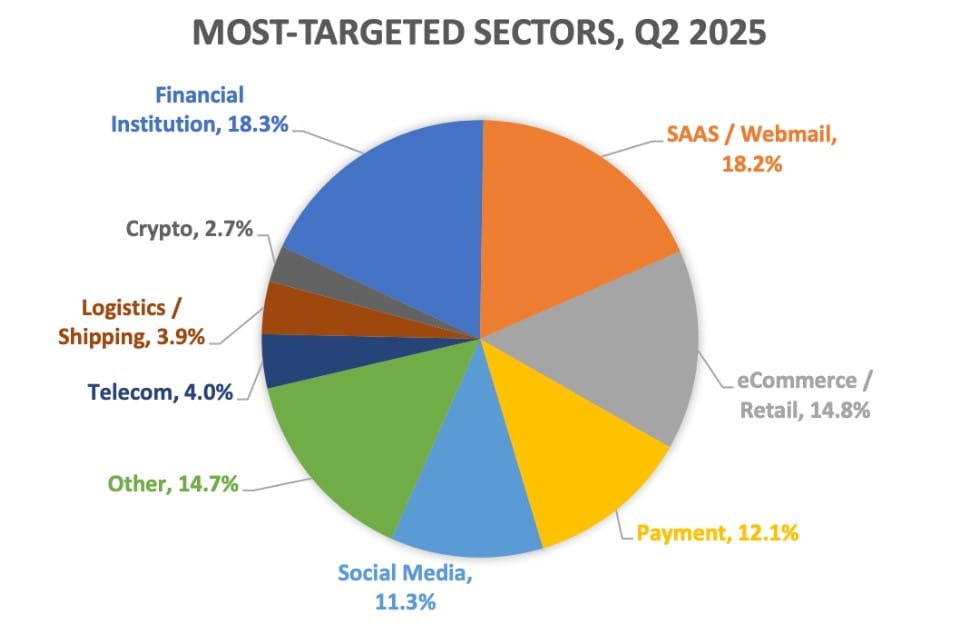
At the same time, financial losses remain significant. CertiK estimates that phishing drained around $395 million across 52 incidents in the second quarter of 2025 alone.
More broadly, crypto crime is on the rise: Chainalysis reported that over $2.17 billion was stolen from services during the first half of 2025.
The Verifiable Phishing Reporter introduces a new level of technical validation for security researchers, providing verifiable session evidence. This approach standardizes documentation and cross-verification of phishing incidents, serving as an additional protocol rather than replacing existing tools.
Industry observers suggest that this new framework could influence future standards, integrating verifiable TLS recordings into cybersecurity workflows, though adoption will depend on interoperability and user participation across platforms.