
A new on-chain proposal for World Liberty Financial (WLFI) has recently been launched and envisages the application of a buyback and burn mechanism on treasury commissions.
The new staking rewards policy envisages that 100% of the liquidity fees would be used to buy WLFI tokens in the market, which would then be burned permanently on-chain across multiple blockchains.
The goal is to turn the treasury's revenue streams into constant buying pressure, while reducing the supply of tokens should theoretically push the price up over time.
Can the burn and buyback mechanism push up the price of WLFIs?
Buyback-and-burn is by nature a deflationary mechanism. Treasury fees are automatically converted into direct market demand, while burns permanently remove tokens from supply. All things being equal, prices tend to rise when supply is reduced, provided demand does not fall.
Naturalmente, tutto dipende dalla performance del tesoro. The more fees it can collect, the greater the impact on the circulating supply and the price of WLFI. Conversely, small and irregular commission flows will have little effect on upward pressure. The mechanism becomes relevant only if the treasury is able to generate consistent and regular flows.
WLFI under pressure
The WLFI token has been under pressure so far. Governance risks, excessive centralisation by Justin Sun and related controversies have undermined sentiment since launch. At the time of writing, WLFI's price stands at $0.1996, down about 40% from its previous all-time high.
Buyback: catalyst or risk?
Buyback proposals often act as catalysts, but are not without their divisions. While they can create value, some analysts argue that crypto buybacks destroy value, as they burn resources that could be invested in development, ecosystem growth, user acquisition, etc.
With regulation still unclear, justifying these buybacks will be more difficult. In the meantime, retail investors are demanding more transparent, equity-like tokens that can offer passive returns to long-term holders.
Technical analysis: possibility of a 50% rise?
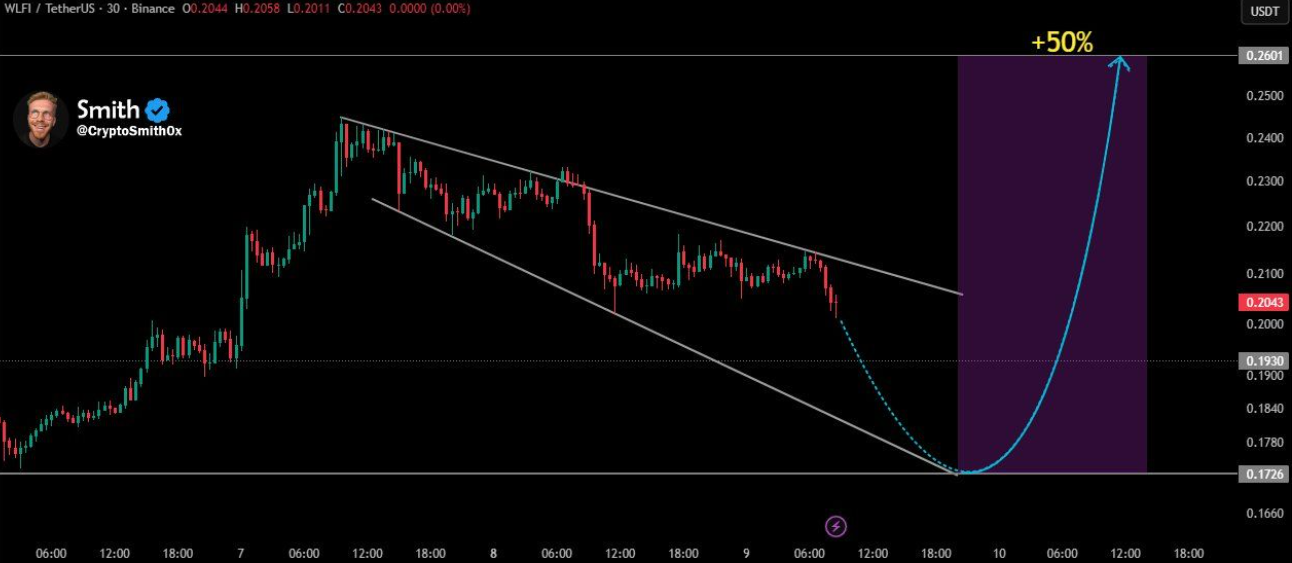
Technically, one analyst on X reports that WLFI is consolidating in a falling wedge, a typical bullish reversal pattern. In the event of a confirmed breakout, targets envisage up to +50% upside towards $0.26.
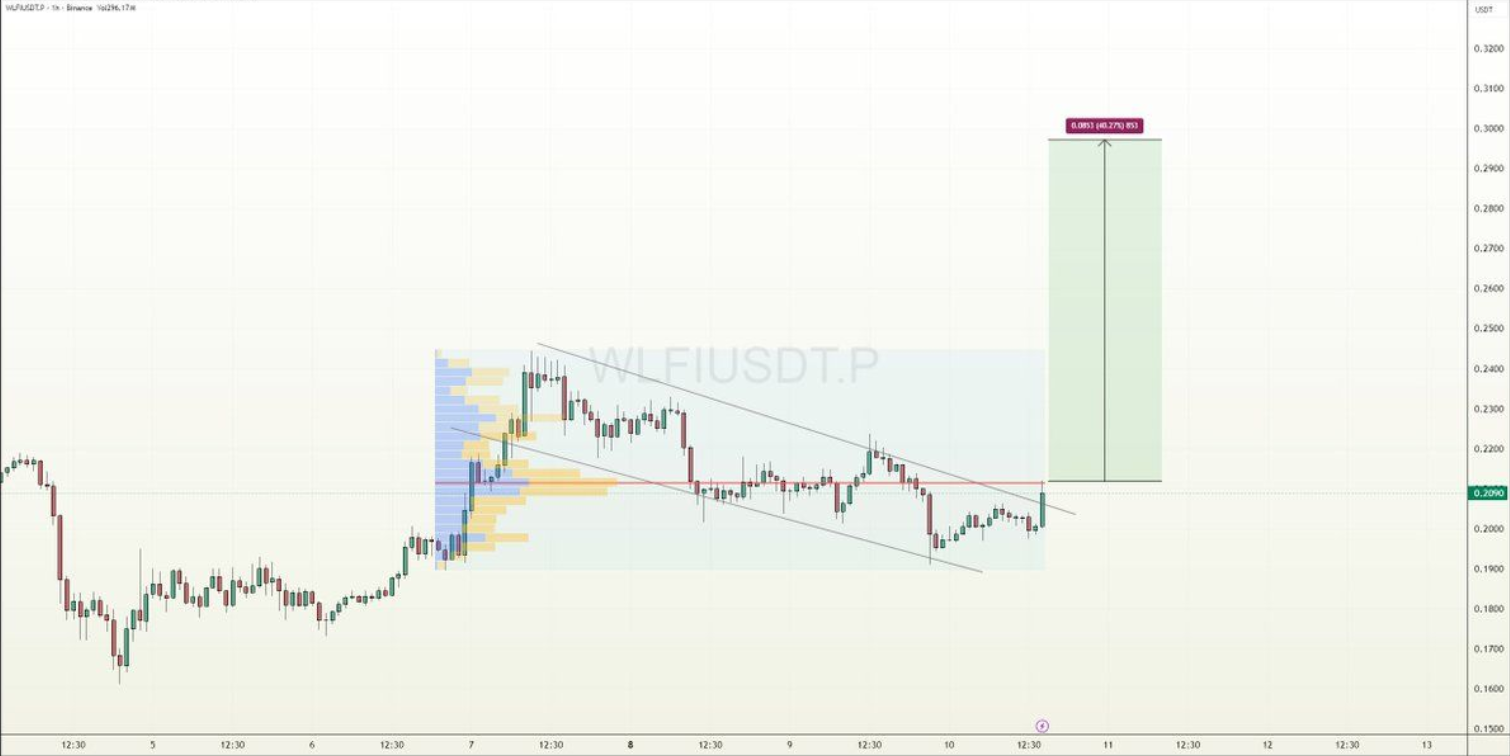
"A strong breakout above this PoC could trigger a short-term rally of 30-40%, with rising volumes confirming momentum: an opportunity to monitor closely!" said CryptoBull on X.
#WLFI is testing the PoC value zone after flipping out of the descending bearish channel on lower timeframes. A strong breakout above this PoC could spark a 30-40% short-term rally, with rising volume confirming momentum - one to watch closely! $WLFI #WLFIUSDT pic.twitter.com/Il4efjkf7O
- CryptoBull_360 (@CryptoBull_360) September 10, 2025
Other chart-based comments point out that WLFI would have already broken a bearish descending channel in the minor timeframes and would be retesting the value zone of the Point of Control (PoC). If buyers manage to close above resistance and maintain trading volumes, confirmation of the breakout could pave the way for a bullish reversal.
Conclusion
World Liberty Financial (WLFI) has therefore initiated an on-chain proposal to implement a buyback and burn mechanism based on treasury fees. The fees collected are immediately spent in the market to buy tokens and then burned, permanently reducing supply.
If treasury flows remain consistent, this will result in continued buying pressure and a potential price rise. However, buybacks remain a controversial practice: more transparency and clarity on governance are needed to mitigate risks and convince the market.