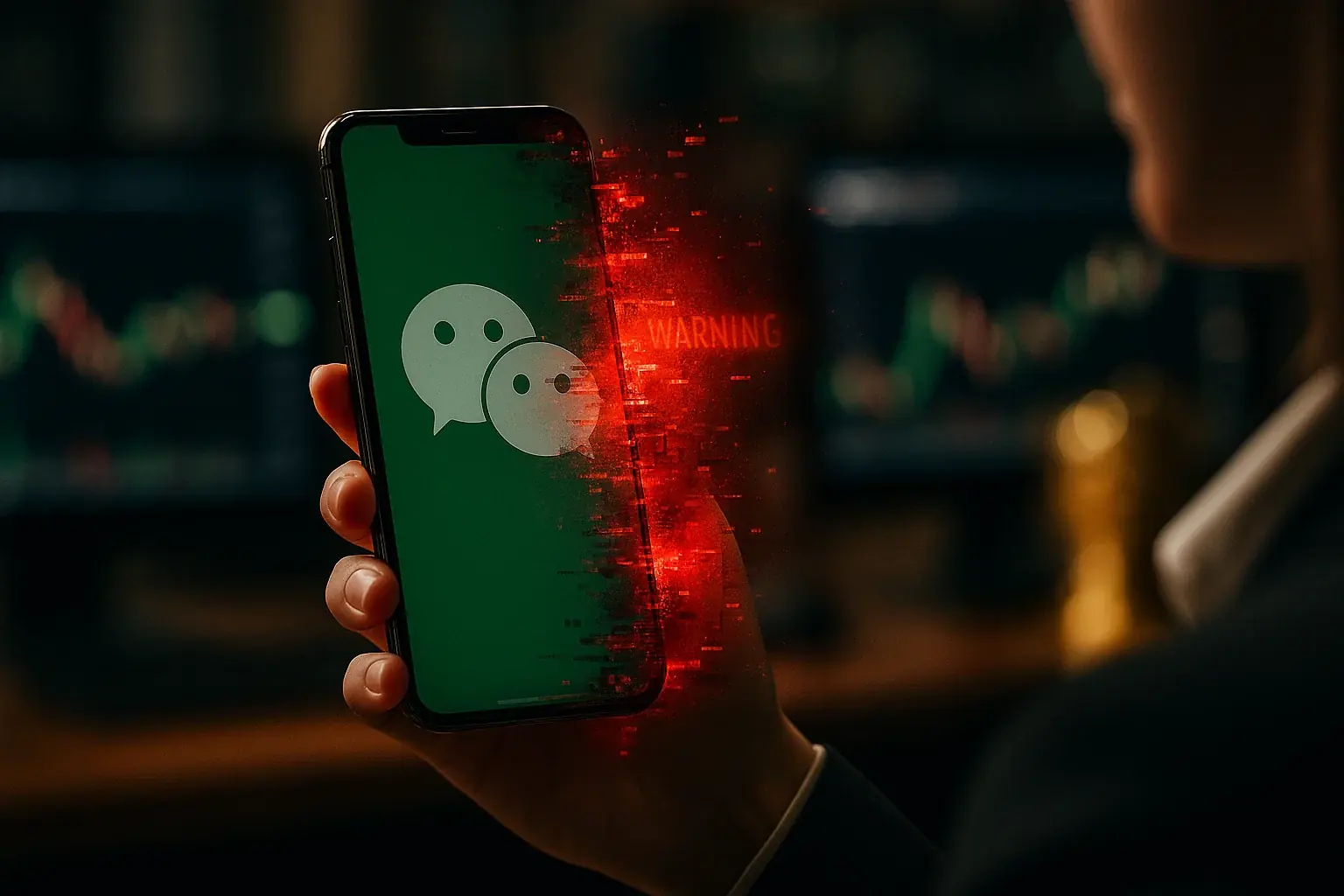

A hacker managed to breach the WeChat account of Binance co-founder Yi He to orchestrate a "pump-and-dump" scheme involving the Mubarakah token, yielding around $55,000 in profits.
This incident raises growing concerns about the manipulation of cryptocurrency markets through compromised social media accounts.
Specifically, it could be due to the forwarding of an altered article from a public account, he reported a user.
看到有人讲一姐@heyibinance 微信喊单
- Huang 黄 (@Huang2024) December 10, 2025
第一时间买入了 $Mubarakah
买完发现大家讲一姐可能是被盗号了
然后具体可能是
转发公众号文章被修改
Whatever 已被套...
只能安慰自己起码也是Bsc meme没错
有生之年回本系列🥲 pic.twitter.com/7Z1ykvO3Cf
WeChat is a widely used messaging and payment application, particularly in China and East and Southeast Asia. The hacker exploited the visibility of the compromised account by forwarding an article on the Mubarakah token.
Changpeng Zhao, another co-founder of Binance, confirmed the breach and warned, pointing out the poor security of traditional social platforms.
Someone hacked @heyibinance's WeChat account. Don't buy meme coins from hacker posts. Web 2 social media security is not that strong. Stay safe!" has posted CZ.
Someone hacked @heyibinance's WeChat account. Do not buy meme coins from the hackers posts.
- CZ 🔶 BNB (@cz_binance) December 10, 2025
Web 2 social media security is not that strong.
Stay safu!
The Traceability of Transactions
Security analysts quickly tracked the hacker's transactions, revealing the details of the fraudulent operation. Blockchain analytics firm Lookonchain revealed that the attacker created two new wallets about seven hours before the attack, using 19,479 USDT to purchase 21.16 million Mubarakah tokens at low prices.
Following the fraudulent post spread by Yi He's compromised account, the price of Mubarakah soared. Geckoterminal data showed that the meme coin peaked at $0.008 in the first few hours of Asian trading, marking a 'pump' of almost 200%.
Mubarakah's market capitalisation also surpassed $8 million. Lookonchain revealed that the hacker has already sold 11.95 million tokens for USDT43,520. The wallets used were $0x6739b732C14515997Caa8deCb6C047dc1c02Fb9c$ and $0xD0B8Ea6AF32A4F44Ed7F8A5E74E7b959239f5AE1D$.
A Recurring Problem in the Crypto Sector
This incident follows the compromise of Tron founder Justin Sun's WeChat account in late November.
The hijacking of social media accounts to promote cryptographic scams has become a recurring problem in the industry. Attackers have targeted public figures in politics, entertainment and business to exploit their visibility. Recent examples include the breach of the official X account of BNB Chain and the compromise of the X account of the former Malaysian Prime Minister.
These cases highlight the industry's ongoing fight against security problems and impersonation attacks.