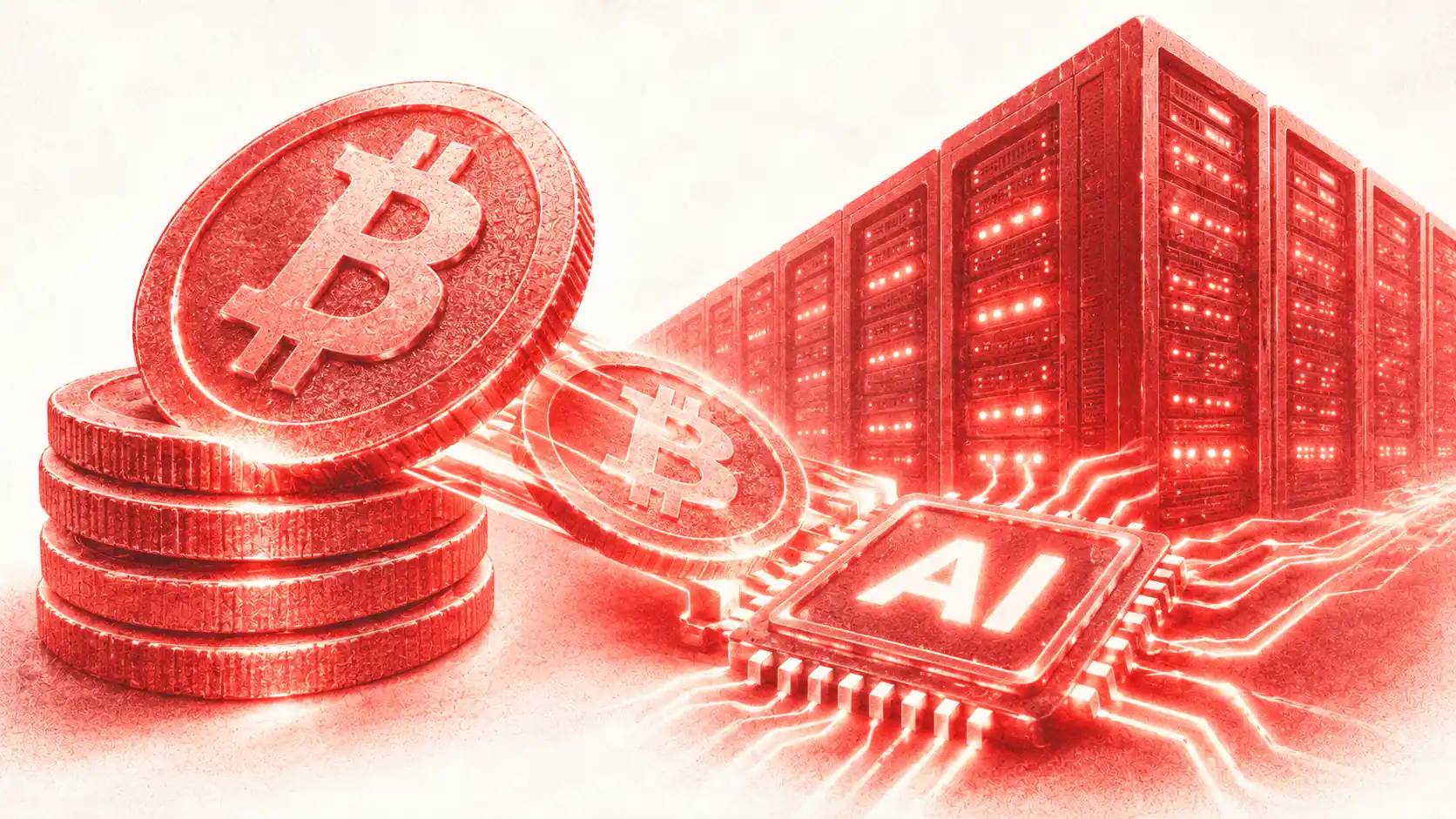


Something unprecedented is unfolding across the mining industry. The companies that built billion-dollar businesses extracting Bitcoin are now dismantling their ASIC racks, liquidating BTC reserves, and converting their data centers into artificial intelligence infrastructure. This is not a tactical adjustment. It is a structural reinvention that is rewriting the identity of an entire industry — and the numbers behind it are striking.
According to CoinShares' Q1 2026 report, publicly listed Bitcoin miners could derive up to 70% of their revenues from AI by December 2026, up from roughly 30% today. That single statistic captures the scale of what is happening.
Why Bitcoin Mining Stopped Making Financial Sense
The underlying problem is straightforward. Mining Bitcoin today costs more than the asset is worth. The average production cost per BTC among listed miners reached approximately $79,995 in Q4 2025, according to CoinShares, while Bitcoin traded between $68,000 and $75,000 during the same period. Losses were structural, not temporary.
The April 2024 Bitcoin Halving cut the block reward from 6.25 to 3.125 BTC, slashing guaranteed revenue per unit of compute. The hashprice — the metric measuring miner earnings per petahash per day — collapsed to around $29 per PH/s/day in Q1 2026, levels not seen since the post-halving lows of 2024. Gross margins in Bitcoin mining have fallen from roughly 90% during the 2021 bull run to around 60% today. AI cloud infrastructure, by contrast, generates margins of approximately 85% with lower energy overhead.
The economics became untenable. And the industry responded accordingly.
Who Is Selling Bitcoin to Buy GPUs
The list of companies that have formally initiated the pivot is substantial. Here are the most significant cases.
MARA Holdings sold over $1 billion in BTC in recent months — a move that would have been unthinkable a year ago for a company famous for its conviction HODL strategy. CEO Fred Thiel stated the objective is to "direct computational power toward its most productive use." MARA still holds 53,822 BTC, but the strategic direction has fundamentally changed.
Core Scientific is arguably the most advanced example. Having emerged from bankruptcy in 2024, it secured a $10.2 billion, 12-year agreement with CoreWeave. It sold approximately $175 million in Bitcoin to accelerate the conversion, and AI colocation revenue already represents 39% of total sales.
Hut 8 signed a $7 billion contract with Google-backed Fluidstack for a 245 MW AI data center over 15 years. In its Q4 2025 earnings call, the company stated that Bitcoin is no longer a "long-term strategic focus."
IREN (formerly Iris Energy) secured a $9.7 billion deal with Microsoft for 76,000 NVIDIA GB300 GPUs across 200 MW at its Childress, Texas campus. It holds zero BTC in treasury — a deliberate strategic choice, not a consequence of financial pressure.
TeraWulf has signed HPC contracts totalling $12.8 billion, with 27% of revenues already coming from AI. Cipher Digital (formerly Cipher Mining) liquidated 34% of its BTC reserves and is repositioning as a pure HPC infrastructure operator.
'Mullet' Data Centers: Bitcoin in the Back, AI in the Front
One metaphor has gone viral across the sector to describe the hybrid approach: the 'Mullet Data Center Strategy.' Bitcoin runs in the back — as a flexible, interruptible workload used to balance grid demand — while AI occupies the front, where multi-year contracts and stable margins concentrate. IREN is the clearest embodiment of this philosophy.
"The long-term economics of HPC and AI data centres should trump Bitcoin mining," Brian Dobson, managing director at Clear Street, told Bloomberg.
What Happens to the Bitcoin Network?
A legitimate question: if miners stop mining, who secures the blockchain?
The network is more resilient than the pivot narrative might suggest. The global hashrate fell from a peak of 1,160 EH/s in October 2025 to roughly 961–1,000 EH/s currently, but Bitcoin's difficulty adjustment mechanism has already compensated. The network recorded three consecutive negative difficulty adjustments in late 2025 — the first such sequence since July 2022 — without catastrophic consequences.
Paradoxically, pure-play miners that remain, operating next-generation hardware with access to low-cost energy, find themselves structurally stronger because competition has thinned. CoinShares projects the hashrate could reach 1.8 zettahash by end-2026, but only if Bitcoin returns above $100,000.
The Risks Every Investor Should Understand
This transformation carries debt levels the mining sector has never seen before. IREN carries approximately $3.7 billion in convertible notes. TeraWulf has total debt of roughly $5.7 billion. Cipher Digital issued $1.7 billion in senior secured notes, with quarterly interest expenses exploding from $3.2 million to $33.4 million in a single quarter.
These are not mining company balance sheets. They are infrastructure operator bets — wagering that AI revenues materialize fast enough to service obligations. If Google, Microsoft, and other hyperscalers slow their compute demand, the most leveraged companies face serious exposure. That risk is real, and investors in these equities need to price it accurately.
- IREN: ~$3.7 billion in convertible notes
- TeraWulf: ~$5.7 billion total debt
- Cipher Digital: $1.7 billion in senior secured notes, quarterly interest up 10x in one quarter
Voices From the Industry
Bitfarms CEO Ben Gagnon was blunt: "We are no longer a Bitcoin company." The statement made waves but accurately reflects the current mood. Bitdeer zeroed out its BTC reserves to fund AI expansion. Even Riot Platforms, historically more conservative, signed its first data center lease with AMD.
"Bitcoin mining created the blueprint for the AI compute boom and the modern data center."
End of One Era, Start of Another
The narrative of the Bitcoin miner as ideological custodian — the convict HODLer accumulating satoshis through every cycle — is fracturing under the weight of real economics. The industry that built the most secure blockchain in history is reinventing itself as infrastructure for the next generation of large language models.
For Bitcoin itself, this is not necessarily bad news. It does mean the network will increasingly depend on efficient, specialized miners without the distraction of AI compute ambitions. And the next halving in 2028 will arrive in a structurally different landscape than any that came before. The question for investors is simple: which companies have already picked their side?