

New rules, greater transparency, and rising adoption in the Eurozone's third-largest economy
Italy is entering a new phase in the development of its crypto ecosystem. As a key member of the European Union, Italy is implementing the MiCA (Markets in Crypto-Assets) regulation — the EU's landmark framework for digital assets — alongside a series of national legislative updates. The combined effect is a progressively clearer regulatory environment for businesses, investors, and industry operators alike.
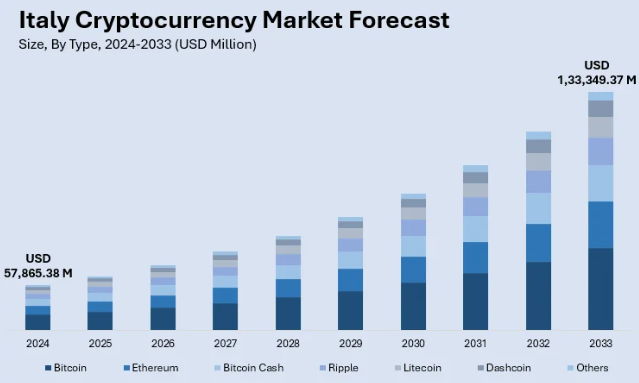
Over the past few years, cryptocurrencies have moved firmly into Italy's mainstream financial conversation. What was once a niche phenomenon is now a debated component of national financial and technology policy. Estimates suggest that by the end of 2025, more than 3.6 million Italians will hold digital assets — a clear sign of a rapidly evolving market.
CONSOB Adopts ESMA Guidelines: What It Means
One of the most significant regulatory milestones came in 2026, when CONSOB — Italy's financial markets supervisory authority, equivalent in role to the SEC in the US or the FCA in the UK — officially adopted the guidelines developed by the European Securities and Markets Authority (ESMA).
These guidelines introduce a more precise classification system for different types of digital tokens. The core objective is to establish when a crypto asset must be treated as a regulated financial instrument under existing EU securities law, and when it falls into a different, lighter-touch category.
The classification framework covers various types of digital assets, including:
- Utility tokens used to access digital services
- NFTs and collectible digital assets
- Hybrid tokens with both financial and technological characteristics
Clearer category definitions reduce regulatory uncertainty for businesses operating across Europe — particularly important for US and UK firms looking to access EU markets — and strengthen investor protection within the European single market.
Key Legislative Changes From 2025
Alongside MiCA alignment, the Italian government introduced several targeted legislative measures to reinforce the crypto compliance framework.
A critical step was Legislative Decree 95/2025, published in late June, which extended the registration deadline for Virtual Asset Service Providers (VASPs) to 30 December 2025. This decision gave industry participants additional time to meet the new regulatory requirements — an approach that contrasts with the more abrupt enforcement shifts seen in some US regulatory actions.
By the first quarter of 2026, the practical effects of these reforms are already materialising. Several fintech and crypto companies — particularly in Northern Italy — have reported changes to their operational procedures to comply with the new European regulatory framework. Some firms confirmed updating their compliance processes, data management systems, and user onboarding models from 13 March 2026, indicating that the new rules are entering active enforcement in the Italian digital asset market.
Italy's Evolving Crypto Tax Framework
Italy's cryptocurrency tax regime is also undergoing significant revision — an area of particular interest for international investors with Italian exposure. From 2026, the government has evaluated a potential increase in the capital gains tax on digital assets up to 33%, though the political debate leaves open the possibility of maintaining the rate at 26%. Importantly, the previous exemption threshold for gains under €2,000 has been eliminated, marking a move toward a more comprehensive and structured taxation model.
Under Italian law, the following crypto activities are generally considered taxable events:
- Converting crypto to fiat currency
- Using digital assets to pay for goods or services
- Receiving cryptocurrencies as a form of payment
Other activities — such as staking, mining, or receiving airdrops — remain in a less clearly defined regulatory space and may be subject to future clarification. For context, this is broadly comparable to ongoing debates in the US and UK over how to classify crypto income streams for tax purposes.
Licensing and Requirements for Crypto Businesses
The new regulatory framework requires companies operating in the digital asset space to comply with both MiCA rules at the EU level and national procedures. Businesses must obtain specific authorisations and register with Italian supervisory bodies.
Crucially, platforms must register with the OAM (Organismo Agenti e Mediatori — Italy's AML supervisory body for financial intermediaries) to comply with anti-money laundering regulations. This registration is central to monitoring sector activity and reducing risks related to fraud and financial crime.
Internationally, crypto regulatory strategies vary sharply. The US has tended toward enforcement-first regulation — acting after problems emerge rather than building preventive frameworks upfront. Several Asian jurisdictions are experimenting with alternative models. Europe, through MiCA, is explicitly choosing a preventive and structured approach: the ambition is to build a regulated digital market from the ground up, enabling innovation without sacrificing financial stability.
Toward a Mature Crypto Market
As of March 2026, these transformations are beginning to take effect, with the European digital asset regulatory framework progressively taking shape as community regulations enter their initial implementation phase. Italy's regulatory evolution signals that the digital asset sector is exiting the experimental phase and entering a more institutional dimension. With clearer rules and a growing market, Italy has the potential to become one of Europe's key reference points for blockchain economy development. The message from the new policy direction is unambiguous: the future of crypto will not depend on the absence of regulation, but on the ability to integrate technological innovation and financial governance into a transparent and sustainable system — a model the rest of Europe, and beyond, will be watching closely.