

The blockchain security industry is on high alert. A new and insidious phishing campaign is targeting users of MetaMask, the popular cryptocurrency wallet.
The peculiarity of this attack lies in its extreme verisimilitude: fraudsters are using a fake 'two-factor authentication' (2FA) stream to trick victims into voluntarily handing over their recovery phrase.
The Anatomy of the Scheme: An Evolved Social Engineering
According to the CSO of the security company blockchain SlowMist on X, the operation stands out for an above-average level of technical and psychological sophistication. The deception process begins with an apparently official communication. The victims receive e-mails that appear to come directly from MetaMask's technical support.
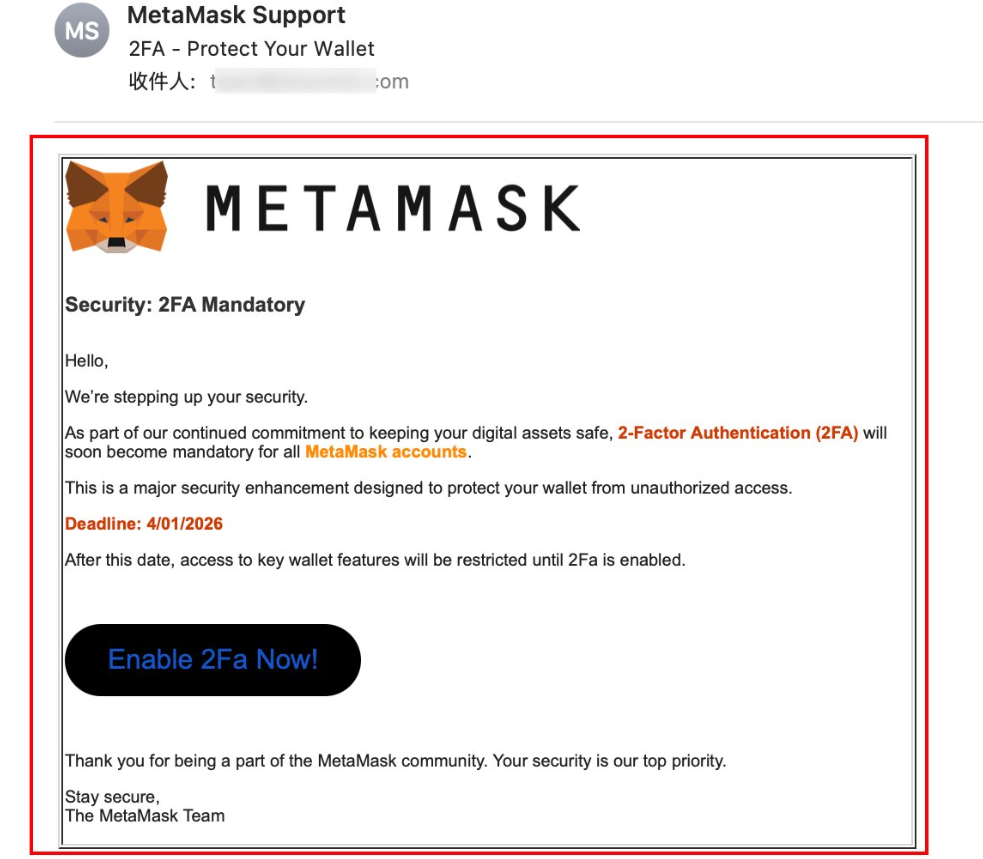
These messages, which utilise the professional branding, wolf logo and original colour palette of MetaMask, announce the introduction of mandatory requirements for two-factor authentication. To maximise effectiveness, the attackers use domains almost identical to the official one: in one documented case, the difference lay in a single letter, a detail almost invisible to a distracted user or one preoccupied with the urgency of the request.
The 2FA Fake Trap
On clicking the link, the user lands on a mirror site where he is guided through an apparently legitimate security procedure. It is here that the ultimate trap is triggered: in the final step, the user is asked to enter the 'seed phrase' (the mnemonic recovery phrase) under the pretext of completing the 2FA security check.
This is the point of no return. The retrieval phrase is the master key to the digital wallet. As experts constantly remind, anyone who comes into possession of it can:
- Transfer funds without any authorisation or knowledge of the owner.
- Recreate the wallet on another device in seconds.
- Gain total control over all associated private keys.
- Sign and execute transactions completely independently.
In essence, once a fraudster obtains the seed phrase, they can bypass any password or device approval, rendering normal security protections null and void.
🚨MetaMask 出现新型 '2FA 安全验证' 骗局 @MetaMask @tayvano_
- 23pds (山哥) (@im23pds) January 5, 2026
注意防范 pic.twitter.com/RJM78If9zb
The Paradox of 2025: Less Losses, More Dangers
The emergence of this threat occurs in a peculiar market context. Data for 2025 showed a drastic decline in losses related to phishing in the cryptocurrency world. Compared to the nearly $494 million stolen in 2024, the volume of theft dropped by around 83% to around $84 million.
However, this drop should not lead to a false sense of security. With the first signs of market recovery in early 2026 - fuelled by renewed interest in meme coins and increased participation by small (retail) investors - cyber criminals have returned to the attack with more refined methods.
How to Protect Yourself
The paradox of this scam is that it exploits the very positive reputation of 2FA - a tool born to protect - to deceive the user. Experts reiterate a golden rule that admits of no exceptions: no wallet provider will ever ask for the recovery phrase to activate security features or for technical verification.
In a climate of newfound enthusiasm for digital assets, awareness of phishing methodologies and cautious credential management remain the only truly effective defence. The golden rule remains unchanged: your seed phrase must never be shared, for any reason, with anyone.