Sending money across borders is slow, expensive, and almost always runs through the dollar. According to CoinGecko data, the global stablecoin market now exceeds $240 billion, with non-dollar currencies holding a negligible share. On June 1, 2026, Japan moved to shift that balance. Two decisions, one day.
What Japan Actually Decided on June 1
Two things at once. First, the Financial Services Agency activated rules allowing qualified foreign stablecoins to be treated as electronic payment instruments, provided they pass equivalence tests on licensing, custody, and home-country supervision. This isn't a blanket green light for every dollar-pegged token. It's a structured pathway for global fintechs and issuers willing to meet Japan's bar.

Second, the ruling Liberal Democratic Party's blockchain panel called for promoting yen-denominated stablecoins across Asian cross-border payments, alongside a framework for crypto ETFs. Tokyo hasn't improvised here. Japan has been building toward this since 2023, when it rewrote the Payment Services Act to classify stablecoins as electronic payment instruments.
The Yen Stablecoin Ecosystem Already Exists
Functionally, this isn't starting from scratch. In October 2025, JPYC became Japan's first fully FSA-licensed yen stablecoin, running on Ethereum, Avalanche, and Polygon. The ambition is substantial: one trillion yen in issuance over three years, roughly $6.8 billion according to JPYC's own projections. Behind it, the heavyweights. Project Pax, backed by Japan's three megabanks MUFG, SMBC, and Mizuho, targets one trillion yen in B2B stablecoin volume by 2028. SBI, in partnership with Startale, is preparing JPYSC, a trust-bank-backed instrument expected in Q2 2026. A three-tier issuer model, built deliberately and governed by strict rules. For ongoing institutional coverage: follow @Reuters on X for the latest updates.
KEY FIGURES
FSA foreign stablecoin rule............. effective June 1, 2026
First regulated yen stablecoin.......... JPYC (FSA license, Oct 2025)
JPYC issuance target................... 1 trillion yen in 3 years (~$6.8bn)
Project Pax (MUFG, SMBC, Mizuho)....... 1 trillion yen B2B by 2028
Global stablecoin market cap........... over $240bn (USD dominant), per CoinGecko
Market projection (Citigroup).......... $3.7 trillion by 2030
Sources: FSA, JPYC, Citigroup, 2026
What Changes for Businesses Paying Across Borders
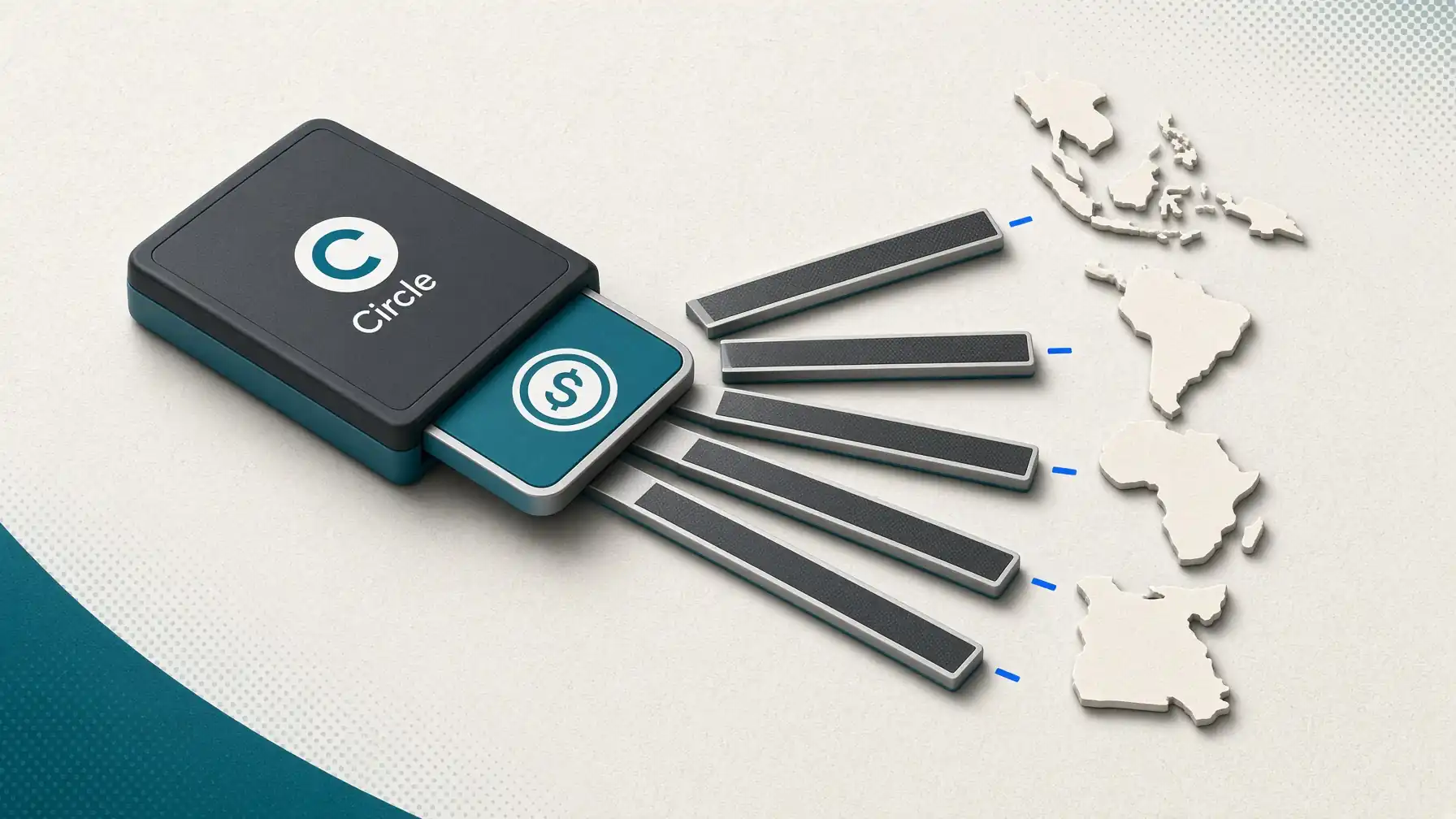
For a company with international suppliers, the practical shift is real. Settling cross-border invoices in yen stablecoins removes the need for multiple foreign-currency accounts and bypasses SWIFT fees entirely. This sits alongside moves like Circle's CPN network, which routes USDC through banks without exposing them to direct crypto exposure. The dollar's grip on stablecoin rails is the target here, and Japan's push is the most credible Asian counterweight yet.
Global Stablecoin Market Cap ($ billions), 2030 Projection
Global stablecoin market cap ($ billions), with 2030 projection
Sources: IMF (2023-2026 data), Citigroup (2030 projection)
Sources: IMF (2023-2026 data), Citigroup (2030 projection)
What to Watch Next
The contrast with the United States is the real story. While Washington continues debating jurisdictional boundaries under the CLARITY Act and GENIUS Act frameworks, Japan has already laid its regulatory foundations. For Europe, the challenge is twofold: MiCA provides structure. Euro-denominated stablecoin volumes remain a fraction of dollar equivalents, even as growth accelerates. The UK's FCA and the EU's ESMA are both watching Tokyo closely.
One number frames the stakes. Citigroup projects the global stablecoin market could reach $3.7 trillion by 2030, more than fifteen times today's level. If even a modest share of that volume settled in yen rather than dollars, the architecture of Asian payments would look very different. JPYC has already attracted hedge fund interest, partly driven by carry-trade plays tied to rate differentials between Japan and the United States.
Japan, a country where cash was dominant until recently, is attempting to skip an entire generation of financial infrastructure. The FSA's June 1 rules and the LDP blockchain panel's Asia-wide ambitions are the opening moves. Watch whether USDC's issuer Circle files for FSA equivalence recognition in H2 2026. Whether Project Pax hits its 2028 B2B volume target. Those two data points will tell most of the story.