
Holders of XRP seem to have adopted a decidedly cautious stance in response to escalating geopolitical tensions between the US, Israel and Iran. In recent hours, the combination of macroeconomic uncertainty and large-scale on-chain movements has turned the spotlight on the resilience of Ripple's digital asset.
The impact of escalation in the Middle East
A joint attack by Israel and the United States against Iran last Saturday reportedly triggered a rapid wave of selling across the cryptocurrency sector. The climate of instability was further aggravated over the weekend, following news of the death of Iran's Supreme Leader, Ayatollah Ali Khamenei.
The situation precipitated further over the weekend, when the first attacks were launched shortly after the traditional financial markets closed. This timing amplified uncertainty across all risk assets, with the crypto sector reacting almost immediately to the geopolitical shock, said the analyst on X.
In response, Iran stepped up retaliatory attacks against Israel and several Persian Gulf countries, fuelling fears of a large-scale regional conflagration. This surge in geopolitical risk has weighed heavily on investor sentiment, pushing capital towards traditional safe-haven assets such as gold, while assets considered 'risk-on', including cryptocurrencies, have suffered heavy corrections.
Data On-Chain: the massive inflow to Binance
In this context of uncertainty, analyst on-chain Darkfost highlighted a suspicious movement: more than 472 million XRP, worth approximately $650 million, have been transferred to the Binance exchange in the past week. This is the "largest inflow period recorded in February".
🗞️ $650M XRP Selling pressure builds as U.S.-Iran tensions rise.
- Darkfost (@Darkfost_Coc) March 1, 2026
This week, the crypto market was marked by rising geopolitical tensions between the United States, Israel, and Iran.
The situation escalated further over the weekend, when the first strikes were launched shortly... pic.twitter.com/Wkr2fqtqPz
Unusually, large transfers to trading platforms are interpreted as a sign of potential selling pressure, as investors move tokens from private wallets to exchanges to facilitate liquidation. However, experts point out that such inflows do not automatically translate into immediate sales. These movements could reflect:
- Liquidity repositioning;
- Arbitrage strategies;
- Collateral management;
- Precautionary measures to cope with volatility.
Analysis of reserves and market performance
CryptoQuant's data reveals that XRP reserves on exchanges had been steadily declining since October 2025. The current peak marks a modest reversal of this trend, suggesting that large holders are seeking operational flexibility.
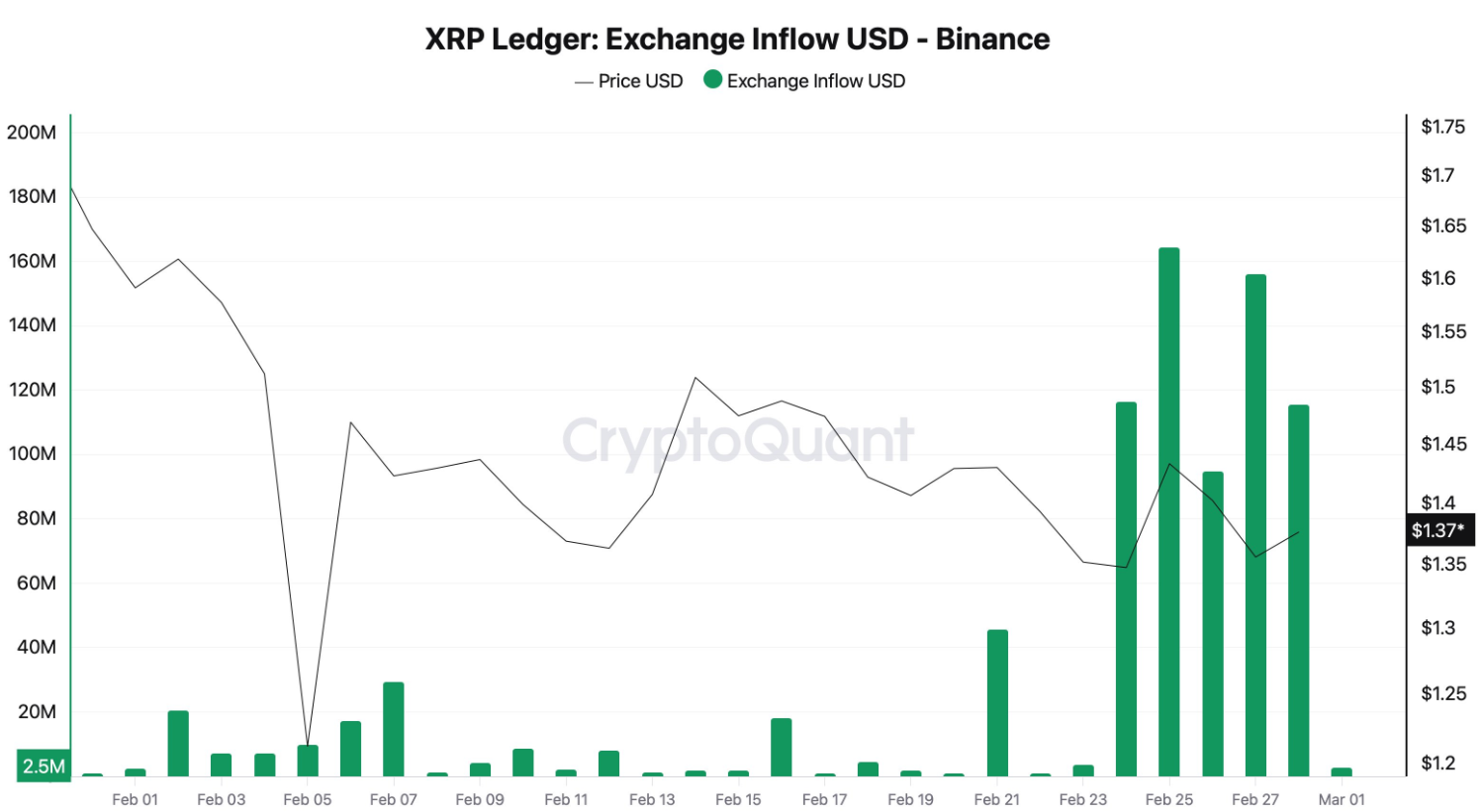
On the price front, XRP followed the general market decline. According to Markets data, the altcoin has lost over 4 per cent in the past 24 hours, trading at $1.37 at the time of writing.
What to expect for the next days
The next few days will be decisive in determining whether the $652 million move was an isolated event or the beginning of a deeper distribution phase by the 'whales'. While geopolitical risk continues to collide with crypto market structure, XRP remains poised between short-term volatility and its long-term adoption prospects.