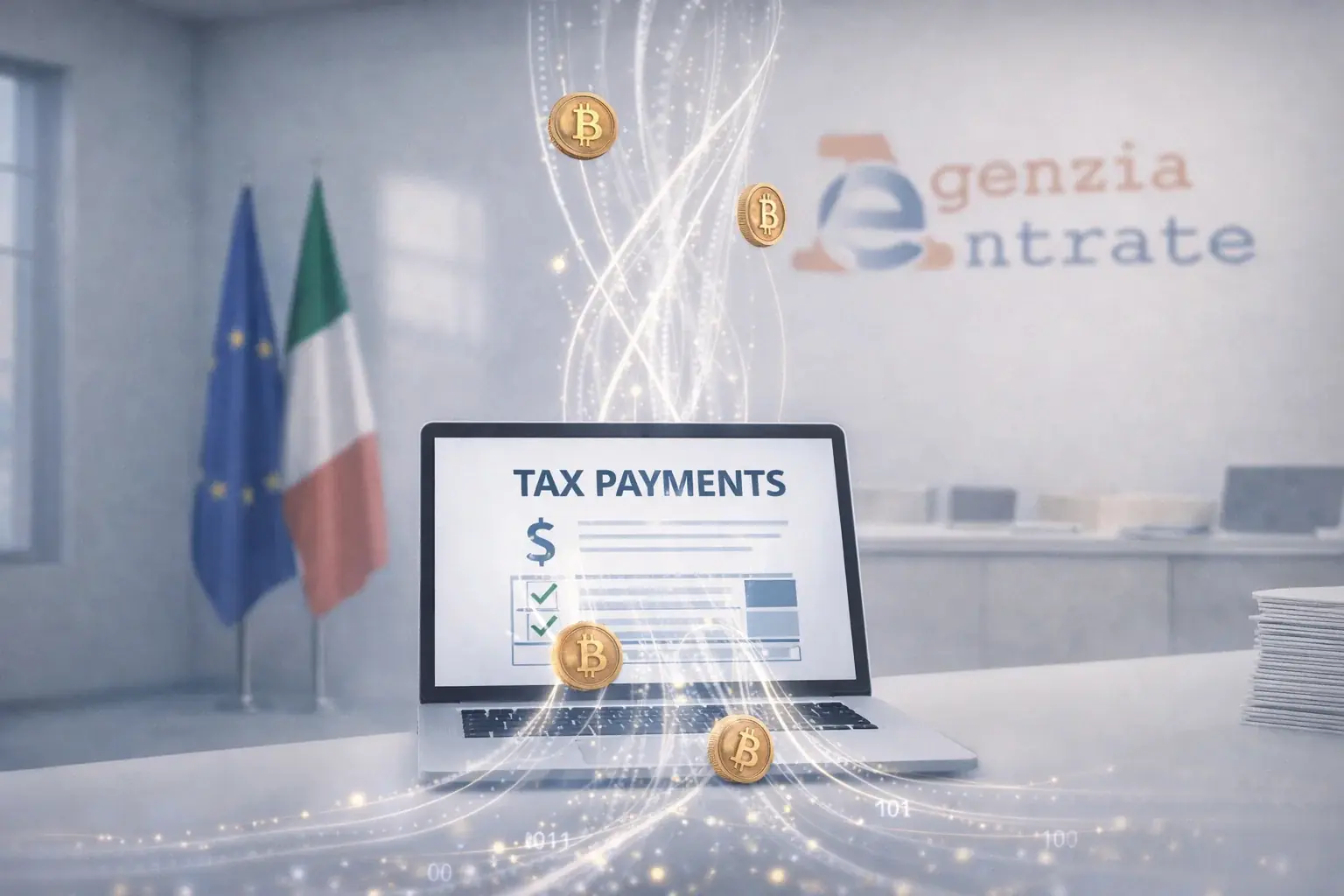

Anybody who has a Binance or Coinbase account, or uses other cryptocurrency exchanges, will find communications regarding their crypto data in the tax drawer of the Agenzia delle Entrate. This is not an error, nor any strange anomalies, but only the application of legislation that requires crypto operators registered in our country to transmit the data of their clients' transactions.
What data must be declared to the IRS
The updated law transposing European directive DAC8 (Law Decree 194/2025) requires users to declare the amount of crypto they hold, as well as any capital gains, but obliges intermediaries to declare every movement made by their users. The directive has radically changed the concept of anonymity, one of the most cherished by early crypto-trading investors, revolutionising one of the cornerstones of decentralised finance.
The operational mechanism envisages that in 2026 the exchanges will start collecting data; in 2027 they will transmit it to the national tax authorities; and in the coming year the first automatic exchange between countries will take place. DAC8 incorporated the new OECD standards contained in the Crypto-Asset Reporting Framework. The update extended to cryptocurrencies the same level of transparency applied to traditional bank accounts, the Common Reporting Standard.
 Banking Law
How to read the communications in your tax drawer
Accessing the received income section of the tax drawer (available on the telematic portal of the Agenzia delle Entrate), many taxpayers active on exchanges registered in Italy are finding communications referring to the ordinary 770 form. These come directly from the exchanges and contain aggregated data on transactions carried out on the platform, during the previous year.
The 770 form
The 770 form is the declaration that tax withholding agents submit, annually, to communicate to the Agenzia delle Entrate the tax data relating to withholdings made, payments made and other relevant information on clients or employees. In the case of cryptocurrency exchanges, these entities make use of the SO panel, using it to transmit aggregated information on users' crypto transactions.
The communication issued to the IRS contains the taxpayer's personal details; a reason code identifying the type of transaction reported; a subject code specifying, further, the nature of the communication; the reference date; the total amount of transactions and, where applicable, the amount of crypto-assets involved.
The main fields to be considered are the reason code (which often, in cryptocurrency-related communications, corresponds to the letter V) and the subject code. This takes on various numeric values. The amount indicated generally represents the countervalue in euros of the transactions carried out or positions held during the reporting period. The quantity, when present, indicates the volume of crypto-assets involved in the transactions.
What these data are for and where to find them
These data are of an informative nature and do not constitute any tax claim. They are used by the Agenzia delle Entrate to check the consistency between what the exchange is communicating and what the taxpayer is declaring.
To check what the exchange is actually communicating to the tax authorities, simply visit your private area on the Agenzia's website (SPID or CIE required); search for the tax drawer service and then go to consultations > tax declarations > income received (from the bar on the left). You will also need to select the year of interest.
The reporting of this data is due to the regulatory framework that is being sought to regulate the presence of cryptocurrency exchanges. These operators are burdened with stringent regulatory obligations, which on the one hand hinder their spread, but on the other allow such sites and platforms to acquire a certain legitimacy, and therefore reliability, in the eyes of the investor. Especially of those who are still sceptical about assets such as cryptocurrencies.