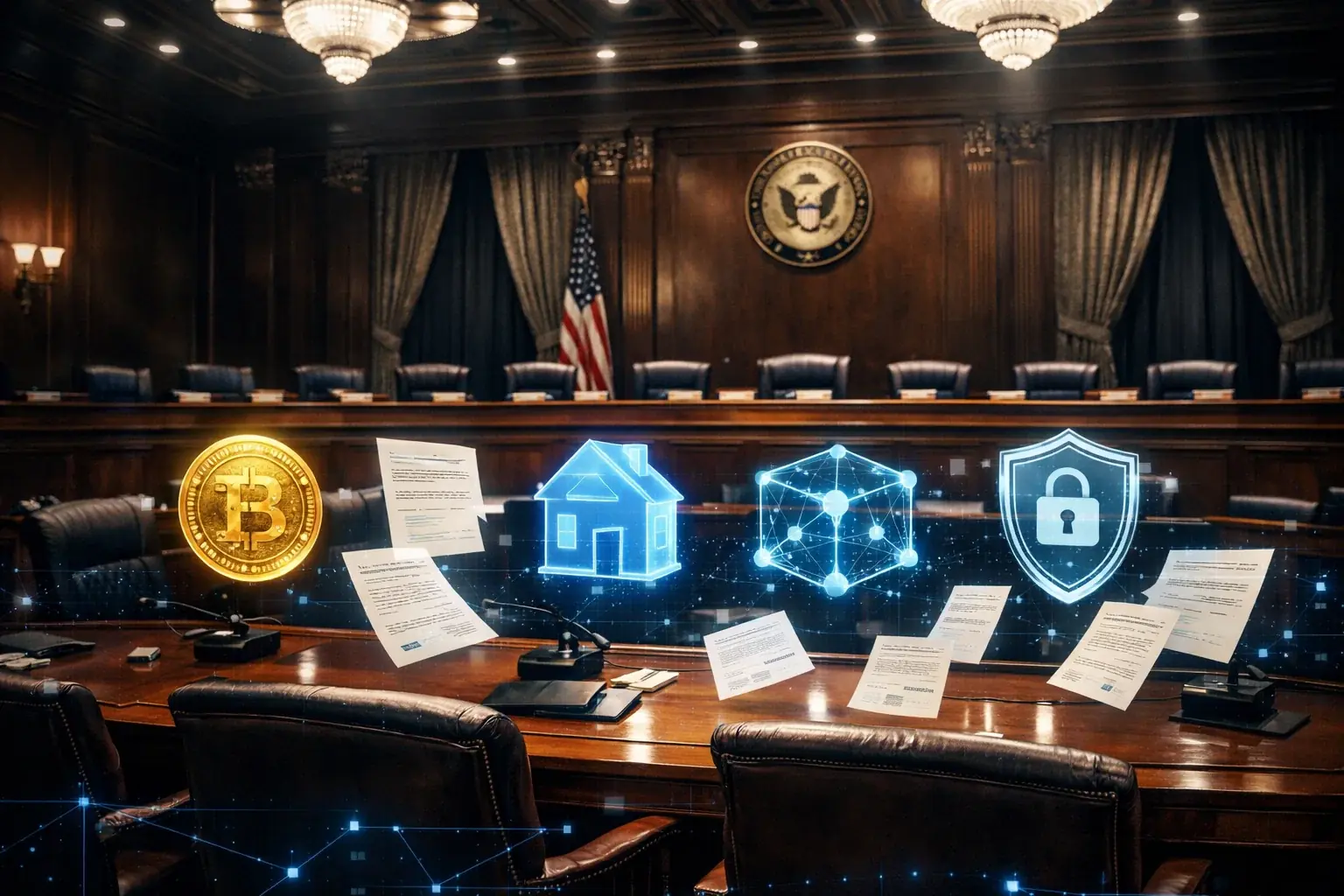

On March 25, 2026, at 10:00 AM EST, the US House Financial Services Committee convened a landmark hearing titled "Tokenization and the Future of Securities: Modernizing Our Capital Markets." The description is not hyperbole: this is the most consequential congressional session on tokenization ever held, arriving at a precise inflection point — with the RWA market surpassing $12 billion and the CLARITY Act moving toward Senate markup.
None of this is accidental. It is the product of months of negotiations, political clashes, lobbying campaigns, and institutional pressure — all converging on what may be the most important regulatory week in US crypto history.
The CLARITY Act: What It Is and Why It Matters
The Digital Asset Market Clarity Act is the bill that would redraw jurisdictional boundaries over crypto assets in the United States. It would establish by law whether a given tokenized asset qualifies as a "digital security" under SEC jurisdiction, or a "digital commodity" under CFTC authority. That distinction — seemingly technical — governs every downstream question: which exchanges can list the asset, what investor protections apply, and which regulator can initiate enforcement action.
For years, the absence of this clarity has kept the industry in regulatory limbo. That limbo may now be ending.
The Stablecoin Breakthrough
The thorniest issue blocking the CLARITY Act has been stablecoin yield. Traditional banks have fiercely opposed allowing crypto platforms to offer returns on stablecoin balances, arguing it would pull deposits away from the banking system.
Senators Thom Tillis and Angela Alsobrooks announced an "agreement in principle" on stablecoin yield — the provision that had stalled the bill for months. The compromise text prohibits both direct and indirect yield on stablecoins, but permits rewards tied to transactional activity. The SEC, CFTC, and Treasury will have twelve months to define exactly where the line falls.
Industry reaction is mixed. Brian Armstrong of Coinbase — who publicly torpedoed an earlier version of the bill in January — has not yet commented on the new compromise. That silence is being read as a significant signal by those tracking Washington's political dynamics.
The Window Is Closing
Senator Bernie Moreno was blunt: if the bill does not pass by May, digital asset legislation may not advance again for the foreseeable future.
Five separate legislative steps still stand between the CLARITY Act and a presidential signature. The clock is ticking.
Why This Matters Globally
Today's hearing and the trajectory of the CLARITY Act are not merely Washington news. They signal that the world's largest financial market is actively building the regulatory framework for real-world asset tokenization. Every major player in this space over the coming years — exchanges, DeFi protocols, stablecoin issuers, banks, institutional funds — will have to operate within a framework being defined right now.
For European readers: the EU is developing its own path through MiCA and the DLT Pilot Regime, but the US framework will set the global benchmark. What happens on Capitol Hill today shapes the competitive landscape for years to come.