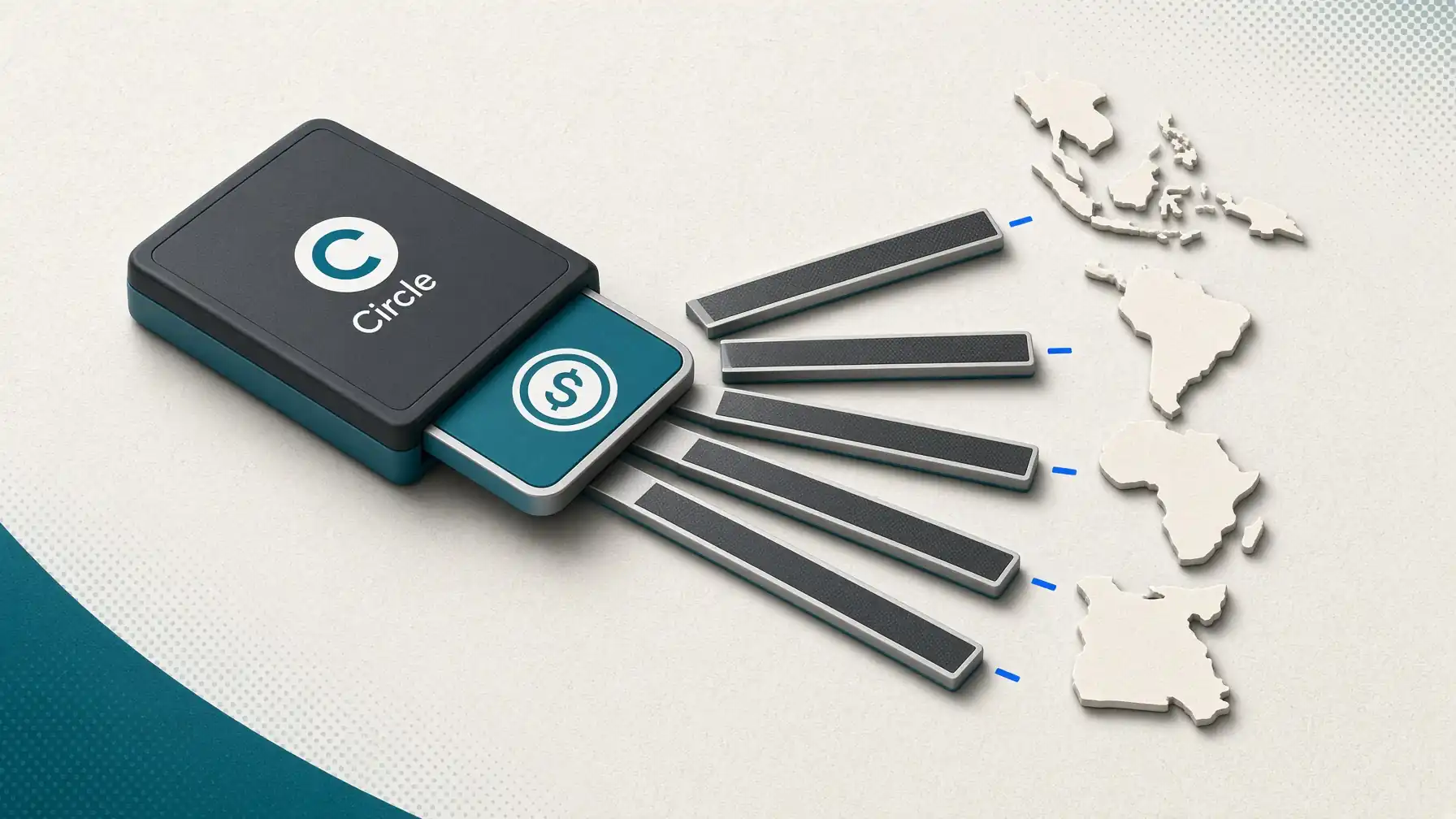
Four years after Libra collapsed, Meta is back in crypto. No global press release, just a quietly updated support page. The number behind the move: 3.3 billion users.
TL;DR: Meta activated USDC payouts for creators in Colombia and the Philippines on April 29, 2026, using Solana and Polygon rails managed by Stripe. The company explicitly ruled out issuing its own stablecoin, choosing Circle's USDC instead.
On April 29, 2026, Meta switched on USDC payments for selected creators in Colombia and the Philippines. Payments run on Solana and Polygon. Stripe handles the rails. The country selection isn't random: creators in both markets earn in dollars but collect via correspondent banking, waiting three to five days and paying fees between 3% and 7%, according to industry data. USDC on Solana settles in under a second for less than a cent.
The future of marketplace commerce is on Polygon.@Meta launched stablecoin payouts for creators on the Polygon Chain.
— Polygon | POL (@0xPolygon) April 29, 2026
Live in Colombia and the Philippines, with 160+ markets coming, users now get faster settlement with USDC while gaining access to dollar denominated assets. pic.twitter.com/hjodzNpuyU
No Meta-coin. Just Circle's USDC
The real story is what Meta is not doing. A company spokesperson told Decrypt that the firm “is not issuing a Meta stablecoin.” Instead, Meta chose USDC, which carries a market cap of $77 billion according to CoinGecko, making it the second-largest stablecoin globally after USDT. The choice is political before it's technical: USDC is both MiCA-compliant in Europe and GENIUS Act-compliant in the United States, the only major stablecoin with dual regulatory certification.
The supported wallets reinforce the point: MetaMask, Phantom, Binance, Bybit, Kraken, and Bitso. No in-house custody, no proprietary token, no Diem reboot. On the tax side, creators receive Form 1099 or 1042 from Meta, plus crypto reporting from Stripe. Two independent audit trails, no grey zones.
What This Means for Polygon, Solana, and Stablecoins
Functionally, marc Boiron, CEO of Polygon Labs, confirmed to Fortune that the program targets coverage of more than 160 countries by year-end. Catherine Gu, head of product at the Solana Foundation, described Solana as the “default place for internet-scale payments.” Polygon has already processed $37 billion in stablecoin volume over the last 30 days with 633 million transactions, per Polygon Labs data. Solana runs sub-second finality. Both networks are competing for the same role: the highway for global micro-payments. Meta chose both. No exclusivity. A strategy built by someone who doesn't want to be locked in.
The broader numbers are striking. Visa announced last week that it hit a $7 billion run rate on stablecoin settlements, up 50% quarter-on-quarter, according to a company statement. Chainalysis projects stablecoin trading volume will reach $1.5 quadrillion by 2035. On-chain payment rails are no longer experimental: they're a parallel infrastructure absorbing real transaction flows. Stripe, already positioned as the “AWS of payments,” picks up the Meta piece as one more tile in an expanding ecosystem.
Europe Watches, and Worries About a Kill Switch
Europe is watching. Meta hasn't formally launched the product in the EU. Yet Italy and Germany jointly proposed a “kill switch” on foreign stablecoins to the EBA back in March, with USDC explicitly in the crosshairs. The proposal cited multi-issuer schemes and reserves held in the United States. A Big Tech firm paying creators in USDC outside the EU, then planning to expand into 160-plus markets: in Brussels, that trajectory raises flags. The next test point is the MISP summit in June.
Meta's crypto return doesn't look like Libra. It's smaller, more tactical, built entirely on third-party rails. Fortune described it as a quiet re-entry: no conferences, no advertising blitz. The real difference this time is that regulators are watching rather than blocking. The next data signal comes with Q2 2026: if the Colombia-Philippines pilot produces clean metrics, Marc Boiron has already written the expansion plan. One hundred and sixty countries, twelve months.