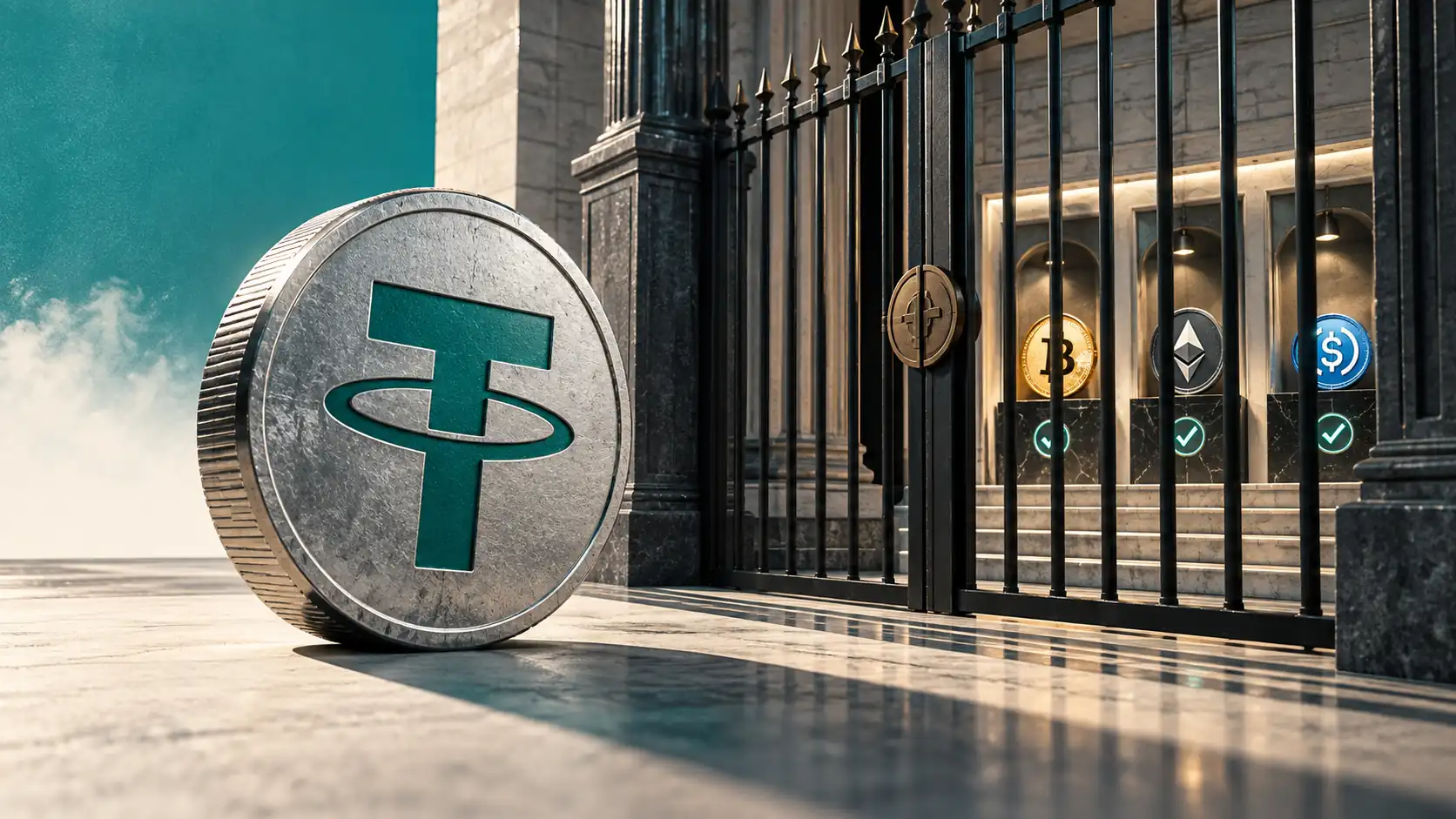


JPMorgan, Citi, Bank of America, and Wells Fargo are building a shared network of tokenized deposits, with a launch targeted for the first half of 2027. The Wall Street Journal broke the story on June 5, reporting that The Clearing House, the bank-owned payments company, will manage the infrastructure. The move looks like an embrace of blockchain. It is a defensive play.
Wall Street Goes On-Chain, But the Motive Is Self-Preservation
Functionally, the Clearing House CEO Davide Watson called it a decisive node for on-chain payments. Citi executive Shahmir Khaliq framed it, in a statement reported by the WSJ, as a step that “effectively consolidates” banks’ role in financing and capital markets. Institutional framing, reassuring language. The real driver, though, is a number hiding in plain sight.
According to DeFiLlama data from April 2026, the stablecoin market has grown to a scale that directly threatens bank deposit bases: Tether’s USDT alone sits at roughly $188 billion in market cap, USDC (Circle) at $78 billion, and various others including DAI at around $53.5 billion. PayPal’s PYUSD trails at $1.5 billion. That is more than $320 billion in deposits that never touch a traditional bank balance sheet.
Stablecoin Market Cap by Issuer (USD billions)
Source: DeFiLlama, April 2026
Source: DeFiLlama, April 2026
Tokenized Deposit vs. Stablecoin: The Difference That Explains Everything
Half the financial press is already blurring the line, so here is the distinction that matters. A tokenized deposit is not a stablecoin. It is a standard bank deposit recorded on a blockchain ledger instead of a traditional one. It stays inside the regulated system, carries the bank’s credit-risk profile, and passes through KYC and anti-money-laundering checks.
A stablecoin, by contrast, is a liability of a private issuer, backed by reserves, and lives on open public chains. Banks are not trying to issue crypto. They are trying to stop deposits from leaving their balance sheets. Deposits are the raw material banks use to extend credit. Fintech analyst Simon Taylor identified the defensive logic immediately in a post on X on June 5, 2026.
For corporate treasurers, the pitch is programmability, real-time liquidity, and cross-border settlement without SWIFT friction. Speed and 24/7 availability are comparable to stablecoins. The trust profile is not.
Grayscale now holds shocking amounts of $ETH and BTC
— BSCN (@BSCNews) June 6, 2026
According to data shared by @Arkham, crypto asset manager @Grayscale holds...
- $12.5B worth of bitcoin:native
- $500M worth of $ETH
Arkham points out the firm has started accumulating @HyperliquidX $HYPE too.
Is $HYPE… pic.twitter.com/p4sjphaK0A
Where Things Actually Stand
The timing is not accidental. The announcement lands as the CLARITY Act advances in the Senate, carrying clauses on stablecoin interest payments that the banks openly oppose. They fear that yield on idle stablecoin holdings will drain further liquidity from checking and savings accounts. Meanwhile, tokenized real-world assets reached nearly $27 billion in April 2026, according to RWA.xyz data, with operators like Ripple pushing institutional DeFi for months.
The most probable outcome is coexistence: tokenized deposits for wholesale and corporate use, stablecoins for retail and DeFi. That split is already visible in payment corridors. The WSJ post by @WSJ on June 5, 2026 crystallized the story for markets.
One detail cuts through the triumphalist announcements. Bank of America’s Mark Monaco admitted in the same WSJ report that demand for tokenized deposits “is not yet overwhelming.” While the big four target wholesale clients, a parallel consortium of regional banks, the Cari Network, comprising Huntington, First Horizon, KeyCorp, M&T, and Old National, is building a network aimed directly at retail customers. Two speeds, one objective: keep money inside the banking system. Watch the Senate CLARITY Act vote and the Cari Network launch timeline as the two indicators that will determine how quickly this reshapes US payment infrastructure.