


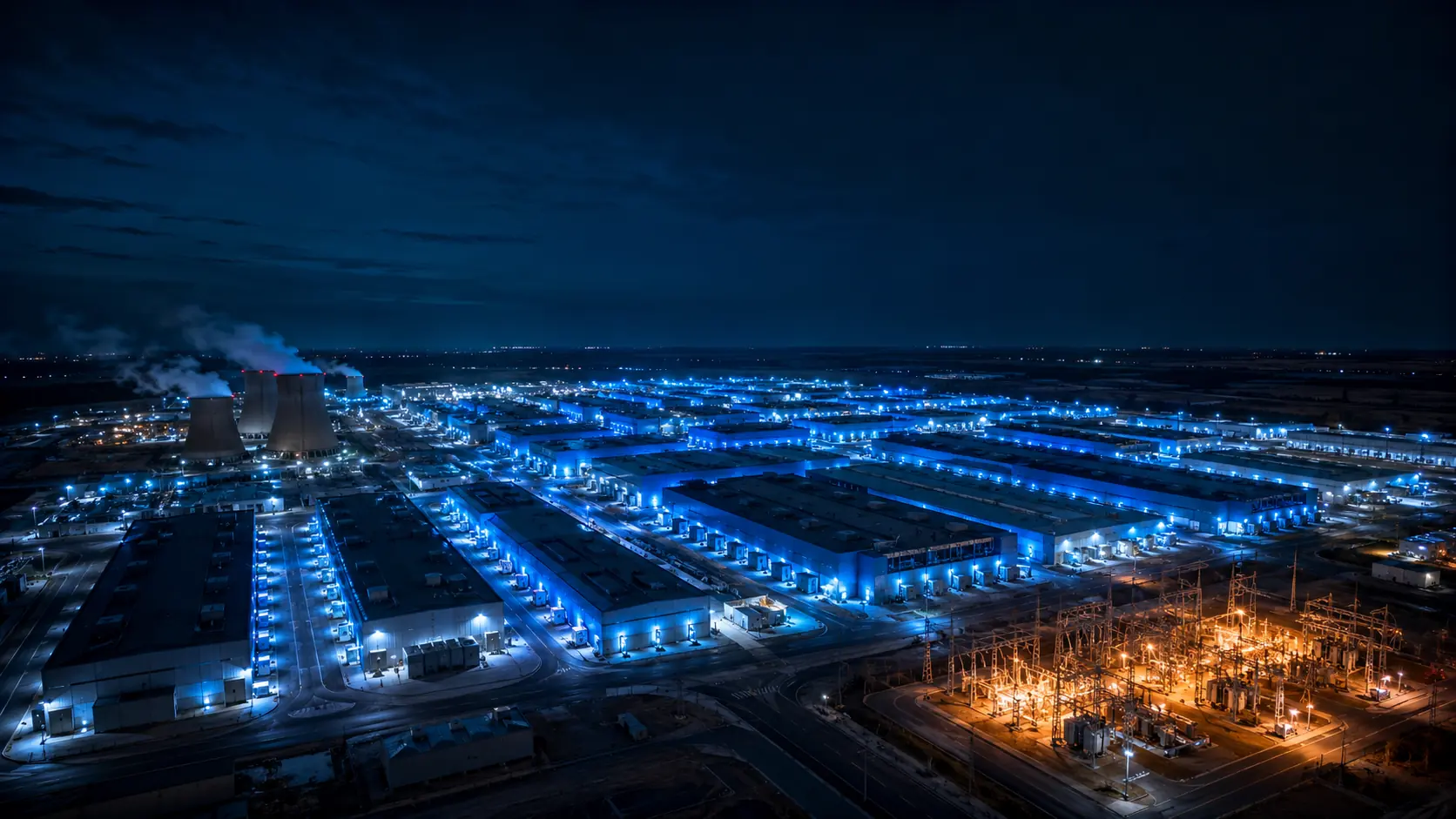
A single rack of next-generation AI chips now approaches one megawatt of power draw, enough to supply around 750 average American homes. On June 1, 2026, Bloomberg reported that the AI sector is nearing its physical limits. Not because demand is slowing. Because the grid can't keep up.
How Much Energy Does AI Actually Consume?
A staggering amount, and growing fast. According to BloombergNEF estimates, data center electricity demand is set to quadruple, rising from roughly 400 terawatt-hours in 2024 to over 1,600 by 2034. To put that in context: it's the equivalent of adding the entire electricity consumption of a major national economy, just to keep AI models training and responding around the clock. The problem isn't any one facility. It's the cumulative load.
How the Bottleneck Actually Works
Functionally, chipmakers, with Nvidia leading the way, keep shipping processors that are exponentially more powerful, each generation demanding data centers with an appetite for electricity that dwarfs earlier infrastructure. The existing grid can't absorb that jump alone. Hence the race toward stable, continuous power sources: natural gas in the near term, nuclear as the long-term bet.
Unchecked power consumption threatens to push electricity prices higher across the United States, widen AI's carbon footprint, and paradoxically slow the very boom it's meant to enable. The stakes couldn't be clearer. SEC filings from 2023 show data centers already accounted for 4.4% of U.S. electricity consumption, a figure projected to reach 12% by 2028. Nvidia itself, in a recent quarterly filing, warned that the availability of data centers, energy, and capital is critical, and that a shortage could hit future revenues.
What This Means for Europe
This is where the story turns geopolitical. Europe's share of global data center capacity is shrinking as operators increasingly favor the United States and Asia, drawn by more reliable grids and aggressive public incentives. France is playing its nuclear card: with nuclear power covering roughly 70% of its electricity mix, Paris is positioning itself as a competitive hub for AI infrastructure investment. The country that solves the energy constraint first captures a disproportionate share of the AI economy.
Sam Altman has been vocal on exactly this point. In a post on X, Altman placed energy among the forms of abundance humanity must build, framing it as close to a moral imperative.
using technology to create abundance--intelligence, energy, longevity, whatever--will not solve all problems and will not magically make everyone happy.
— Sam Altman (@sama) May 4, 2024
but it is an unequivocally great thing to do, and expands our option space.
to me, it feels like a moral imperative.
What to Watch: The Three Fronts That Matter
For anyone tracking this sector, three areas carry the most weight. First, efficiency: every gain in compute density per watt shifts the curve. Second, the energy mix: natural gas now, nuclear and renewables next. AI workloads run continuously and can't tolerate intermittency. Third, geography: data center location will follow the geography of available power. Authoritative forecasts and scenarios are tracked by the International Energy Agency (IEA).


The figure that puts everything in perspective comes from Morgan Stanley, which estimates U.S. data center demand could reach 74 gigawatts by 2028, against a power access deficit of roughly 49 gigawatts. That means two-thirds of projected demand risks going unmet. The world's fastest chip is worthless without a socket to plug it into. The next phase of AI will be decided at power plants, not just in research labs.