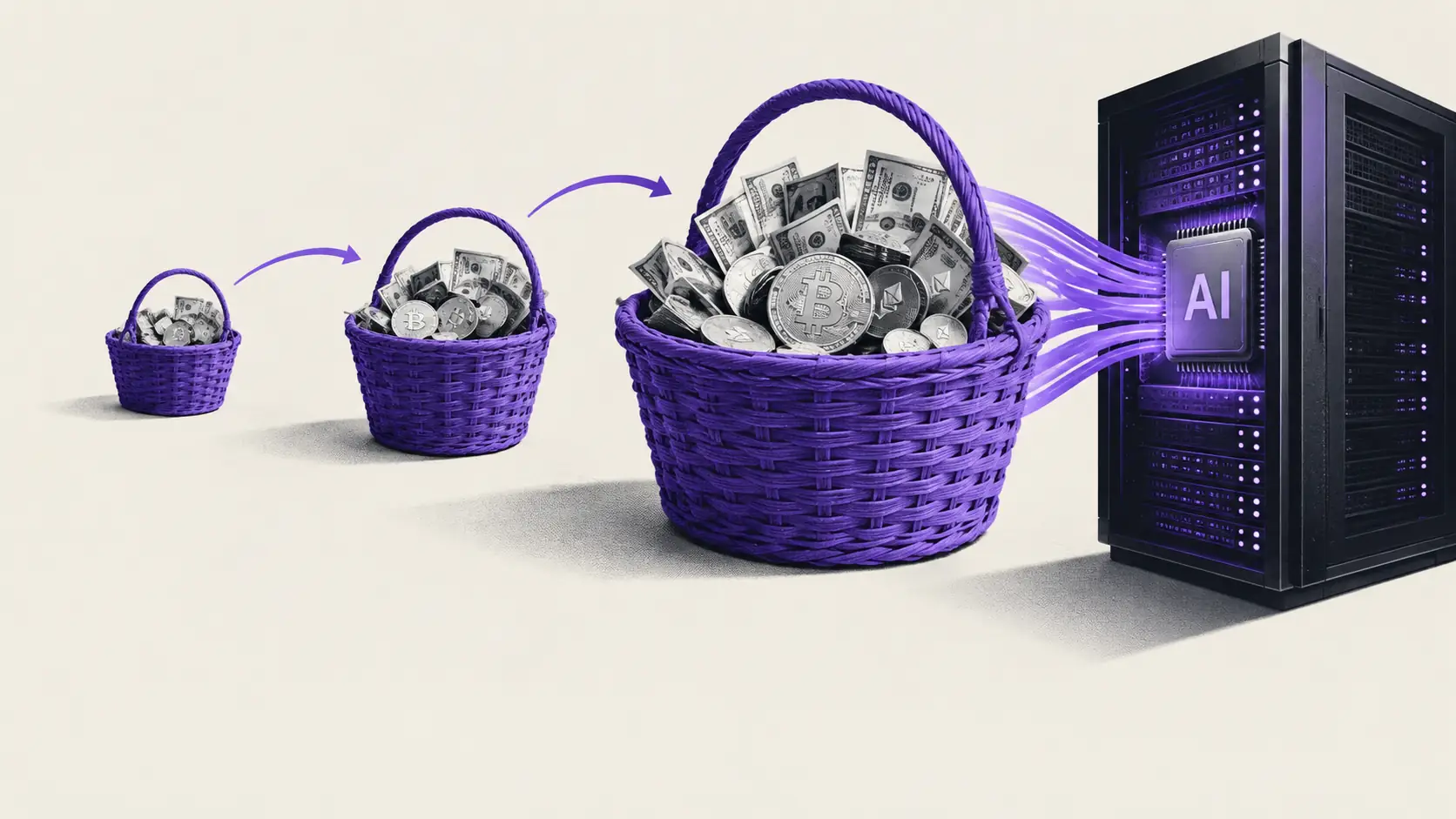


Blackstone's AI investments look straightforward on paper. On July 23, 2026, the group revealed that nine of its ten best-performing investments are tied to artificial intelligence, and its assets under management have reached $1.35 trillion, according to Blackstone's official Q2 2026 earnings release.
Capital has chosen the physical side of AI: land, power, data centers, cooling systems, and fiber networks. This mirrors the broader shift analyzed in our deep-dive on capex flowing into compute infrastructure.
Blackstone beat distributable earnings expectations and monetized $31.8 billion in assets during the quarter, per the official Q2 2026 press release. Then one statistic reframes the entire picture: only 14% of Americans surveyed in June 2026 said they would accept a technology data center in their community. The constraint isn't demand. It's the right to build.
AI Has Become a Real Estate Strategy
Blackstone isn't betting on models alone. It's buying and financing the buildings where those models are trained and run. QTS, acquired in 2021 for roughly $10 billion, has become a cornerstone of this approach. According to Blackstone's management on the Q2 earnings call, the platform could double in size within two years.
This is the part that public narratives consistently miss. AI looks like software, but it scales like heavy industry: it consumes land, transformers, water, turbines, and network connectivity. Every GPU cluster needs a physical home, a grid connection, and a community willing to host it.
$BX Announces Q2 2026 Results: https://t.co/wNEkfN1DyE
— Blackstone (@blackstone) July 23, 2026
Capital Follows AI, Not Without Friction
The corporate post on X celebrates growth and results. That's expected. But the financial structure also reveals a less comfortable tension beneath the surface.
Quarterly inflows into Blackstone's private credit fund BCRED dropped from $3.7 billion in Q2 2025 to $1.9 billion in Q1 2026, then to roughly $1.0 billion in the quarter just closed, according to Blackstone's own reported company data.
BCRED Fund Quarterly Inflows
Source: Blackstone company-reported data for Q2 2025, Q1 2026 and Q2 2026
This isn't a Blackstone crisis. It's a signal worth reading carefully: enthusiasm for AI infrastructure coexists with more selective fundraising in private credit, and investors are less willing to treat every vehicle as a liquid bond substitute.
The Power Grid Is Only Half the Problem
So far, the bottleneck has been framed in terms of megawatts. That constraint is real, as our analysis of energy and AI data center capacity shows in detail.
But even when electricity exists, a community can block the project outright. QTS canceled a data center initiative in Virginia following local opposition and litigation. The power was there, though the political consent wasn't.
Blackstone's management has responded by emphasizing union-rate employment, workforce training, waterless cooling systems, and new energy capacity contributions. These are concrete commitments. They're also an implicit admission that the old playbook (build first, explain later) no longer holds in 2026.
Three Scenarios for AI Capital
- Orderly expansion: data centers, grids, and new power generation grow in sync. Timelines stay predictable, and returns depend primarily on execution quality.
- Local slowdown: permitting delays and community opposition push projects toward areas with stronger political support, available energy, and tax incentives. Already-permitted sites appreciate sharply in value.
- Selective overcapacity: demand remains strong overall, but specific campuses are built in the wrong location or with energy costs that make economics unworkable.
The second scenario is the most underappreciated. If the political constraint tightens further, a site with grid access, permits, and community consent could be worth more than the structure built on top of it.
What Actually Changes
Bitcoin miners have already sensed this shift. Some are converting sites and power contracts toward AI hosting, as the comparison between miners and data center operators illustrates.
The transition can generate very strong revaluations, but it doesn't eliminate industrial risk. Contracts, grid connection timelines, customer concentration, and required capital remain decisive, even in projects backed by AI hosting-linked financing.
The complete financial report is available in the SEC filing. The international earnings presentation can be watched in the Blackstone Q2 2026 results video.
The competitive advantage won't come from owning more buildings. It will come from owning sites that can receive power, clear permits, and convince the people living nearby to let them operate. Watch QTS's Virginia pipeline and Blackstone's BCRED inflow trend in Q3 2026 as the two clearest early signals of which scenario takes hold.