


In the same week Michael Saylor sold $216 million worth of Bitcoin, Tom Lee spent $74 million buying Ethereum. While the world watched Strategy reverse course, Lee was quietly building the largest Ethereum treasury on the planet.
The corporate treasury era isn't ending with Strategy's sale. It's changing assets, and the reason is more interesting than a simple rotation.
TL;DR: Bitmine, led by Tom Lee, holds 5.74 million ETH (4.8% of all Ethereum supply), targeting 5% by 2026. Unlike Strategy's static Bitcoin stack, 85% of Bitmine's ETH is staked, generating over $210 million per year in rewards according to company estimates.
What Happened
Bitmine Immersion, listed on the NYSE as BMNR and led by Tom Lee, the Peter Thiel-backed founder of Fundstrat, holds over 5.74 million ETH, roughly 4.8% of Ethereum's entire circulating supply. The stated goal, which Lee callsthe 5% alchemy,is to control one-twentieth of the entire network by 2026. Total holdings across crypto and cash approach $11 billion, per the company's press release on PR Newswire.
It's the largest public Ethereum treasury in the world, second only to Strategy among all crypto treasuries. The contrast of the week couldn't be sharper: on one side, Strategy sells Bitcoin to pay dividends; on the other, Bitmine buys Ethereum on dips. Bitmine isn't alone: SharpLink, led by Ethereum co-founder Joseph Lubin, is also accumulating.
One Step Away from 5% of All Ethereum
Ethereum held by Bitmine vs. the 5% supply target. Source: Bitmine, July 2026
Why It Matters: A Treasury That Works
The difference from Strategy isn't the coin. It's the fact that Ethereum works. About 85% of Bitmine's ETH, close to 4.9 million tokens, is staked, meaning locked to secure the network in exchange for rewards. Those rewards are worth, according to company estimates, over $210 million per year.
 Bitmine Immersion Technologies, Inc.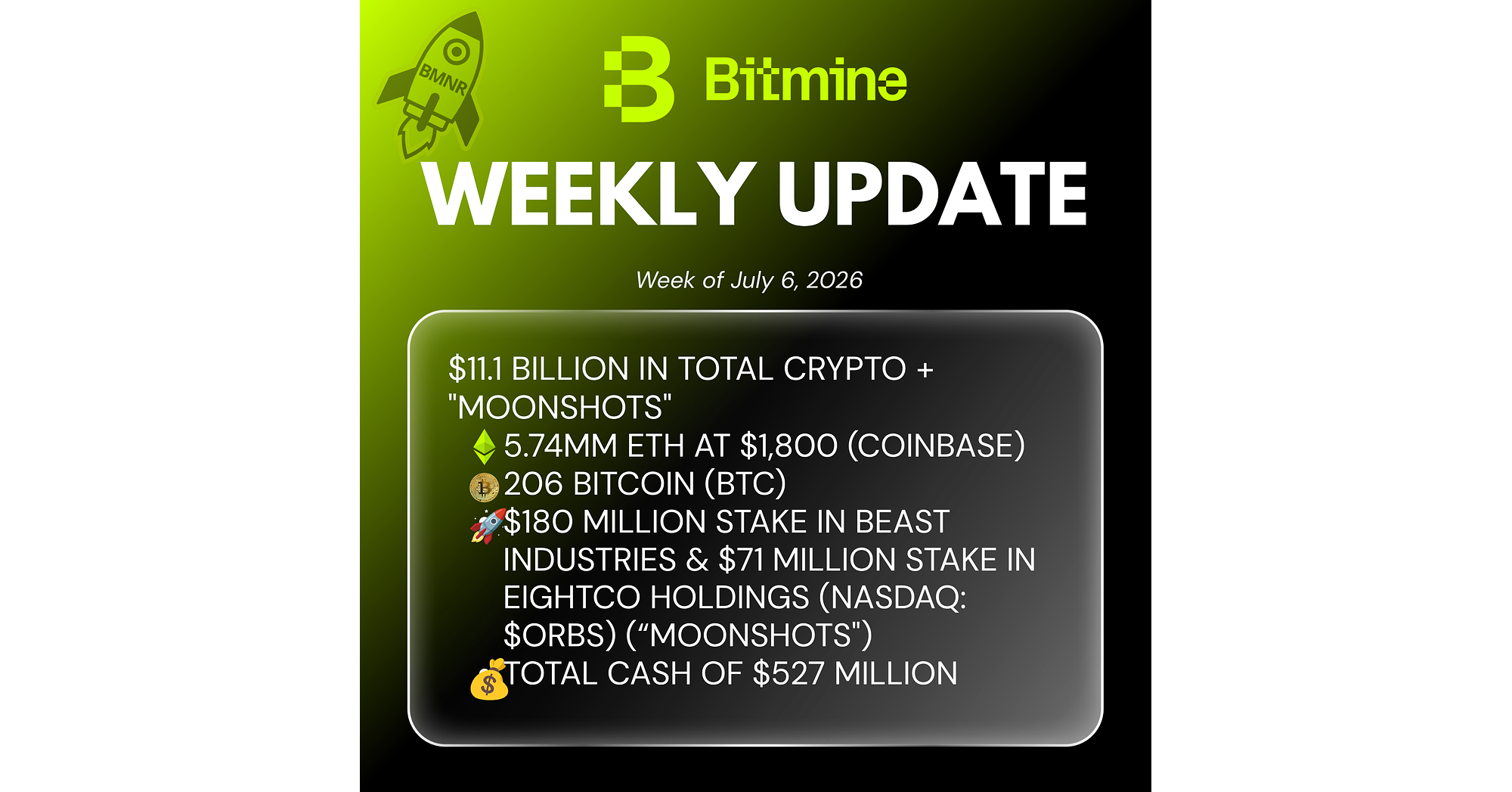
The math changes entirely. Strategy's Bitcoin sits idle and generates nothing, forcing the company to issue shares or sell holdings to raise cash. Bitmine's Ethereum, by contrast, generates a yield that partly finances the purchase of more Ethereum. The treasury feeds itself. This is precisely why Bitmine and SharpLink have become two of the largest funders of Ethereum research: whoever holds the productive asset has the resources to support the ecosystem.
The Downside: Same Flywheel, New Risks
Don't mistake evolution for safety. This is the same machine that put Strategy under pressure: the stock premium over net asset value works on the way up and reverses on the way down, and when that premium evaporates the model seizes up. Ethereum adds its own layer of risks, from staking penalties and lock-up periods to smart-contract vulnerabilities.
There's also a concentration problem worth taking seriously. A single company controlling 5% of a network reduces its liquidity and concentrates its governance, because that same entity votes, stakes, and funds research. One telling divergence deserves mention: while treasuries were buying, Ethereum ETFs recorded seven consecutive weeks of outflows. Through one door, institutions sell what treasuries are buying through another. One side is wrong.
The Bigger Picture
The real story of 2026 isn't Bitcoin versus Ethereum. It's which corporate structure survives the cycle: the holder of an inert asset, forced to sell, or the holder of a productive one, collecting a coupon. Lee is betting that a treasury with a yield is a better business than one that merely custodies.
It's a smarter design, at least until a deep drawdown tests whether staking rewards can outpace the collapse of the premium. The treasury model is maturing, from a Bitcoin monument to an Ethereum engine. Whether that engine holds under stress, the next bear market will decide. The underlying data remains verifiable through filings at the SEC and the official Ethereum Foundation documentation.