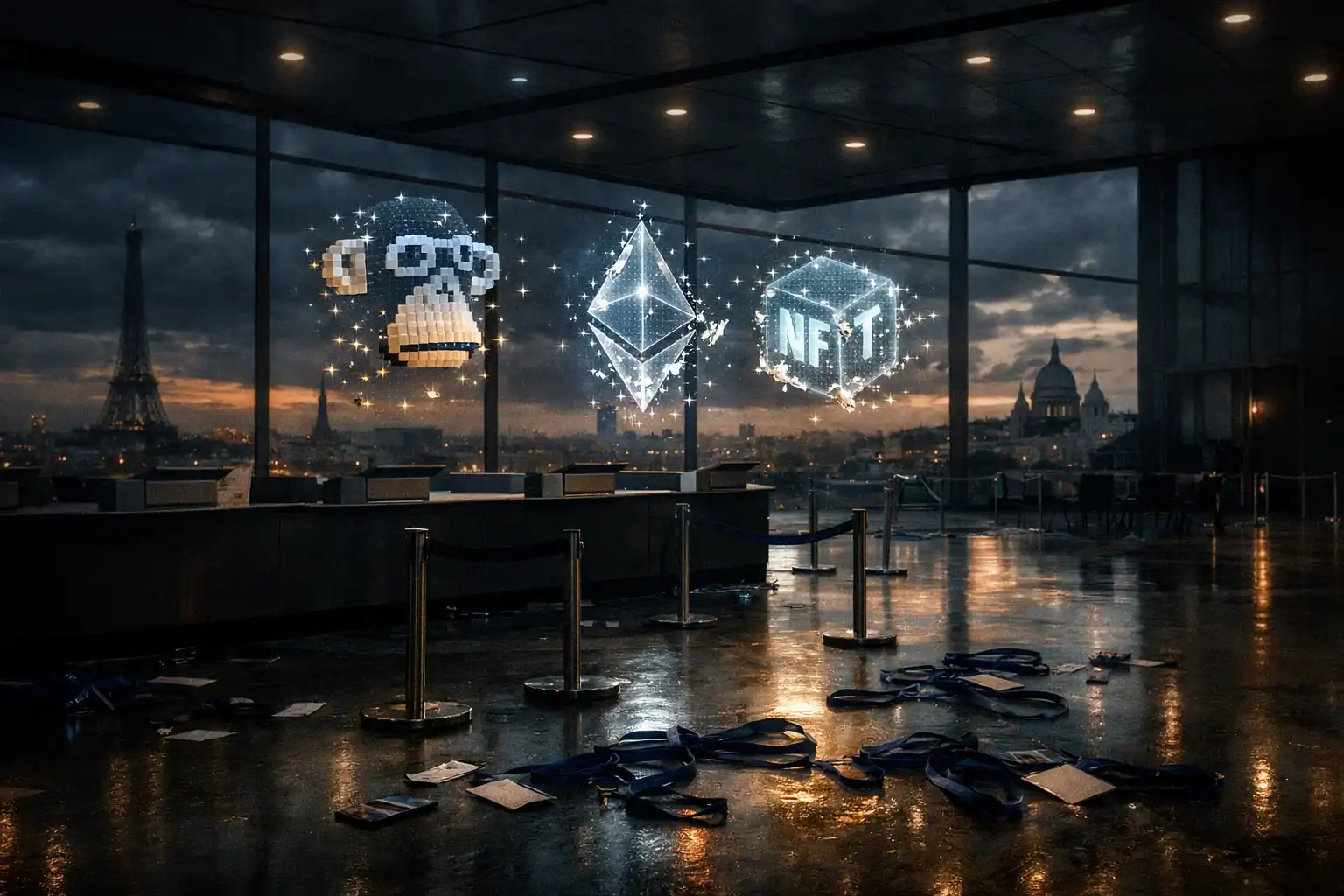

It should have been the event circled in red on every Web3 enthusiast's calendar. Flights booked, hotels confirmed as 'business expenses' and that secret hope that the event could rekindle optimism in a tired market. Instead, with a month of anticipation, NFT Paris and RWA Paris 2026 have pulled the plug.
A surrender without concessions
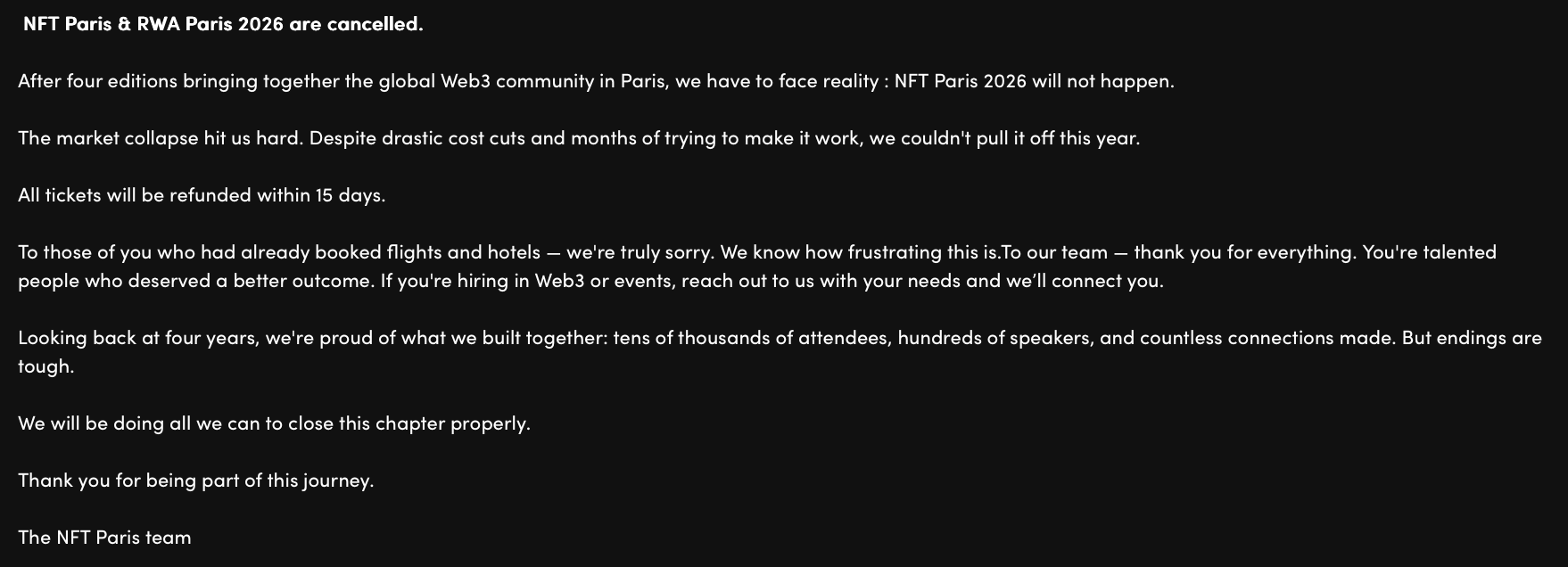
The official statement that appeared on the site is direct, almost exhausted. "The market slump has hit us hard," the organisers write. Despite 'drastic cost cuts' and months of trying to make ends meet, the organising machine has come to a standstill. The promise is to reimburse all tickets within 15 days, accompanied by a public apology for those who have already invested in non-refundable travel and accommodation.
The numbers, on the other hand, do not lie. The NFT market has never regained the cultural dominance of 2021. The end of 2025 was particularly bleak, with monthly sales plummeting. In an environment where sponsors are no longer looking for 'vibes' but for return on investment (ROI), an event of this magnitude has become an unsustainable financial risk.
The long shadow of the black chronicle
However, there is another reality stirring the crypto community in France, a reality that goes beyond price charts: the rise of kidnappings, home invasions and extortion linked to the possession of digital assets. While officially the reason for the cancellation is economic, for many, security has become the 'background radiation' that is changing the behaviour of an entire sector.
The real reason why NFT Paris was cancelled
— Arthemort (@Arthemort) January 11, 2026
- **January 1, 2025** : The father of a crypto influencer kidnapped and held hostage (Saint-Genis-Pouilly, Ain)
- **January 21, 2025** : David Balland, co-founder of Ledger, and his partner kidnapped and held hostage. Acts of…
The news of the last year in France is disturbing:
- 31 December 2024: A home invasion in Saint-Genis-Pouilly targets the parents of an influencer; the father is kidnapped and later found.
- January 21, 2025: Ledger co-founder David Balland is kidnapped near Vierzon with a cryptocurrency ransom demand.
- May 13, 2025: In Paris, a kidnapping attempt targets the pregnant daughter of Paymium CEO Pierre Noizat, foiled only by a whisker in the street.
These are not isolated cases. Between 2025 and early 2026, the police bulletin was filled with similar incidents in Normandy, Nantes, Essonne and Val-d'Oise. Attending a conference means wearing a name badge, posting photos in real time and meeting strangers: the exact opposite of the prudence required in this climate.
A divided sector
While NFT Paris closes its doors, Paris Blockchain Week (scheduled for April 2026) continues to sell tickets. This divergence signals a rift in the industry. On the one hand, NFTs, tied to retail culture and the sentiment of the moment; on the other, tokenization (RWA) and institutional adoption, protected by longer time horizons and stronger budgets. McKinsey estimates that tokenized financial assets could reach $2 trillion by 2030.
Conclusions
NFT Paris built something real, turning usernames into handshakes for four editions. Its end marks the closing of a chapter. If a weak market can kill an event quickly, a market that is afraid can change forever the very meaning of 'being there'.