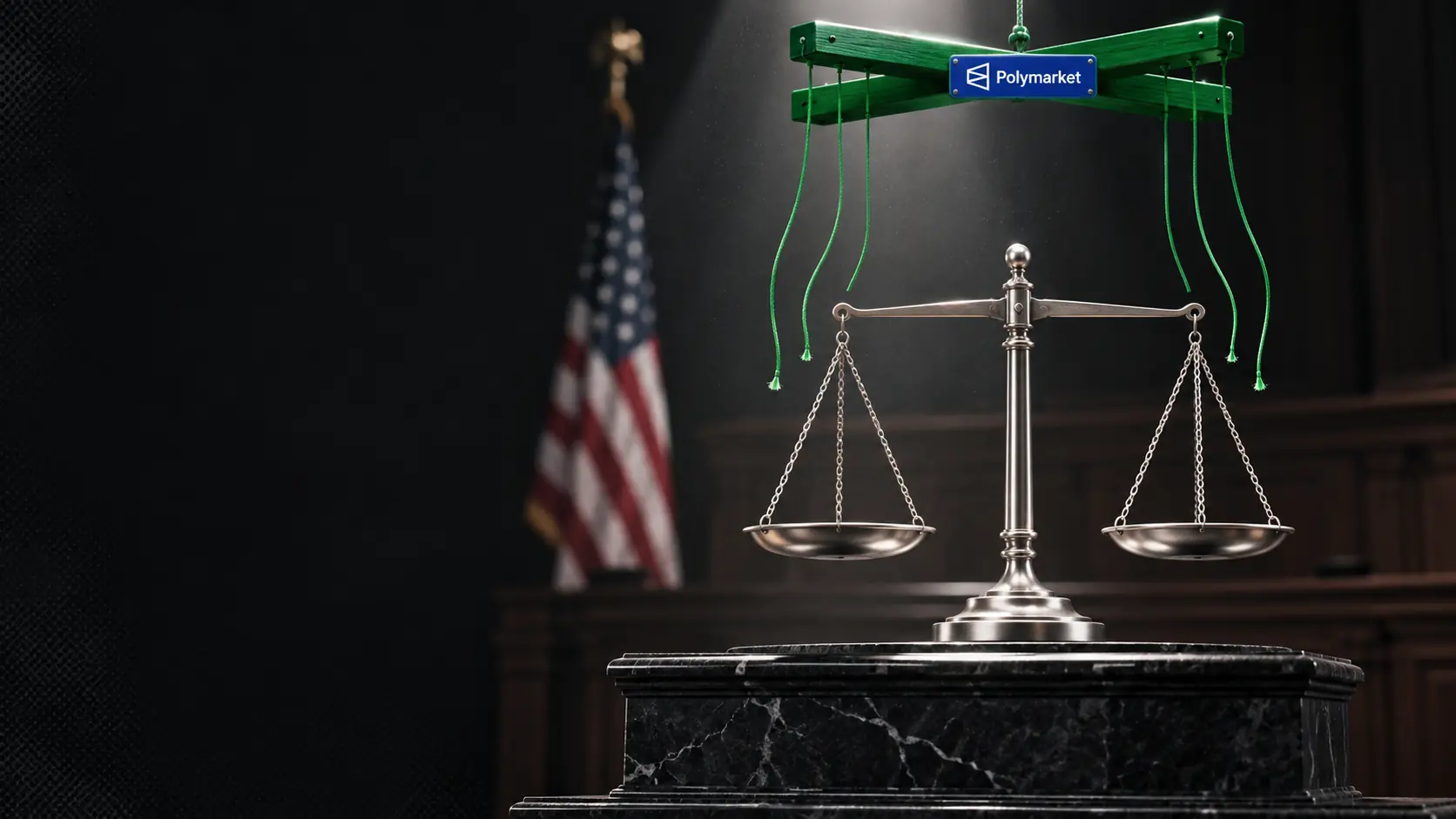


A U.S. Army soldier placed a $32,537 bet on Polymarket at 3 a.m. on January 3, 2026, wagering that Nicolás Maduro would be removed within a month. Hours after Trump's announcement on Truth Social, that bet paid out $436,000. Nobody denies he knew. The real question, the one keeping regulators up at night, is different: was knowing enough to make it a crime?
That question has no clean answer in American law. Not yet. And that gap is what makes the Polymarket case one of the most consequential legal tests crypto markets have ever faced.
TL;DR: A U.S. soldier was indicted on April 24, 2026 for using classified information to win $436,000 on Polymarket. The CFTC has opened a 45-day public consultation but has not yet defined where legal knowledge ends and illegal insider trading begins on crypto prediction markets.
A Law Written for a Different World
Functionally, the Commodity Exchange Act prohibits trading on material non-public information. The rule is clear on paper. In practice, that law was drafted for traditional financial markets: wheat futures, crude oil contracts, interest rate swaps. Not for a decentralized platform built on Polygon where anyone can bet on the outcome of a secret military operation using twenty dollars and an anonymous wallet created the week before.
The soldier was indicted on April 24, 2026 and pleaded not guilty. His case is the first attempt by American prosecutors to apply insider trading law to crypto prediction markets. The outcome is uncertain; the timeline, long. Meanwhile, the law exists but the boundary is undrawn. Where does “being well-informed” end and “using classified information for profit” begin? The answer shifts depending on who you ask: a federal judge, a regulator, a defense attorney, or Polymarket CEO Shayne Coplan, who sits on the CFTC’s Innovation Advisory Committee.
A subtler case involves Karoline Leavitt. On January 7, 2026, Polymarket users bet that her press conference would last fewer than 65 minutes. She wrapped up 30 seconds before the limit. The market paid out. But Leavitt never used classified information: she controlled the event itself. Is that insider trading, though market manipulation? Or simply someone deciding when to step down from the podium? No American law answers that question explicitly.
The Blockchain That Exposes but Cannot Convict
There is a technical paradox at the center of this story. Polymarket runs on Polygon: every bet is a public transaction, visible and traceable in real time by anyone with a browser. That transparency is precisely why the Maduro case was discovered so quickly. The suspicious wallet was there, on-chain, readable, with all its positions concentrated on Venezuela. No broker, no intermediary, no dark pool. The evidence was public and accessible to all.
A newly created Polymarket account invested over $30,000 yesterday in Maduro's exit. The US then took Maduro into custody overnight, and the trader profited $400,000 in less than 24 hours. Insider trading is not only allowed on prediction markets; it's encouraged. https://t.co/EtZyW1IWTa pic.twitter.com/MzsU9kOU73
— Joe Pompliano (@JoePompliano) January 3, 2026
Yet that same transparency did not automatically make the behavior illegal. On-chain data shows what happened, not why it happened. Chainalysis, integrated by Polymarket on April 30, 2026, can detect statistical anomalies in trading patterns before an event resolves. It identifies when a wallet opens an unusual position in the hours before a government announcement. It cannot tell whether that wallet belongs to someone with access to classified documents or to someone with a very sharp geopolitical read.
That distinction is not technical. It is legal. And the law has not resolved it.
The Four Grey Zones1. Being informed vs. holding classified documentsBeing well-informed is legal. Profiting from secret government documents is not. But who draws that line on decentralized prediction markets?2. Influencing vs. predictingCan someone who controls an event’s outcome bet on it? Leavitt decided when to end her press conference. She used no confidential information: she created the event itself.3. Derivative vs. wagerThe CFTC classifies event contracts as regulated swaps. New York, Arizona, Nevada, and Wisconsin classify them as illegal gambling. Same platform, two opposite legal categories.4. Anonymity vs. traceabilityPolymarket is fully public on-chain but allows anonymous accounts. The wallet is visible; the identity is not. Chainalysis can flag the pattern, not the person.SpazioCrypto analysis based on CFTC data, Warner Senate Office, Polymarket, May 2026
Wash trading, where a participant buys and sells the same contract using linked wallets to inflate volume artificially, is illegal in the United States but difficult to prove on a decentralized platform. Per analyst assessments reported by industry observers at The Block, it is a widespread practice on Polymarket. Nobody has ever been sanctioned for it on a crypto prediction market. The law has no operational answer here either.
For context on how the CFTC is reshaping its authority over digital assets more broadly, the joint SEC-CFTC classification of Bitcoin, Ethereum, and Solana on March 17, 2026 is worth reading: the same regulator now asserting jurisdiction over prediction markets has just redrawn the entire map of digital asset categories.
Can Prediction Markets Function Without Clear Rules?
It depends on what you want them to do. If their job is to aggregate dispersed information and produce accurate probabilities, then people who know more should bet more: that is exactly how the “wisdom of crowds” mechanism works. Polymarket claims 94% accuracy one month before events resolve. That precision does not come from the number of users; it comes from the quality of information those users bring to the market. Removing “too-informed” participants could make markets less accurate, not more fair.
If instead their purpose is to serve as accessible and transparent financial instruments for everyone, then someone entering with classified information breaks the level playing field. Same market, two incompatible logics. The CFTC has not yet chosen which one wins. Senator Warren has called for a fast decision. The CFTC responded by opening a 45-day public consultation from the Federal Register publication date, without taking a position.
A US Army soldier was charged with using classified information about the timing of the capture of then-Venezuelan President Nicolás Maduro to make more than $400,000 trading on Polymarket's prediction market, the Justice Department said. https://t.co/D2DAq3nFIN
, Bloomberg (@business) April 24, 2026
📷: XNY/Star… pic.twitter.com/xGWiXBI6GF
The U.S. Senate unanimously passed a resolution banning senators from betting on prediction markets. A resolution, not a law: no penalties, no enforcement mechanism. That too says something about where regulation stands right now.
The soldier’s case goes to trial before summer. The CFTC must formally respond to the March 30 letter signed by Senator Warren and 40 colleagues. Polymarket, meanwhile, has sought $400 million in funding at a $15 billion valuation while managing state-level lawsuits, federal investigations, and a newly activated on-chain surveillance system. The core question stays open: are prediction markets a tool for collective knowledge, or infrastructure that monetizes whoever already knows the answer? Depending on the case, they may be both. That is precisely why nobody has figured out how to regulate them yet.
Frequently asked questions
What happened in the Polymarket insider trading case?
On January 3, 2026 a US Army soldier bet $32,537 on Polymarket on the removal of Nicolás Maduro, collecting about $436,000 a few hours after Trump's announcement. Indicted on April 24, 2026, he pleaded not guilty: it is the first attempt by US justice to apply insider trading laws to crypto prediction markets.
Is Polymarket considered gambling?
It depends on the jurisdiction: for the CFTC, event contracts are regulated swaps, while US states such as New York, Arizona, Nevada and Wisconsin classify them as illegal gambling. In Italy, remote gaming is reserved for operators with an ADM license, which Polymarket does not hold.
Is insider trading banned on prediction markets?
The Commodity Exchange Act prohibits trading based on non-public information, but it was written for traditional financial markets, not for decentralized platforms on Polygon. The line between "being well informed" and using confidential information for profit has not yet been drawn: the trial of the American soldier will be the first test in court.