


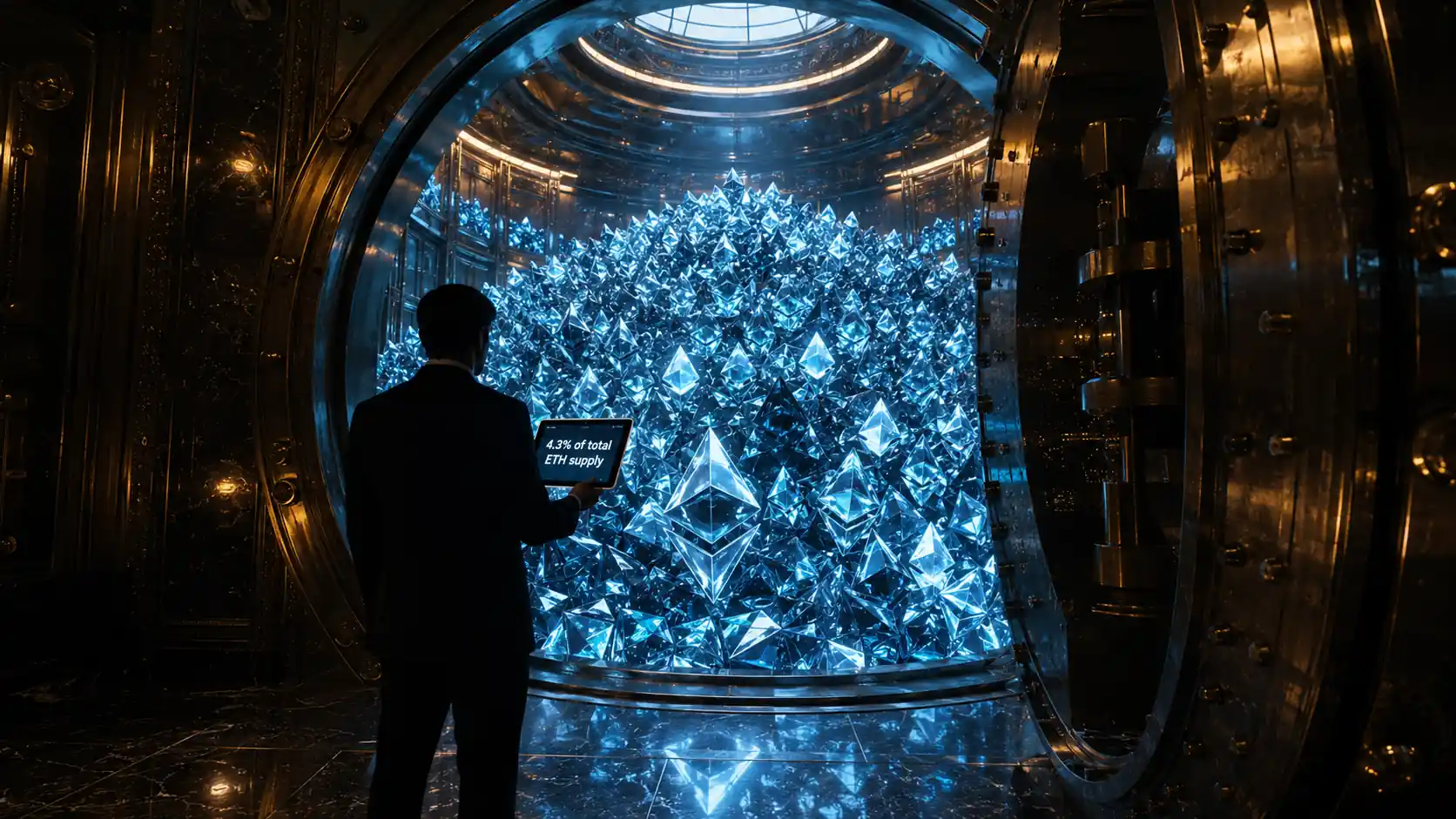
BitMine Immersion Technologies announced in May 2026 that it holds 5.21 million ETH, representing 4.3% of Ethereum's entire circulating supply, with an estimated value of $13.4 billion at current prices, according to BitMine's official communications. The company has no intention of stopping there.
Key Data
- ETH accumulated by BitMine (May 2026) 5.21 million ETH
- Share of total circulating supply 4.3%
- Estimated value at current prices $13.4 billion
- Stated target by end of 2026 5% of supply
- Layer 2 fee reduction post-Fusaka (PeerDAS) 40-60%
Source: BitMine Immersion Technologies / OANDA · May 2026
Source: BitMine Immersion Technologies / OANDA · May 2026
What Happens When One Company Holds 5% of All Ethereum?
Functionally, the answer depends entirely on how that ETH gets deployed. If it sits dormant in cold storage, the network impact is close to zero: Ethereum's proof-of-stake mechanism requires 32 ETH per validator, and an unengaged wallet plays no role in consensus. If BitMine moves that position into staking, the numbers are striking: roughly 162,813 potential validators, a concentration that would exceed Lido Finance's share before its forced decentralization in 2025.
The most likely outcome, given BitMine's corporate structure, is partial staking with hybrid custody: a portion held in cold storage as a balance-sheet reserve, the remainder staked through institutional operators such as Figment or Kiln. Official communications have not yet specified the operational strategy. What is already clear is the yield math: Ethereum staking returns roughly 3-4% annually, translating to approximately $402-536 million per year on BitMine's current holdings, per OANDA estimates.
The deeper story is the underlying asset itself. Since Fusaka went live in December 2025, the institutional privacy infrastructure built on Ethereum by Arc, Canton, and Tempo has attracted $1 billion in funding. BlackRock filed BSTBL, the first tokenized money market fund on ETH. Fidelity and State Street moved in the same month. Ethereum is no longer just the chain for retail DeFi. It has become the settlement layer for institutional capital. Holding 5% of that network is not a speculative trade. It's a structural position.
The Systemic Risk Nobody Is Naming
There is a conversation the industry hasn't confronted directly. If a single entity controls 5% of Ethereum's circulating supply, what happens during a liquidity crisis forcing a full liquidation? The FTX collapse involved roughly $5 billion in crypto on its balance sheet. $13.4 billion of ETH concentrated at a single corporate entity, per BitMine's own disclosures, is a different class of counterparty risk.
The more reasonable read, though, is that BitMine is not an exchange. It carries no customer liabilities, no leverage against third-party deposits. Any sale draws down the company's own capital. The market would absorb that pressure over weeks, not hours. It's not Celsius, though it's not FTX. The structural difference matters.
The comparison that holds up best is MicroStrategy on Bitcoin. That accumulation strategy drew identical criticism: concentration risk, liquidity fears, questions about forced-liquidation impact. Goldman Sachs subsequently filed an income ETF on Bitcoin built directly on MicroStrategy's positions. The market rewarded concentration rather than penalizing it. The RWA ecosystem growing on Ethereum, with over $12 billion in capitalization according to CoinGecko data, makes this bet more defensible over the long term.
The Clarity Act Connection and Why Timing Matters
The regulatory backdrop is not incidental. The Clarity Act currently moving through Congress classifies ETH as a “digital commodity” under CFTC jurisdiction, not a security under SEC oversight. That single classification makes large-scale corporate ETH accumulation legally straightforward, with no investment adviser registration required. BitMine's timing is not accidental.
The choice of Ethereum as the vehicle is equally deliberate. USDC processed $21.5 trillion in on-chain volume on Ethereum's network in Q1 2026, according to Circle's quarterly report. That is the infrastructure BitMine is buying into.
The next Ethereum upgrade after Fusaka is Glamsterdam, expected in the second half of 2026. PeerDAS already cut Layer 2 fees by 40-60%, per Ethereum Foundation technical documentation. Glamsterdam targets statelessness: lighter nodes, more distributed validation, further compressed costs. Fidelity Digital Assets filed for an ETH money market fund the same week BitMine announced its milestone. State Street's digital fund stack is already live.
The Ethereum Foundation published a manifesto in May 2026 stating that “the next billion Ethereum users won't be people with wallets, they'll be autonomous agents with API keys.” If that vision plays out, holding 5% of the network today may prove to be the simplest and hardest-to-replicate position of the next five years. That's the bet BitMine is making, and the market is watching closely.