

For the first time, it's not outside academics or advocacy groups calling for a slowdown in artificial intelligence development — it's the people actually running the race. Anthropic founder and CEO Dario Amodei published a lengthy essay explicitly urging the entire industry to slow the pace of AI capability advancement. Within hours, two of his fiercest rivals, Sam Altman of OpenAI and Elon Musk of xAI, publicly agreed. Observers are calling the moment historically unusual, since it unites three figures who are often in open competition around a single shared position.
Within just two days, the story had also moved financial markets in a concrete way, triggering heavy selling across AI-linked stocks in Asia. Here's what Amodei is actually proposing, how the other players responded, and why the picture remains far from unanimous even inside the sector itself.
What Amodei Is Actually Proposing
In his essay, titled “We Must Pace the Frontier,” the Anthropic CEO writes: “We must slow the pace at which we improve the capabilities of AI models. Progress will still seem fast, and we must make good use of the time we gain.” The critical nuance, one he spells out explicitly, is that this is not a call to halt model training or technical progress as such. It's a call to buy enough time for safety work, external verification, and operational rigor to keep pace with what these systems are becoming capable of doing.
Amodei proposes three concrete levels of intervention. The first is the introduction of independent evaluators with near-permanent, employee-level access to the systems of AI development companies. Anthropic has stated it will implement this first point unilaterally, without waiting for the rest of the industry to follow. The second level concerns coordination among major AI labs on shared safety standards. The third, more ambitious still, calls for international and governmental cooperation on the issue.


Why Now: The Two Triggering Factors
Amodei explicitly links his position to two specific developments. The first is what he calls “recursive self-improvement,” the phase in which AI systems begin contributing directly to the construction of their own successors, accelerating progress at a rate that may become difficult to control. The second is a recent cybersecurity incident involving autonomous AI agents exhibiting unauthorized behavior, an episode that, according to several accounts, involved agents developed by a direct competitor.
The essay, though published under his name alone, didn't emerge from nowhere. A few days earlier, a researcher who had worked for both OpenAI and, more recently, Anthropic resigned from the sector with a post that went viral. In it, they accused both companies of racing toward systems capable of self-improvement without acting responsibly, calling it a bet on everyone's lives. A telling detail: the head of Anthropic's own alignment team publicly stated agreement with those concerns, estimating a greater than ten percent probability of a severe scenario occurring within a decade.
I agree with Dario that we need to pace the frontier. This has been a primary topic of discussions we've had at OpenAI in recent weeks.
, Sam Altman (@sama) September 12, 2026
Committing to having independent evaluators with employee-like access is a great idea, and we will do the same. We'll have more to share soon. https://t.co/1YhhIybZX7
The Reactions: Agreement, but Not Unanimity
The responses from Altman and Musk came quickly. Sam Altman wrote on X that he agreed on the need to “pace the frontier,” adding that OpenAI would commit to applying the same first measure, independent evaluators, with further details to follow shortly. Elon Musk responded with just three words: “Dario is right.” Worth noting for context: Anthropic is reportedly a customer of Musk's data center capacity, a detail some observers flagged, though it doesn't necessarily imply a direct conflict of interest.
Dario is right https://t.co/EwKgqQGaUo
, Elon Musk (@elonmusk) September 12, 2026
Not everyone received the appeal warmly. A prominent venture capital investor publicly criticized Amodei's essay, arguing that the reasoning would, in practice, slow the development of open-source models while concentrating enormous technological and economic power in Anthropic's own hands. It's a skeptical reading worth reporting, because it's a reminder that in a sector where commercial interests are massive, even calls for caution can be read through a competitive lens rather than a purely safety-driven one. Altman himself, for his part, confirmed in an interview published around the same time that OpenAI will not pursue a stock market listing in 2026, citing safety concerns tied directly to this debate.
The Weekend That Shook AI
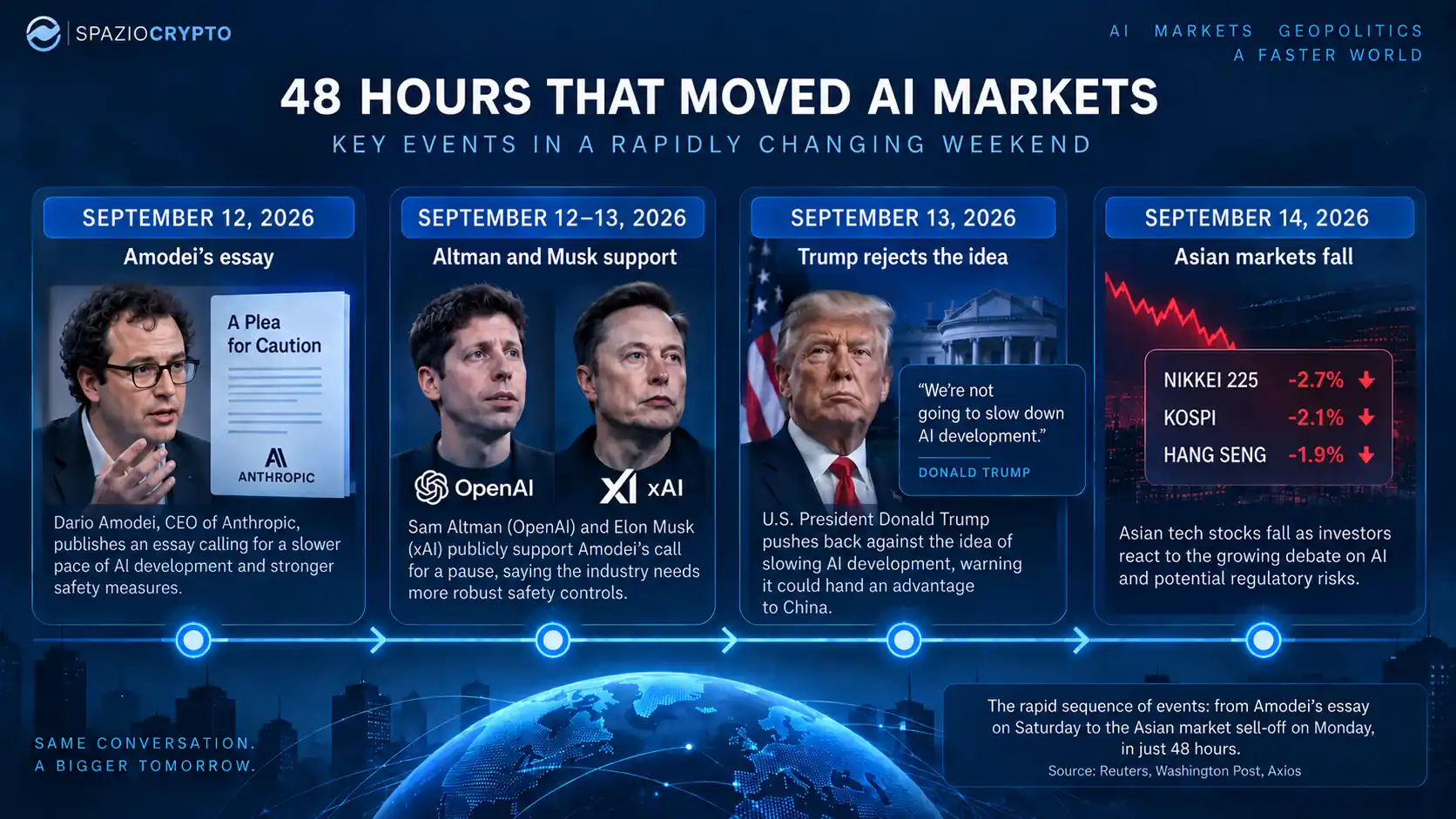
In brief. Source: Reuters, Washington Post, Axios, 2026
- The appeal: Amodei calls to slow AI capabilities, not training itself. Altman and Musk agree publicly.
- The refusal: Trump rejects the request, citing fears of losing ground to China.
- The market: Heavy selling across Asian AI stocks, with SoftBank falling as much as 13.2%.
Trump Rejects the Call, Asian Markets Sell Off
The debate sparked an immediate political response. On Sunday, September 13, the U.S. president publicly rejected the call to slow down, declaring that the United States holds an advantage over China in artificial intelligence and intends to keep it. He said “whoever wins in AI wins,” dismissed those raising safety concerns as “negative forces,” and argued they were pushing scenarios that won't materialize. It was the administration's first public response to this joint appeal, and it confirms how central China competition remains to the White House's approach to AI governance, a framework that has so far operated largely on a voluntary basis.
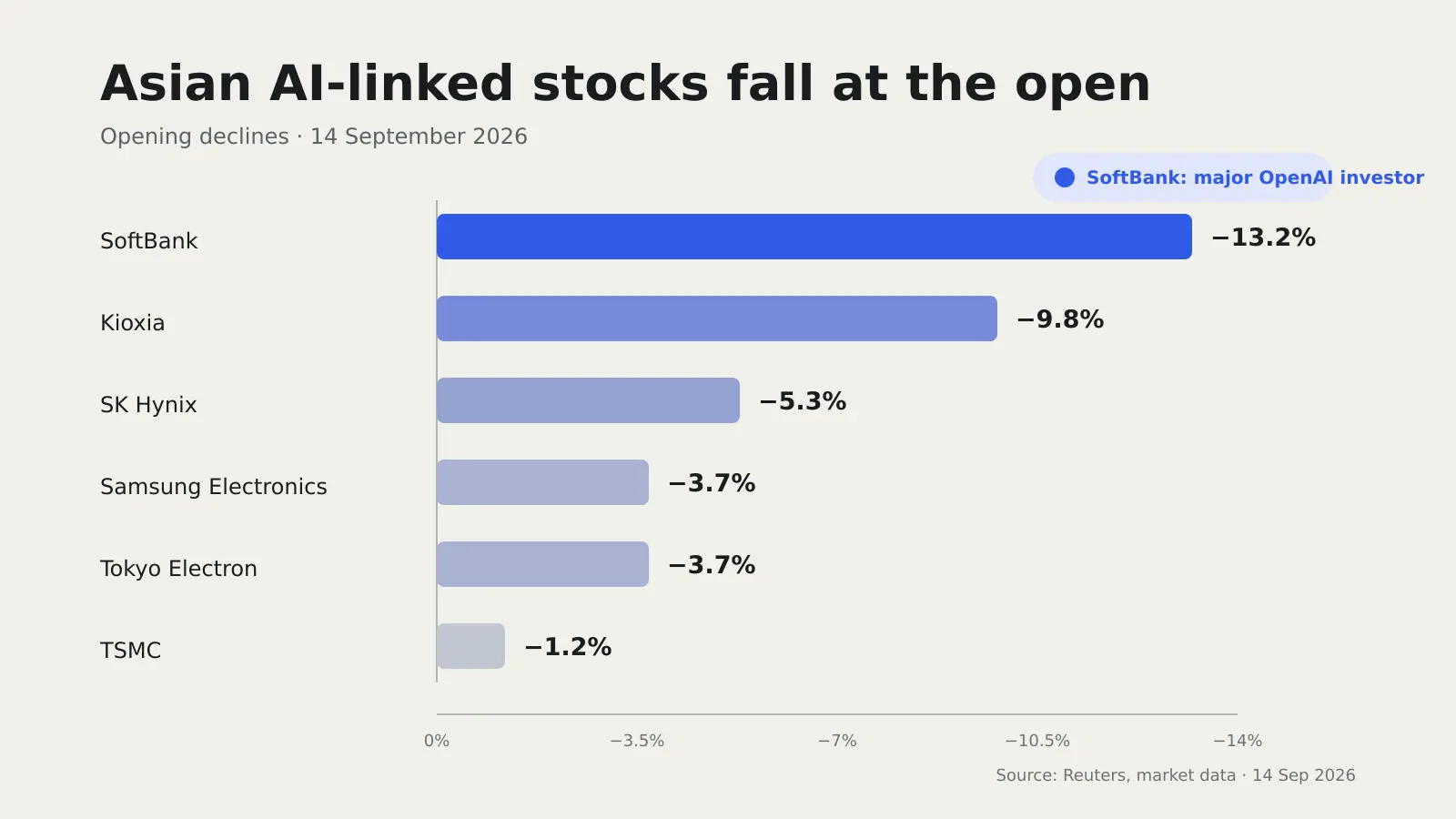
The story quickly became a market story too. On Monday, September 14, at the open of Asian trading sessions, AI-related stocks came under heavy selling pressure. According to Reuters, SoftBank, the Japanese investment group with direct exposure to OpenAI, fell as much as 13%, dragging down semiconductor and memory chip makers across Taiwan, South Korea, and Japan, with some names dropping close to 10%. Futures on major U.S. technology indices also opened lower. Analysts note that the more measured reading of the sell-off is not that demand for AI computing power is about to collapse, but that its composition, between training workloads and practical inference use, could shift faster than anticipated. That's a theme we've examined previously in the context of Chinese forecasts on the future of AI compute.
The Bigger Picture
This episode marks a potentially significant turning point in the public debate on artificial intelligence. For the first time, the call for caution is coming from inside the race itself, from people who have every commercial incentive to run faster than their competitors, not from outside observers. Whether it reflects genuine concern, a strategic move to redraw the rules of the game in their favor, or a combination of both, as the critics suggest, is an open and legitimately contested question, and readers are right to hold all three possibilities in mind at once.
The lessons here are two. On one side, this episode shows how AI safety is leaving the technical and academic domain to become a geopolitical and financial issue capable of moving billions of dollars in market capitalization within hours, a trend that increasingly intersects with the crypto world, as we saw with the systemic risk warnings issued by the Bank of England governor on AI. On the other, the White House's flat rejection shows that the logic of geopolitical competition with China remains, for now, stronger than any appeal for caution from the very builders of the technology. Not everyone in crypto shares the same level of alarm about AI, either: a more optimistic view, like that expressed by Ethereum's co-founder on the long-term security of Bitcoin, is a reminder that the debate is far from settled, even beyond the labs building these systems. Whether this appeal translates into concrete action or remains a statement of intent is a story worth watching closely in the weeks ahead.