

China is proposing a BRICS open-source AI zone to export its models, computing capacity, and technical standards to emerging economies, in a direct challenge to Western dominance of artificial intelligence infrastructure. At the BRICS summit in New Delhi, President Xi Jinping outlined a five-point initiative placing Beijing at the centre of a shared AI ecosystem for the bloc's eleven member states. The announcement arrived just one day after three of America's most prominent AI executives called publicly for a slowdown in AI development, making the timing anything but coincidental.
What's unfolding isn't simply a race between the United States and China to build the most powerful model. A second, quieter competition is now taking shape: the contest to win the technological loyalty of dozens of emerging nations that have yet to decide which digital infrastructure will underpin their economies. This is China's AI strategy for the Global South, and it deserves serious attention.
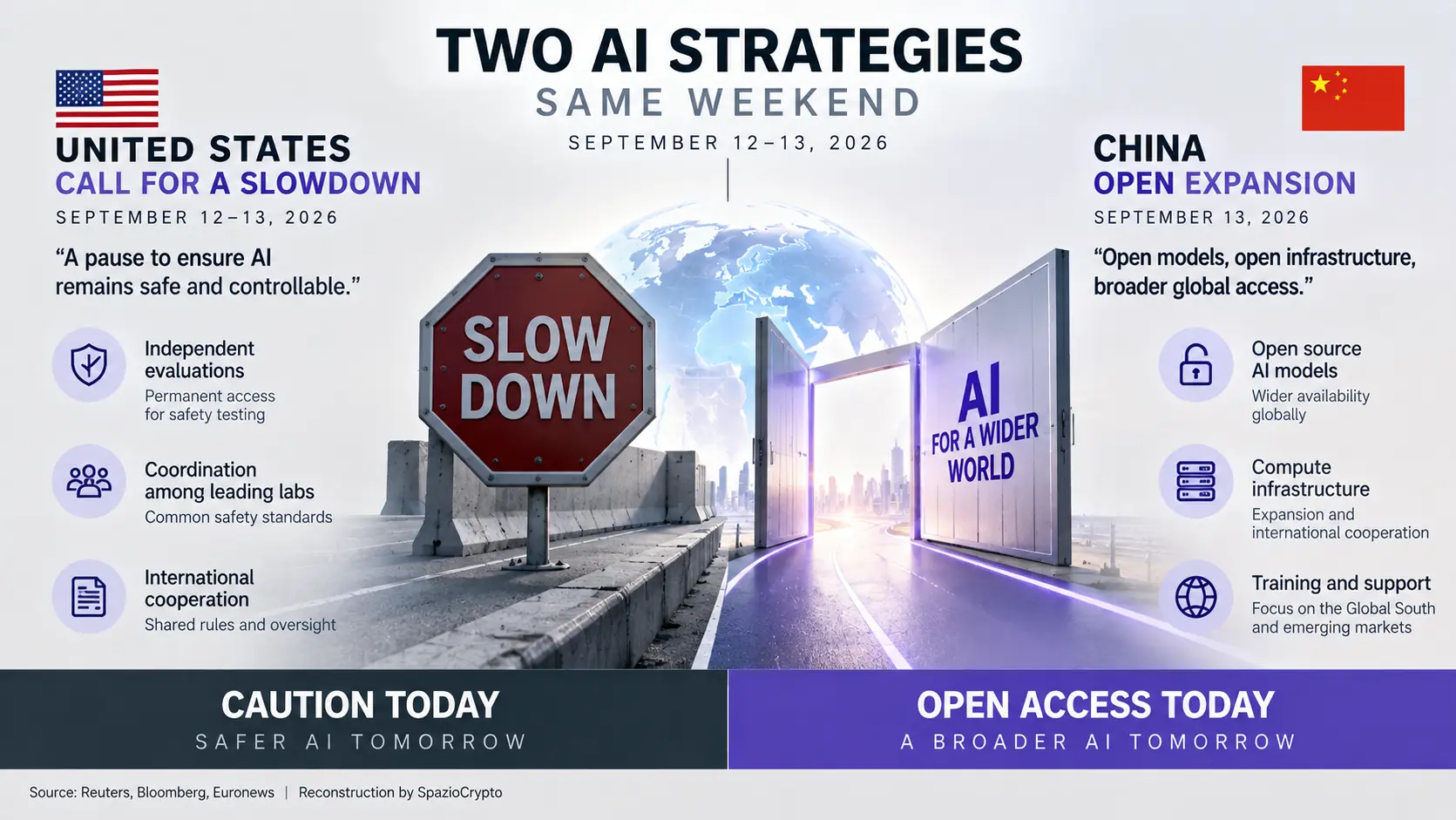
Two Strategies, One Weekend
The Chinese proposal landed just one day after a widely circulated essay by the CEO of one of America's leading AI companies called for slowing the pace of AI development, an appeal that two other Silicon Valley heavyweights quickly endorsed, including Anthropic's Dario Amodei, Sam Altman of OpenAI, and Elon Musk. While America's AI builders were publicly debating caution and shared rules, Xi Jinping walked into New Delhi with a proposal pointing in exactly the opposite direction: don't slow down. Accelerate, and share.
It's hard to read that sequence as anything other than two competing visions of AI's future, both surfacing in the same weekend. On one side, the architects of the most advanced AI systems in the world calling for guardrails. On the other, Beijing offering much of the developing world open, free access to advanced models, framing itself as a genuine alternative to a sector that, in its telling, risks remaining concentrated in the hands of a few companies and a few countries.
 Agencies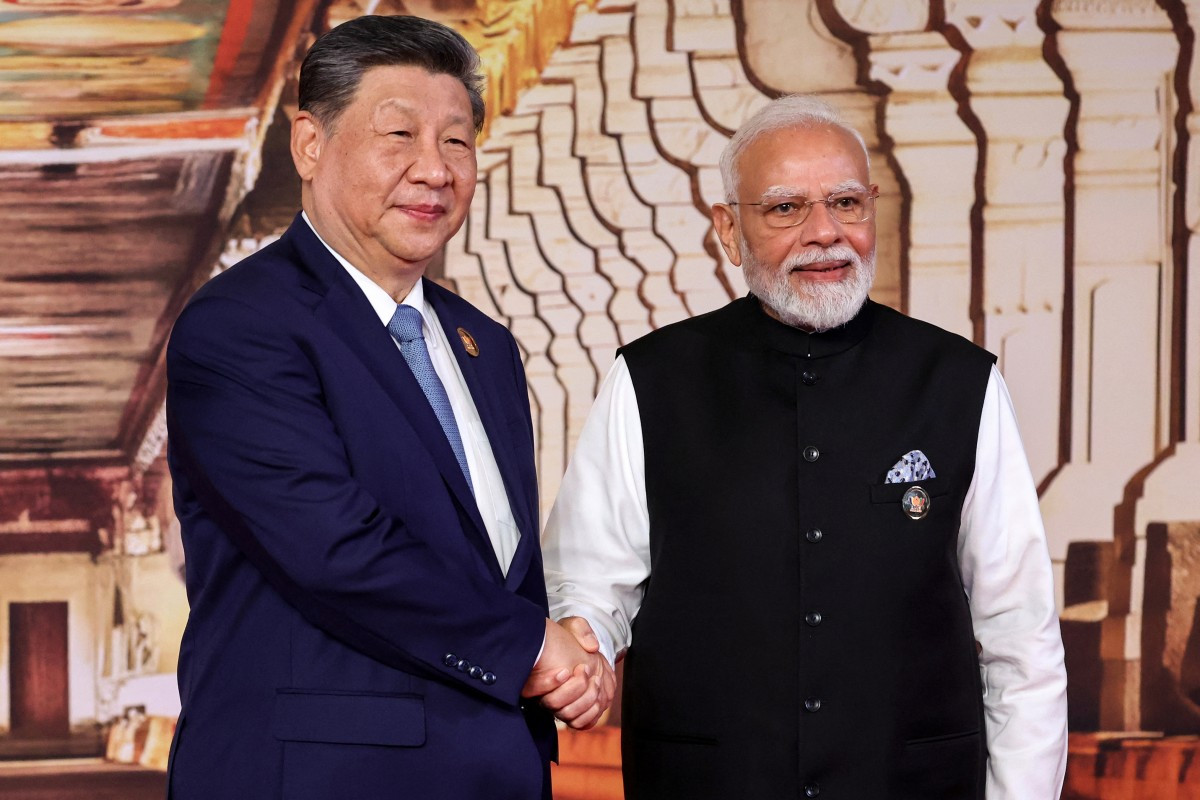
What the Chinese Proposal Actually Says
Xi's initiative has five components, according to reporting by CCTV, Xinhua, and Reuters. The centrepiece is the creation of what he called an “open-source zone for artificial intelligence” reserved for member states of the BRICS bloc. China has offered to lead its construction directly, promising to support cooperation on developing and applying large language models, and to organise specialised seminars and training courses for technicians and researchers from partner countries. The stated goal, in Xi's own words, is to build “an open ecosystem” that allows bloc members to cooperate on AI development rather than remaining dependent on technologies controlled by a small circle of companies and nations. The reference to American technological dominance was barely veiled.
Alongside the main proposal, Xi announced a special economic zone partnership among BRICS members and confirmed that China will host a dedicated services-trade forum next year. The BRICS group is no longer the compact original formation: it now counts eleven members, including Brazil, Russia, India, China, South Africa, Saudi Arabia, Iran, Indonesia, Ethiopia, Egypt, and the United Arab Emirates, collectively representing a substantial share of the world's population.
Xi's Proposal at a Glance
Key points. Source: CCTV, Xinhua, Reuters, 2026
- The core: a China-led open-source AI zone for all 11 BRICS member states.
- The stated goal: an open ecosystem, independent from a handful of companies and nations.
- The timing: announced one day after US AI leaders called for a slowdown.
Not an Isolated Move: A Long Game
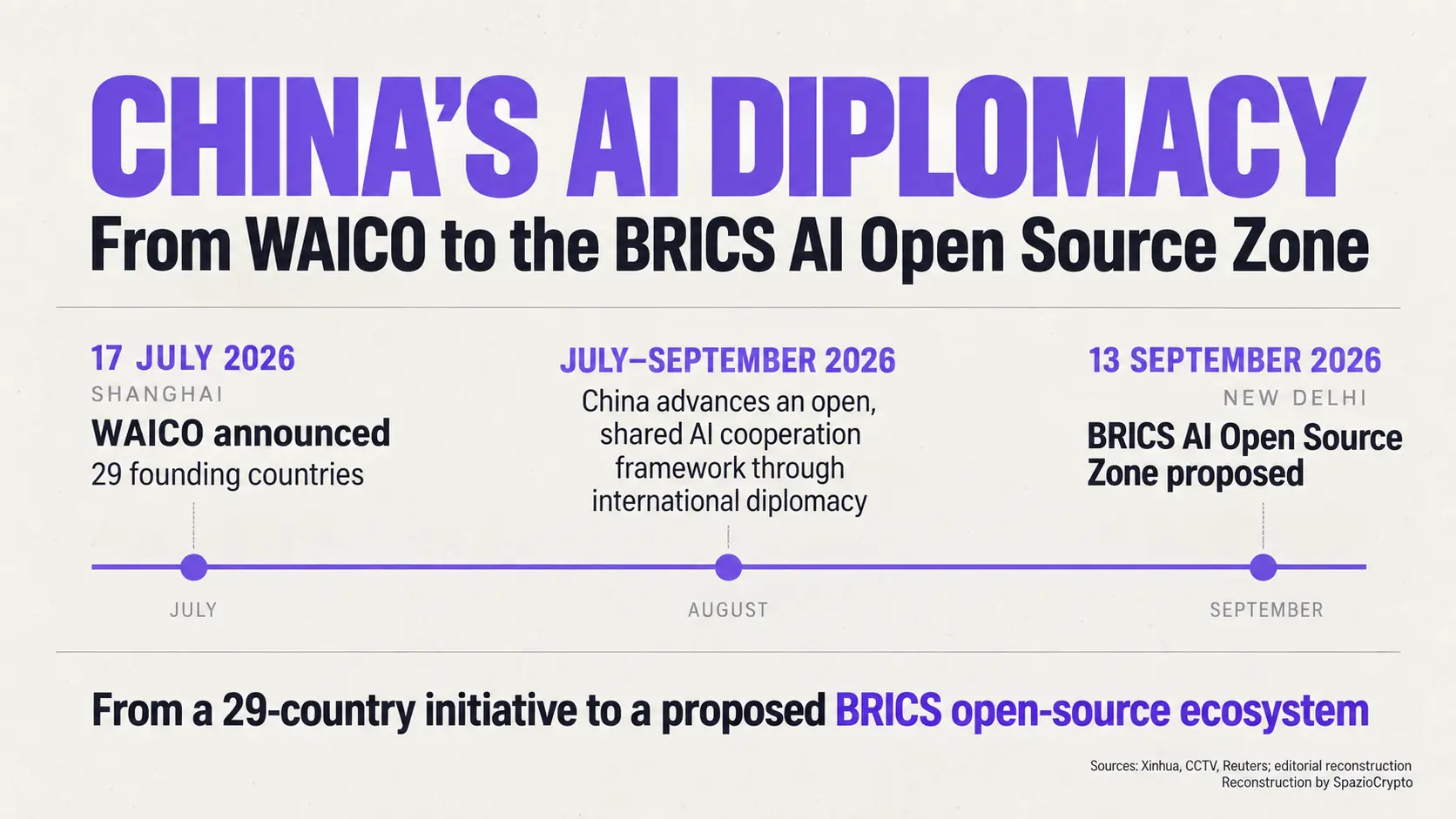
This proposal didn't appear from nowhere. It fits into a diplomatic sequence Beijing has been building for months. Just two months before the New Delhi summit, Xi Jinping announced in Shanghai the founding of a new international organisation dedicated to AI cooperation, backed by twenty-nine founding countries at a conference that drew more than fourteen hundred guests and one hundred forty thematic forums, according to Xinhua. The BRICS proposal is the latest piece of that larger strategy, positioning China as the default technology partner for emerging economies across Asia, Africa, the Middle East, and Latin America.
Open-source models developed by Chinese companies have already achieved considerable international reach, often wider than Western governments publicly acknowledge. Some of the most capable large language models produced by Chinese labs are today widely used across the Global South. This initiative aims to formalise and accelerate precisely that trend. The strategy also connects to a separate trajectory we've covered: China's domestic projections for explosive growth in AI inference compute demand by 2029. While Chinese infrastructure scales internally to support millions of operational AI agents, Beijing is simultaneously working to turn its models, computing capacity, and technical standards into instruments of international influence.
The Bigger Picture
What we're watching may mark the start of a genuinely new phase in the global AI competition. For years, the public debate focused almost entirely on the direct US-China contest to build the most powerful and advanced model. What's coming into focus now is a second dimension of that same contest, one that may prove equally consequential: the race to secure the technological adoption and loyalty of dozens of emerging nations that still need to choose which ecosystem will underpin their digital futures.
The lesson for observers is twofold. China's strategy of free models, technical training, and institutional cooperation represents a sharply different approach from the cautious, regulation-oriented posture taking shape in the United States, a posture that intersects with growing concerns about AI's systemic risks to financial stability, flagged publicly by the Governor of the Bank of England and the Financial Stability Board. At the same time, the real outcome of this ecosystem contest won't be decided in advanced research labs. It will be decided in the daily choices of developers, companies, and governments across dozens of countries who must determine, in the years ahead, on which technological foundations to build their digital economies. That's a quiet contest, but probably a decisive one, and it deserves the same attention we give to the headline race between the world's most powerful models.