

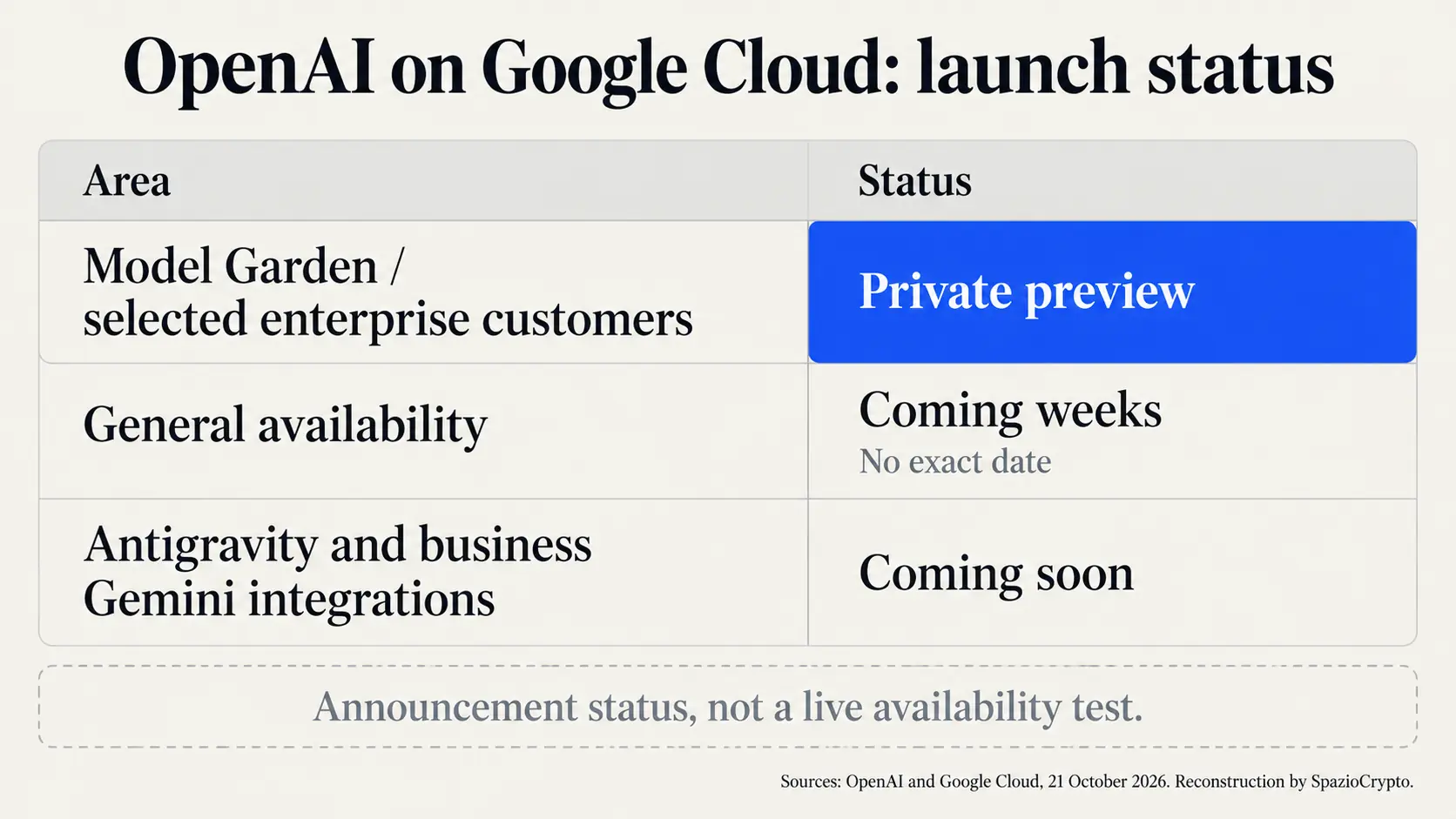
OpenAI and Google Cloud announced on October 21, 2026 a distribution agreement that places OpenAI models inside Model Garden. OpenAI on Google Cloud begins as a private preview restricted to selected enterprises: general availability is expected within weeks, with no precise date confirmed. For enterprise buyers, the practical change is the purchase path: access runs through the Marketplace and can draw on existing GCP committed spend.
Two Press Releases, Two Different Phases
OpenAI's announcement describes the path toward general availability. Google Cloud's version is more specific: the first group of customers can already access the preview. Neither statement describes an open launch. They separate a controlled rollout from the broader commercial phase that follows. That distinction matters for any team planning infrastructure migrations or committing to new features for enterprise users.
Google's Model Garden listing includes GPT-6 Astra, GPT-6.1 Sol, and GPT-6 Luna. These are catalog entries, not models being announced for the first time. Their capability descriptions come from the vendor and don't represent an independent performance comparison. The development fits within the broader trajectory of AI adoption in enterprise, but its real value will be measured by actual deployment patterns, not simply by new names appearing on a commercial page.
For a technical lead, the preview phase serves one purpose: evaluating compatibility, model behavior, and operational conditions. It doesn't replace a production decision. The preview has most value when it lets you test a model against a known set of tasks, using stable evaluation criteria you already trust. Without that grounding, a wider model catalog can mean more options to manage rather than better outcomes to deliver.
Marketplace Changes the Procurement Path
OpenAI states that enterprises will be able to purchase through Google Cloud Marketplace and apply existing GCP committed spend. Google adds consolidated cloud billing and inclusion in Flexible Savings Plans. The concrete change is the commercial channel itself: neither company has announced a unified model price or a guaranteed cost reduction for every customer.
The difference between a simpler purchase path and a cheaper service is worth keeping clear. An enterprise with pre-committed cloud budget may find it useful to direct that spend toward new workloads. That alone doesn't prove the final cost is lower than what another channel would offer. Reaching that conclusion requires applicable price lists, contract terms. Usage figures from your own workload, not an abstract vendor ranking.
 Michael Gerstenhaber
Our read: this agreement can reduce some of the organizational friction in adopting new AI capabilities, by placing the model closer to where a company already buys compute. It doesn't eliminate integration work. Response quality, error handling, usage limits, and accountability for who approves outputs all still need to be verified independently.
Codex Is in Scope, Other Integrations Follow Later
According to Google Cloud, admitted customers can connect local Codex CLI and Desktop workflows to the platform for inference. OpenAI's announcement includes Codex agentic workflows as part of the deal. Integrations with Google Antigravity and Gemini enterprise tools are described in both statements as forthcoming. They should not be presented as features currently available to all customers.
The separation between agent and model is a theme SpazioCrypto examined previously in its analysis of the Gemini enterprise agent. This deal extends that theme: the interface used to assign a task, the model that processes it, and the channel through which it's billed can sit at entirely different layers of a stack. Reading an offer correctly means identifying which component is actually included in your specific configuration.
Adding a model to a development environment doesn't automatically authorize every action an agent can take. Drafting a proposal, modifying a repository, and deploying an application carry different consequences. Any enterprise testing the new access should evaluate each of those steps separately, rather than treating a compatibility announcement as a blanket guarantee of reliable autonomy.
Data Guarantees Have Different Timelines
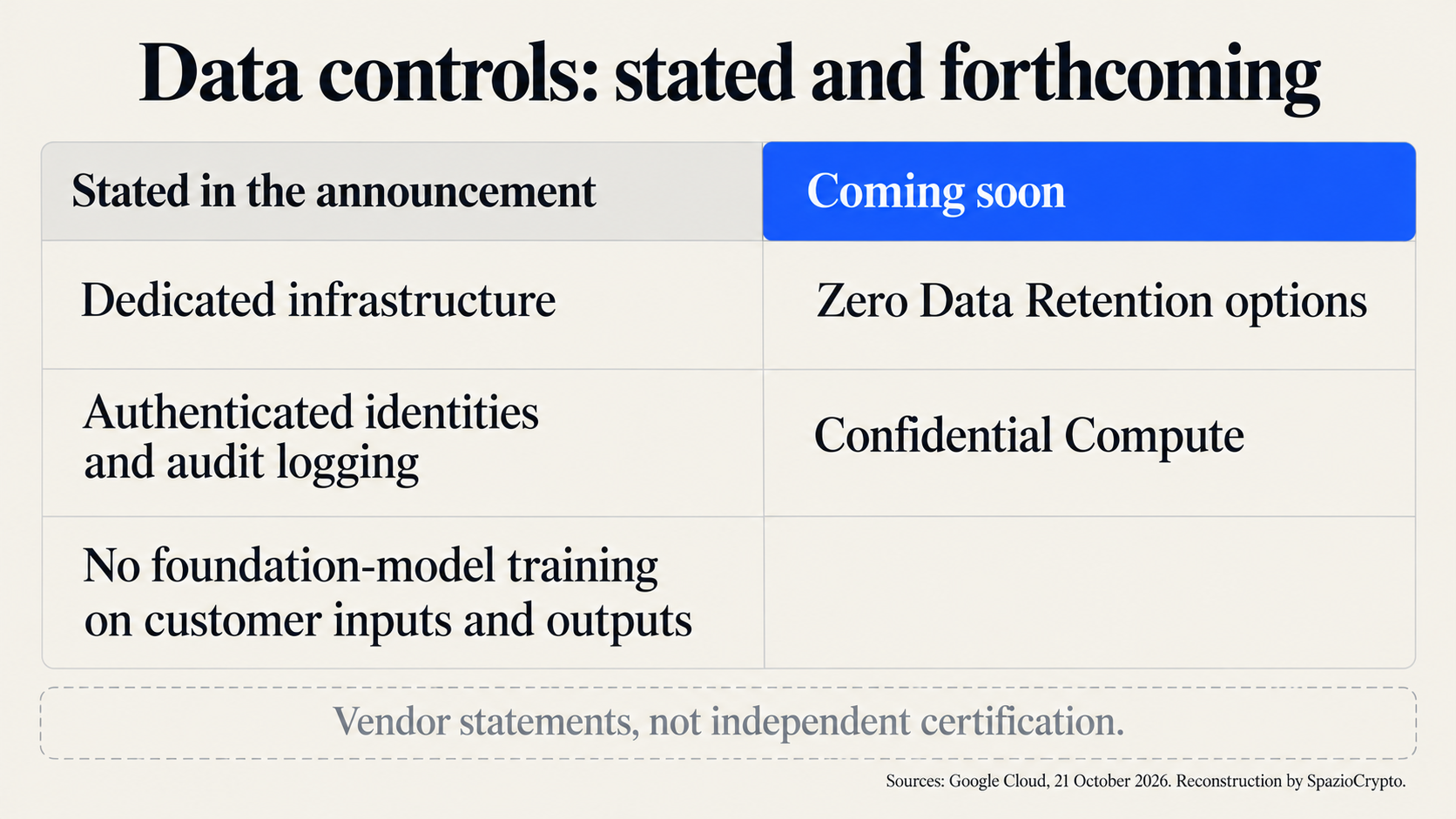
Google declares dedicated infrastructure, authenticated identities, audit logs, and data perimeter protections. Prompts, context, and outputs are stated not to be used for training base models. Zero Data Retention and Confidential Compute are listed separately as forthcoming options. That timing gap matters: the preview cannot be credited with properties that belong to a later stage of the product.

A single control feature is not the same as a compliance certification for the full application an enterprise builds on top of the service. The technical distinction is real: you need to examine how permissions are assigned, what data enters the pipeline, and what remains in logs. A vendor announcement describes what the provider offers; whether a specific project meets compliance requirements also depends on the choices made by whoever builds it.
For enterprises operating under EU data residency obligations, neither announcement publishes a list of enabled regions or provides a specific confirmation of local data access. There's no basis for promising European data residency from these announcements alone. The point to verify is the contractual boundary of the service actually offered to your organization, separate from the international launch messaging.
The Microsoft Relationship Stays in Place
OpenAI is explicit that Microsoft remains its primary cloud partner. The Google Cloud agreement is not framed as a replacement of that relationship. The promise of greater choice also needs to be read carefully: being able to select a different model doesn't mean an application can switch platforms without adaptation, validation, or cost.
The useful measure is portability of the actual workload. Prompts, connected tools, evaluations, and review procedures all need to keep working after any change. That's an operational consideration, not a result already measured in the preview. The deal's value will be easier to judge once customers have public pricing and comparable output data, rather than only the ability to register interest.
OpenAI on Google Cloud: Summary
- Confirmed: agreement announced October 21, 2026, private preview now active for selected customers.
- Not disclosed: general availability date, full pricing, and enabled regions.
- To watch: broader access and activation of integrations and data protections listed as forthcoming.
The Bigger Picture
Our read, stated as such: competition in enterprise AI is now partly fought on how easily companies can buy, govern, and slot a model into existing workflows. The top-performing model in a benchmark isn't automatically the easiest to adopt. Equally, a convenient commercial channel doesn't demonstrate superior quality. Those two assessments need to stay separate.
The concrete signals to watch are general availability, published pricing, supported regions, and documentation for the features announced today as forthcoming. Reproducible enterprise evaluations on real workloads will matter too. Until those elements are in place, what's verifiable is the launch of a new access channel with a selective initial perimeter.
Sources
Announcement and availability: OpenAI, October 21, 2026 and Google Cloud, October 21, 2026. Public communication: OpenAI LinkedIn post, accessed October 22.