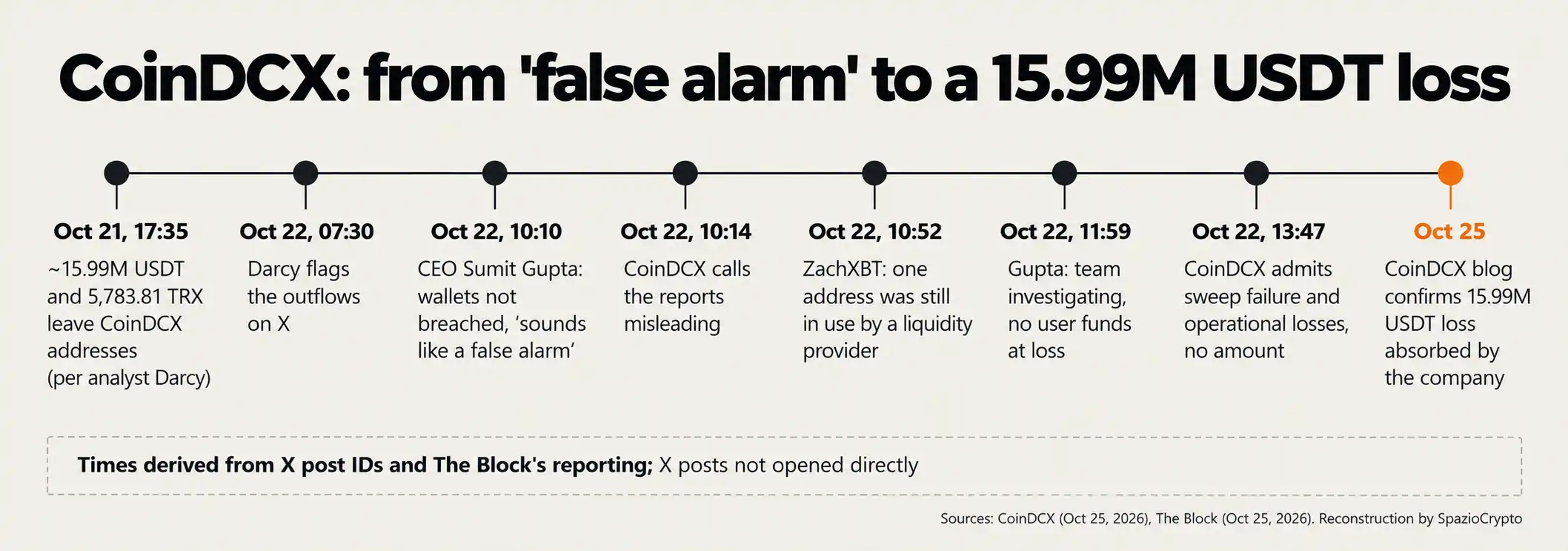


CoinDCX, one of India's largest crypto exchanges, confirmed on October 25, 2026, a loss of 15.99 million USDT from addresses it had decommissioned following the July 2025 attack. The figure matters less than the context: three days earlier, on October 22, founder and CEO Sumit Gupta had called initial reports a likely false alarm, and the official account had labeled them misleading. According to the company's statement, the loss was absorbed entirely by CoinDCX, and customer balances were not affected.
The following account is drawn from the full statement CoinDCX published on its blog and The Block's reporting of October 25. Posts on X by CoinDCX, Gupta, ZachXBT, and analyst Darcy were not directly accessible with our tools; they are cited here through The Block, which quotes and links them.
Further update on the TQKJQ wallet On-Chain activity.
— CoinDCX (@CoinDCX) October 22, 2026
Following the July 2025 security incident, we advised users not to deposit crypto to the compromised wallet addresses. These addresses were generated earlier in 2025, were compromised during the incident, and have since been…
CoinDCX deposit address TQKJQ was in use by a LP for 10 months after your July 2025 incident and swept user deposits + received gas as recent as April & May 2026 to your current public hot wallet.
, ZachXBT (@zachxbt) October 22, 2026
Meaning $15.8M in user deposits was unaccounted for by your team.
Why are Indian… pic.twitter.com/S8WYtGNIjz
What Happened Between October 21 and 22?
According to the company's statement, CoinDCX detected unusual activity in its systems on October 21, and internal controls moved to protect active wallets and trading engines. The following day, on-chain data and community alerts flagged an irregular movement of funds. As reported by The Block, the first public disclosure came from Darcy, co-founder of the asset recovery service FlashRescue: approximately 15.99 million USDT and 5,783.81 TRX had left CoinDCX's hot wallet and several deposit addresses at 11:35 a.m. New York time on October 21.
All of the funds, per Darcy's reconstruction, converged on a single Tron network address. The largest single transfer was 15,819,002 USDT; from there, the amounts were split and sent to deposit addresses on Binance, OKX, and Gate. For readers less familiar with USDT, the Tether stablecoin pegged to the US dollar, our guide to stablecoins and how they work explains why these tokens circulate predominantly on fast, low-cost networks like Tron.