

While Western debate on artificial intelligence still centers on building ever-larger, more powerful models, a Chinese research report suggests the sector is about to enter an entirely different phase. According to the research institute affiliated with China's primary state-owned telecommunications operator, the country's AI industry is shifting away from competing on model size and training capacity, toward the large-scale deployment of AI “agents”: systems capable of completing tasks autonomously. This shift fundamentally reshapes compute demand for inference in China, and its implications extend well beyond the country's borders.
The report's headline projection deserves careful reading alongside appropriate skepticism: it is a forecast, not an established fact. Still, understanding why it matters is worthwhile. Below, we break down what the study actually projects and why this story connects directly to recent developments in the global race to build AI infrastructure.
What the Report Projects
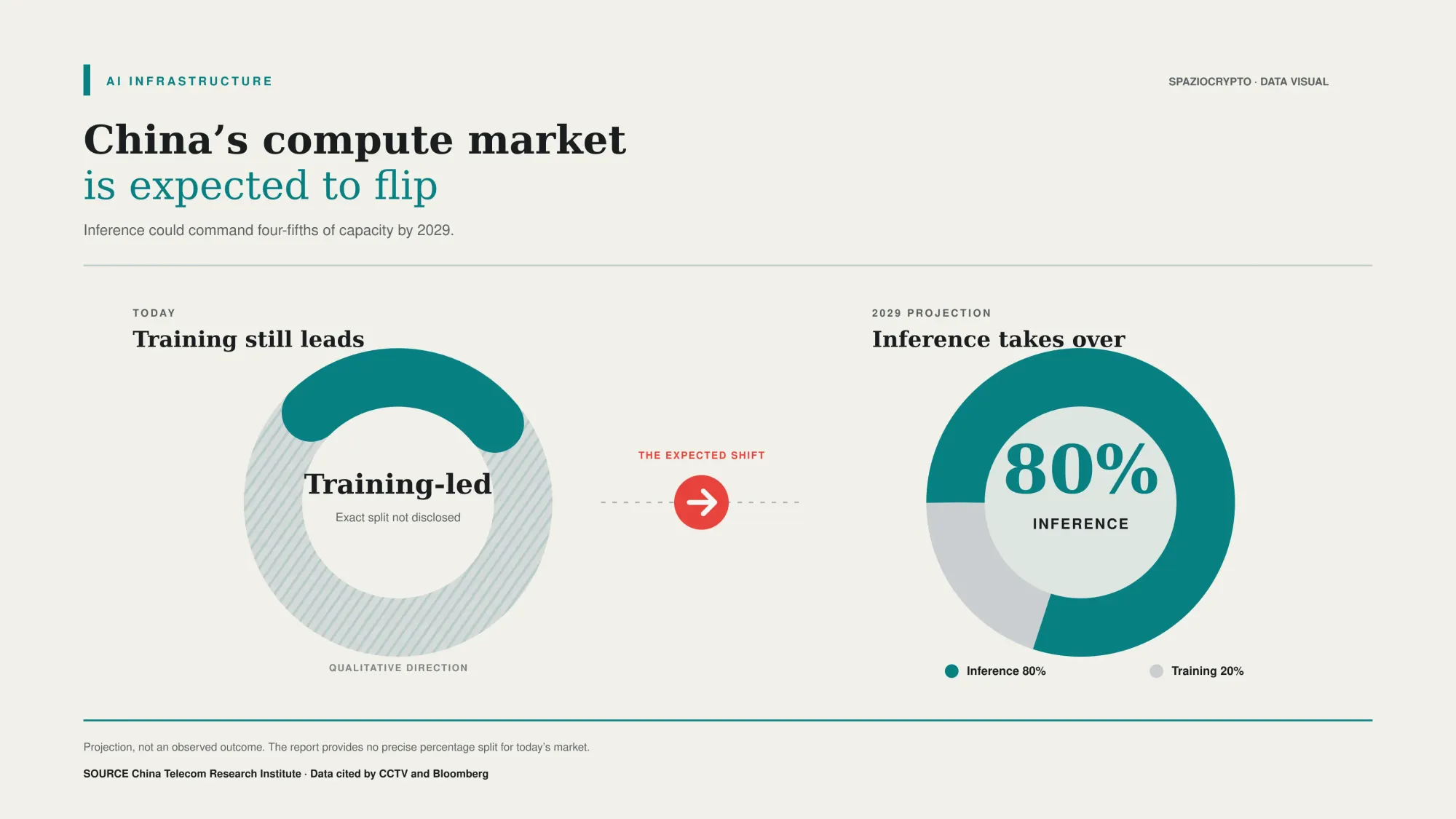
According to the China Telecom Research Institute, as reported first by Chinese state broadcaster CCTV and later picked up by Bloomberg, demand from AI agents could drive China's total computational requirements up by nearly tenfold within two to three years. The more striking figure, though, concerns the composition of that demand. Per the forecast, by 2029 inference, meaning the practical use of an already-trained model to perform real-world tasks, could account for roughly 80% of China's entire compute market, surpassing training-related demand for the first time.
Precision matters here: this is a projection produced by a research institute, however authoritative and state-linked, not a verified data point. Forecasts of this kind, especially over a multi-year horizon in a fast-moving sector, always warrant caution. That said, the direction the report indicates aligns with what other global analysts have observed independently, which is why it merits serious attention.
 赵斌宇
赵斌宇
Why the Bottleneck Changes Nature
To grasp why this shift matters so much, you need to understand the difference between training a model and running it every day. Training a large AI model demands an enormous amount of compute, but that demand is concentrated in relatively defined windows: massive clusters of machines working in parallel for weeks or months at a stretch. It is an expensive problem, but one with clear temporal limits.
Millions of AI agents running simultaneously demand something structurally different: continuous, geographically distributed compute with extremely low latency, because an agent responding in real time cannot tolerate delays. That translates into a need for far more data centers, denser connectivity networks, robust data storage systems, and, critically, enough electricity to keep all of it running around the clock. Chinese authorities are already working on a specific infrastructure plan aimed at bringing low-latency network coverage to most major metropolitan areas within a few years, physically moving compute nodes closer to end users.
The Second Phase of the AI Race
What the Chinese report forecasts. Source: China Telecom Research Institute, 2026
- The forecast: inference reaching 80% of China’s compute market by 2029, overtaking training.
- The driver: AI agents could expand total compute demand by nearly 10x within two to three years.
- Already underway: China Telecom is already selling AI token bundles to consumers, packaged like mobile data plans.
Not Just Theory: It's Already Happening
One element makes this forecast feel less abstract than it might otherwise seem. China Telecom, the same operator behind the institute that published the report, has already begun selling AI usage packages to its customers structured exactly like traditional mobile data plans: a few yuan per month for a set number of “tokens”, the unit used to measure consumption of language models, with tiered plans for heavier users. The platform underpinning this service already hosts more than one hundred different language models and hundreds of sector-specific applications, and revenues tied to this “intelligent compute” business nearly doubled in the first half of this year, according to China Telecom's financial disclosures.
That is a concrete signal that the transition from experimental to mass-market inference is not a distant hypothesis. It is a process already in motion. And China Telecom is not alone: the country's other major telecoms operators are chasing the same revenue stream, in what is rapidly becoming a new core business line for the sector.
 Alina Maria Stan
The Missing Piece in the Global AI Puzzle
This report makes far more sense when read alongside two other developments we've covered recently. On one side, we reported how Google is locking in decades of nuclear energy in Finland to power its data centers, and how former Bitcoin mining operator IREN is pivoting its entire business to capture demand for physical AI infrastructure. On the other, we examined how China's Z.AI is raising billions on financial markets specifically to acquire compute capacity.
Those stories addressed the supply side: where the energy comes from, and where the capital to build AI infrastructure originates. The Chinese inference report addresses something equally significant, namely where the demand will come from to actually fill that infrastructure once it exists. If millions of AI agents were to become operational at scale, the need for continuous, distributed compute would intensify pressure on energy, capital, and physical infrastructure alike, making the strategic moves we're tracking on both fronts even more consequential. The crypto world is also paying close attention to autonomous agents, as Tether's vision of a machine-driven, automated-payment economy illustrates.


The Bigger Picture
If the Chinese forecast proves accurate, even partially, AI demand would shift in character far more than in scale. The first act of the global AI race was defined by a handful of labs competing to build the most powerful model possible. A second act, shaped by the widespread deployment of autonomous agents running around the clock, could prove even more infrastructure-intensive. The reason is straightforward: we'd be talking not about a few weeks of intensive training runs. About continuous operation across millions of simultaneous systems.
Two lessons stand out for any observer. First, the debate around artificial intelligence can't stop at model quality alone. It must increasingly account for how and where these systems will actually be deployed at scale, along with every infrastructural consequence that entails. Second, the contrast between China's approach, coordinated between the state and its major telecoms operators, and the more fragmented, private-sector-led model typical of Western markets, raises a real question about which structure will prove more effective in building the infrastructure this next phase demands, whatever its true scope turns out to be. For a grounding in the underlying technologies, our guide on what cryptocurrencies and artificial intelligence are remains a useful starting point.