

Tether is preparing to bring USDT back to the blockchain where it first launched. According to a statement made on October 2 by Viktor Ihnatiuk, co-founder of Utexo, the project backed by Tether aims to issue USDT on Bitcoin using the RGB protocol, twelve years after the token debuted on Bitcoin via Omni in 2014. One critical caveat: at the time of writing, the launch has not been confirmed as completed, and no exchanges or payment providers have been officially announced to support the new version.
The story is compelling less because yet another network supports USDT and more because of the historical irony: the dominant stablecoin is returning to the infrastructure it started on, but with an entirely different architecture. Here is what has been announced, by whom, and what changes technically.


What Was Announced, and by Whom
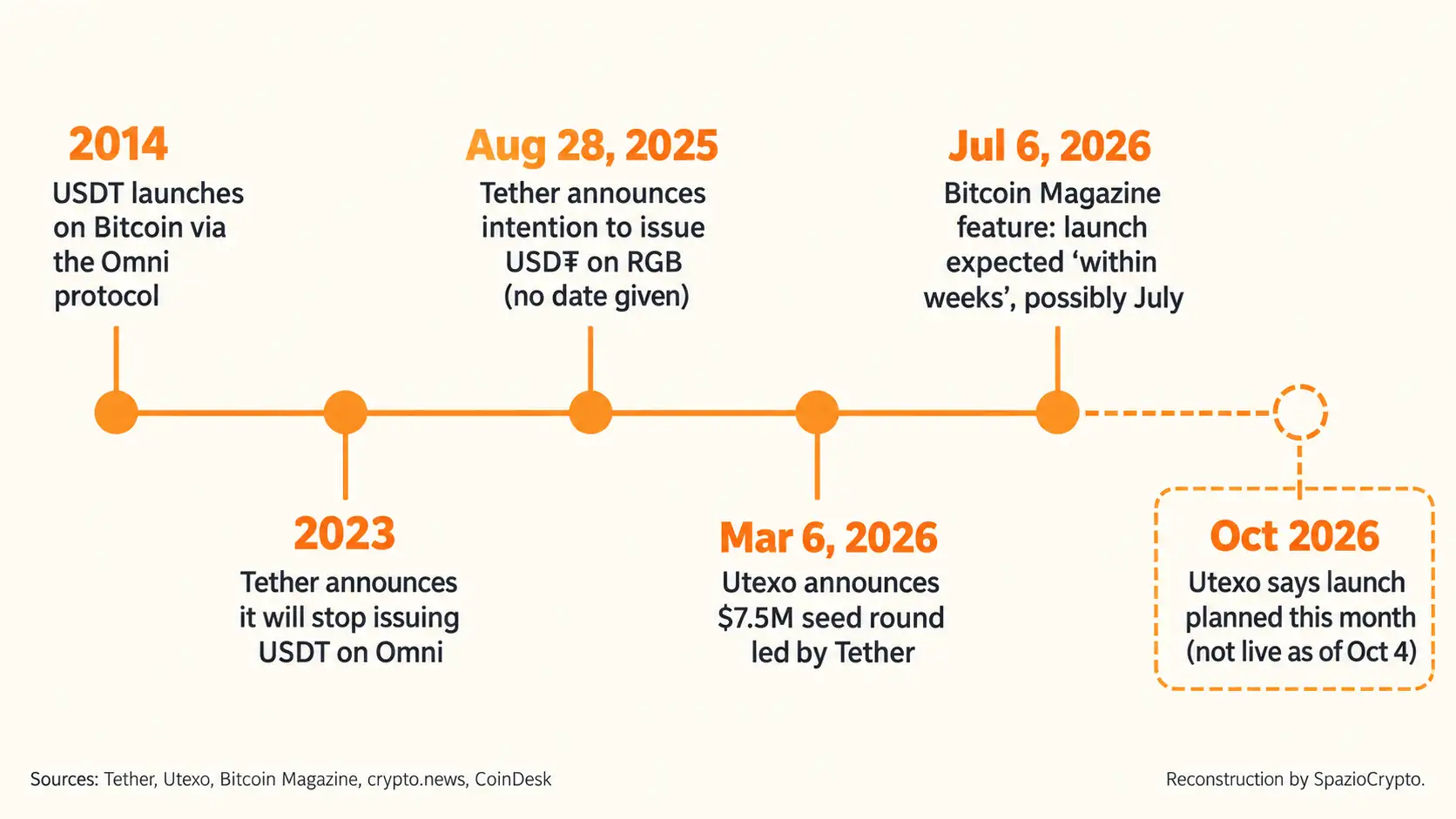
The first official step came on August 28, 2025, when Tether published a press release announcing its intention to issue USD₮ on RGB, a protocol for issuing and transferring assets on Bitcoin and the Lightning Network, citing a launch “in the near future” without specifying a date. Then on March 6, 2026, Utexo announced a $7.5 million seed round led by Tether. CEO Paolo Ardoino stated that Bitcoin had always been central to Tether’s vision for USDT and that what had been missing was production-ready infrastructure. According to crypto.news, participants in the round included Franklin Templeton, Maven11 Capital, Fulgur Ventures, Auros Ventures, and Flow Traders.
The timeline, though, has shifted repeatedly. As early as July 6, according to crypto.news’ account of an interview published by Bitcoin Magazine, the debut was expected within weeks, possibly in July, with wallet support including Tether Wallet. At the end of September, Ardoino wrote on X that USDT was coming back, posting “it’s coming home,” as reported by CoinDesk. On October 2, Ihnatiuk pointed to October as the target month, adding that Utexo had obtained a commercial license to issue USDT on Bitcoin under the Tether brand and to distribute it, through its own infrastructure, to exchanges, wallets, and payment providers.
From Omni to RGB: What Changes Technically
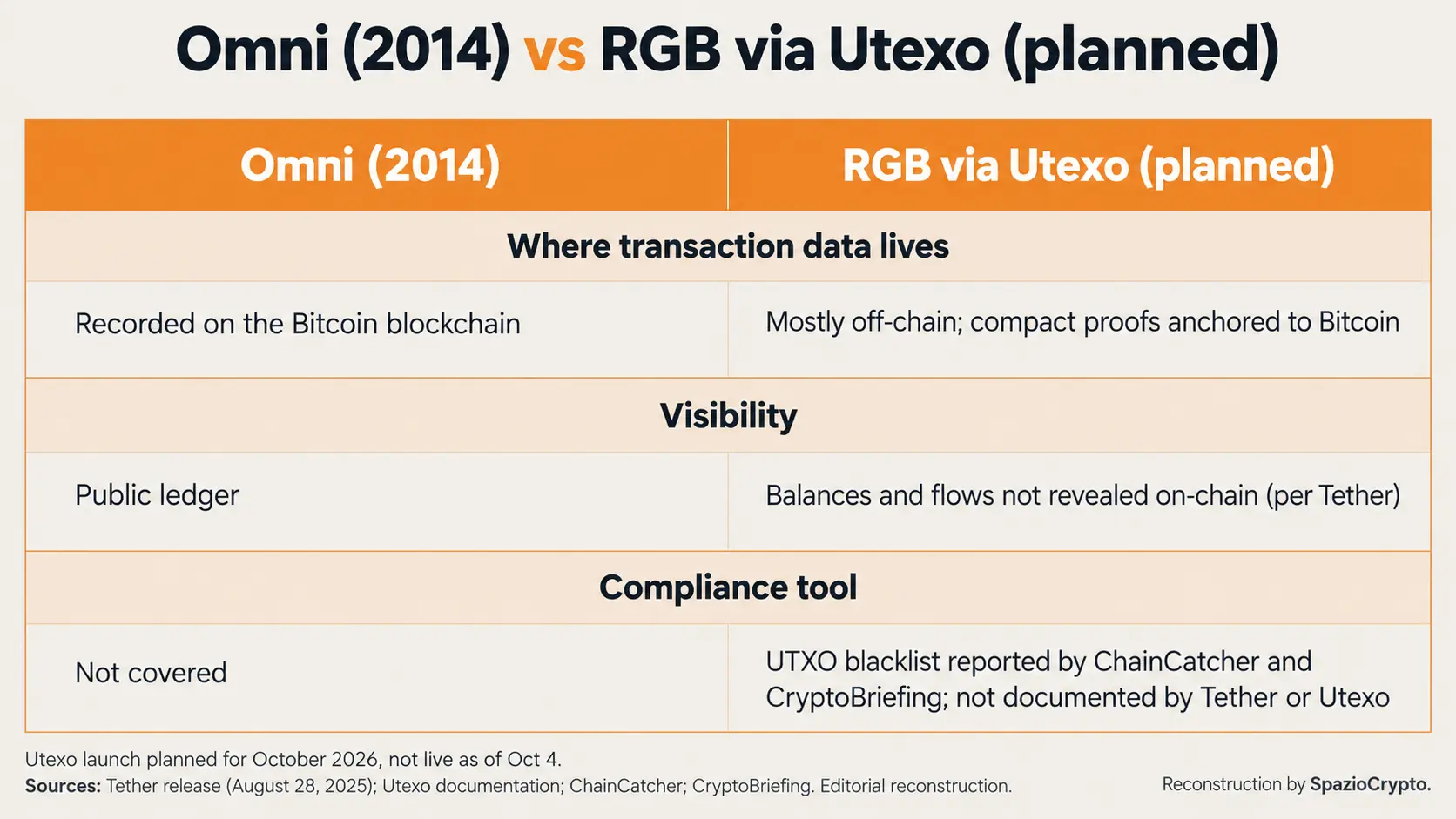
In 2014, USDT launched on Bitcoin via the Omni protocol, which recorded token data directly on the blockchain. Over time, the vast majority of USDT migrated to faster and cheaper networks like Tron and Ethereum, and in 2023 Tether announced it would stop issuing new USDT on Bitcoin’s legacy Omni layer.
RGB works in the opposite direction. With client-side validation, asset data stays off-chain, and only compact proofs are anchored to the Bitcoin ledger. Tether’s own press release explains that this model reduces on-chain footprint, protects privacy, and enables Lightning Network compatibility, without any new opcodes or changes to Bitcoin’s consensus rules. Ownership is tied to Bitcoin’s unspent transaction outputs, or UTXOs. Bringing USDT to Bitcoin via RGB does not mean placing every USDT transaction on the Bitcoin blockchain, and according to 24/7 Wall St., miners would earn only minimal fees from the project.
 Unknown
Utexo’s documentation describes an execution and settlement layer for payment operators, where transactions run off-chain and state is anchored to Bitcoin, without introducing a new consensus mechanism. Three services have been announced: private USDT transfers, direct BTC-to-USDT swaps without intermediaries, and bitcoin-collateralized loans without wrapping. Lightning Network support is expected to follow after the mainnet launch.
The Freezing Problem
There is one point that the RGB version makes particularly sensitive. On Ethereum and Tron, Tether can freeze individual addresses, a tool it has deployed at scale: in our in-depth piece on the Senate report on USDT and Iran, we reported how the company claims to have helped freeze nearly $550 million linked to Iran in 2026. On RGB, assets are tied to UTXOs, not to addresses. According to ChainCatcher, as cited by KuCoin, Utexo would not be able to freeze assets the way Tether does on Ethereum; instead it would maintain a blacklist of UTXOs linked to sanctioned or illicit activity, distributed to exchanges and institutions to block redemption. CryptoBriefing describes the same approach as blacklisting specific outputs rather than freezing entire accounts. In the sources we were able to consult, this mechanism is not yet formally documented by either Tether or Utexo.

What Is Confirmed and What Is Not
The distinction that matters. Source: Tether and Utexo press releases, industry press, October 2026
- Primary sources: Tether’s intention to issue USD₮ on RGB (August 28, 2025) and Utexo’s Tether-led seed round (March 6, 2026).
- Industry press only: October launch date, Utexo commercial license, UTXO blacklist mechanism.
- Not confirmed: a specific launch date, officially announced distribution partners, primary documentation on the blacklist mechanism.
The Bigger Picture
The real interest lies in the architectural reversal. Omni used Bitcoin as a place to write token data; RGB uses it as an anchor, leaving data with the parties involved. For Tether, it is a way to return to Bitcoin without routing every transaction through it. For Bitcoin, it is the prospect of becoming a settlement layer for stablecoins without touching its base protocol.
Two lessons stand out. First, the project’s success won’t depend on the technology itself but on adoption: a new USDT variant only matters if wallets, exchanges, and payment providers actually support it, and today no names have been publicly confirmed. Second, the privacy that makes RGB attractive is precisely what challenges Tether’s compliance model, which has relied on freezing addresses across public networks. For European readers, a further open question is how this version would sit within the MiCA framework, where USDT is already under regulatory pressure, as both CryptoBriefing and Yahoo Finance have noted. While the Federal Reserve was drafting rules for bank-issued stablecoins, the world’s largest stablecoin issuer is quietly reopening a different path on a separate network. Whether the launch actually happens, and when, is what we’ll be watching.