

Google has announced an investment of at least €13 billion in Finland to build new AI-dedicated data centers, the largest single investment the company has ever made in Europe. But the most revealing part of this story has nothing to do with concrete and servers. It's about electricity, and specifically a 22-year contract that ties Google to a nuclear power plant. Google's Finland AI investment and the energy deal behind it offer the clearest picture yet of where the real bottleneck in the AI race actually sits.
 Bikash Koley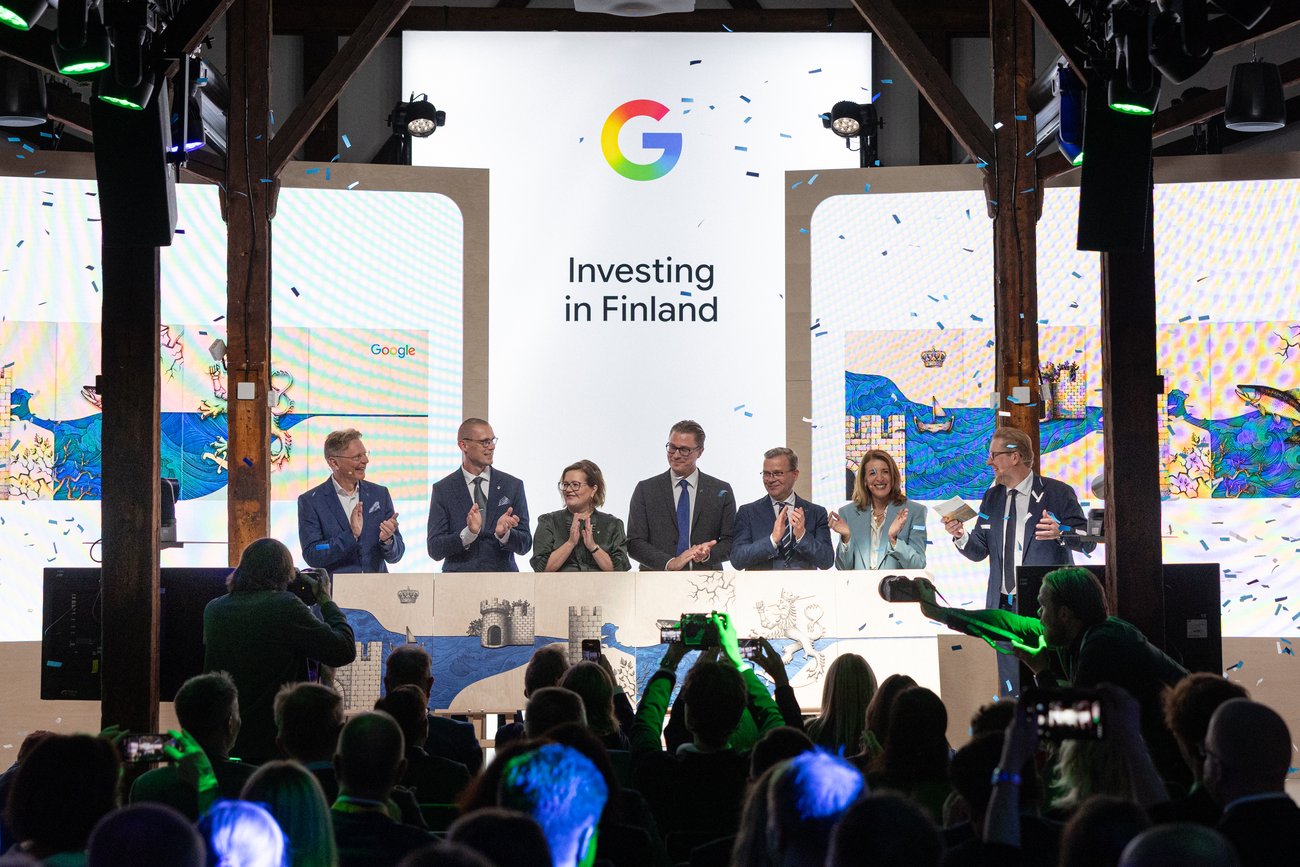
This announcement is one of the clearest examples of a problem now pressing hard across the tech industry: building the data centers that AI requires is actually the easy part. Finding enough reliable energy to run them, at scale, for decades, is the harder challenge. Here's what the deal involves and why its structure matters.
The Investment and the Numbers
According to Google's announcement, the plan covers the construction and expansion of digital infrastructure across four locations in Finland, including the company's existing hub in Hamina. The total investment of at least €13 billion is spread across the next two years. Google estimates the construction program will support more than 37,000 jobs in the country and contribute several billion euros per year to Finnish GDP during the build-out phase. These are, for now, projections declared by the company itself, not independently verified results.
The computing capacity generated by these data centers will power some of Google's best-known services, from AI models and search engines to Maps and YouTube. What makes this investment particularly instructive, though, is the energy infrastructure surrounding it, and what it reveals about how the relationship between Big Tech and national electricity grids is changing.
The Real Heart of the Deal: Rescuing a Nuclear Plant
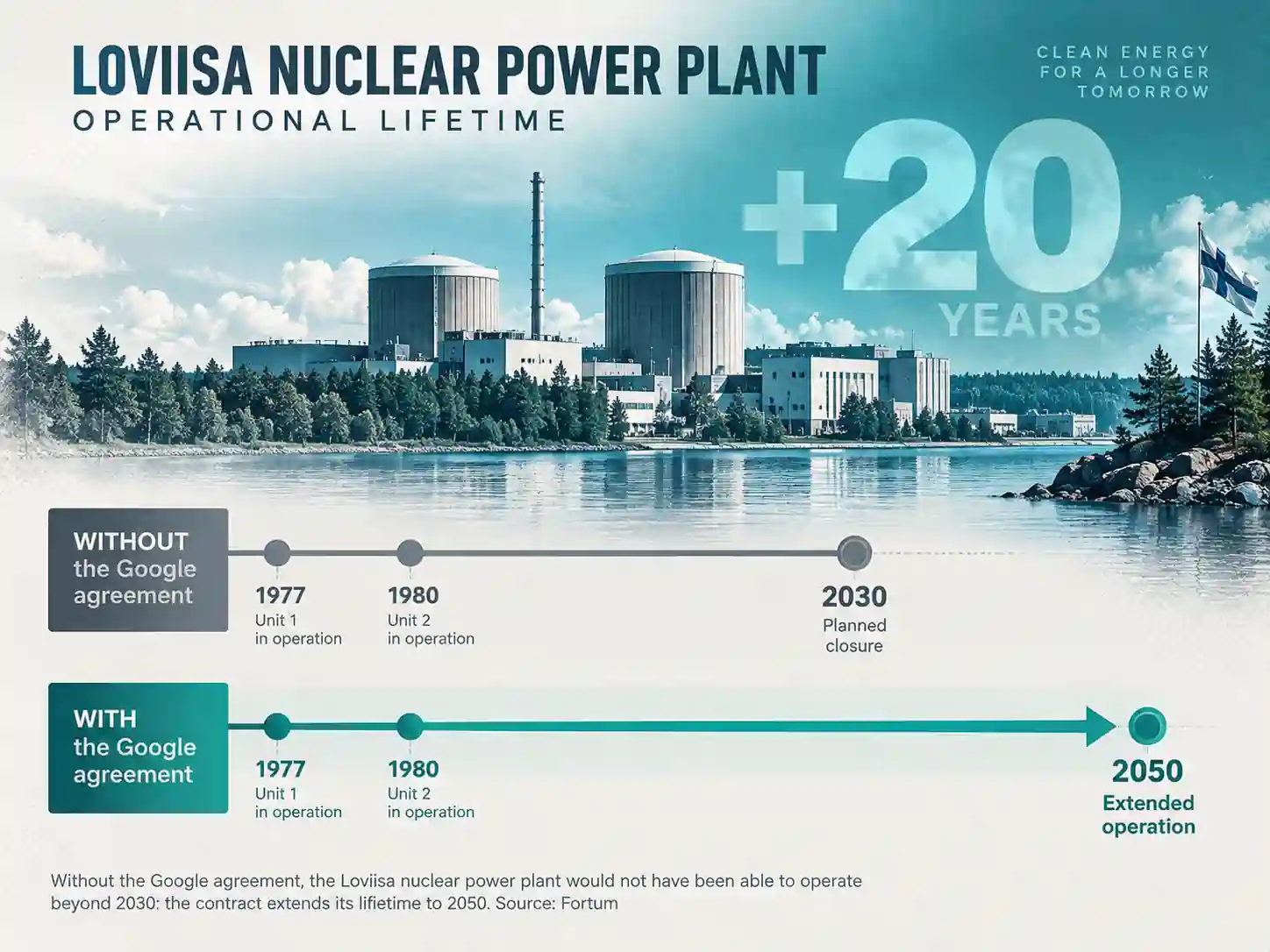
Here's where the story becomes genuinely striking. Google has signed a 22-year power purchase agreement (PPA) with Finnish energy company Fortum, securing up to 50% of the generating capacity of the Loviisa nuclear power plant. Loviisa currently supplies around 10% of Finland's total electricity, according to Fortum's own disclosures.
The critical detail: without this agreement, Fortum stated the plant would not have been able to continue operating beyond 2030. The 22-year contract with Google provides the revenue certainty needed to justify a roughly €1 billion modernization program, extending the plant's operational life to 2050. In other words, AI computing demand has become, for the first time in Europe, the financial mechanism keeping a strategically important national energy asset alive. This is also the first agreement of this type that Google has signed outside the United States.
The Google-Fortum Deal: Key Numbers
What the agreement covers. Source: Google, Fortum, 2026
- The investment: €13 billion over the next two years, Google's largest-ever European commitment.
- The nuclear contract: 22 years, up to 50% of Loviisa plant capacity, operational through 2050.
- The rest of the mix: 629 MW of new wind energy and a 94 MW battery storage system to stabilize the grid.
A Necessary Technical Clarification
Before getting swept up in talk of “clean energy for decades,” a honest technical note is warranted. A PPA of this type doesn't mean a dedicated stream of electrons from Loviisa physically and exclusively reaches Google's data centers. It's more accurately a commercial and financial arrangement: it guarantees stable revenues for the producer and, on paper and over time, balances the buyer's consumption against the plant's output. Claims about the “cleanness” of the resulting compute depend on the precise contract structure and on the overall energy mix of the grid, not simply on the annual volume of nuclear power declared.
One other detail worth noting: it emerged not from the official press release but from a direct question put to Google representatives by a journalist from Finnish public broadcaster Yle. The total €13 billion figure reportedly includes investments tied to the Loviisa nuclear agreement itself. That context matters for understanding what the headline number actually covers.
Why This Connects to the Crypto World
If you're wondering what any of this has to do with cryptocurrencies, the answer is more direct than it might seem. This episode confirms a pattern worth tracking closely: competition for energy access, grid connections, and physical capacity is becoming one of the central battlegrounds of the entire digital economy, the same terrain where, not long ago, Bitcoin mining was being fought out.
It's no coincidence that some of the best-positioned companies to capture this opportunity are former mining operators, who spent years accumulating rare expertise in large-scale energy procurement, land access, and grid connections. When even a company of Google's scale must lock in 22-year agreements with nuclear plants just to secure the electricity it needs, the value of that expertise — knowing how to source and manage enormous quantities of energy, becomes obvious. We covered a related transformation in our piece on how IREN shifted from Bitcoin mining to AI data centers.
The Bigger Picture
The Google-Fortum agreement marks a shift in how the AI bottleneck is understood. For months, public debate focused almost exclusively on the shortage of advanced microchips. This deal shows that once that obstacle is partly overcome, the binding constraint on AI growth becomes stable, continuous energy supply, available over timeframes measured in decades rather than quarters, more like public infrastructure than a simple commercial utility.
The lesson here is twofold. On one hand, Big Tech companies are no longer simply electricity customers. They're becoming financiers and long-range planners of national energy infrastructure, signing contracts whose duration would once have been associated only with state utilities. On the other hand, this dynamic confirms that the future of AI, and with it the future of digital technologies including crypto, will be shaped as much in power plants and grid control rooms as in research labs. Whoever controls access to large-scale energy in this new landscape controls a meaningful share of the future of digital computing. For a broader grounding in how these infrastructure layers connect, our guide on what cryptocurrencies and blockchain are remains a useful starting point.