

One figure captures the full intensity of the global AI race better than any other: Chinese company Z.AI has returned to capital markets to raise another five billion dollars, just two months after collecting four billion. In less than nine months since its stock exchange debut, the company has now raised a total approaching nine and a half billion dollars, according to Reuters reporting on the deal. Z.AI's back-to-back fundraises in Hong Kong represent one of the clearest examples yet of how artificial intelligence has become one of the most capital-hungry businesses in recent economic history.
This isn't simply a story about one company raising a lot of money. It signals a deeper shift in the competitive rules of AI, where access to capital is becoming nearly as consequential as the quality of the models themselves. Here's what the deal involves and why it matters beyond the headline number.
The Deal Structure: Equity and Convertible Bonds
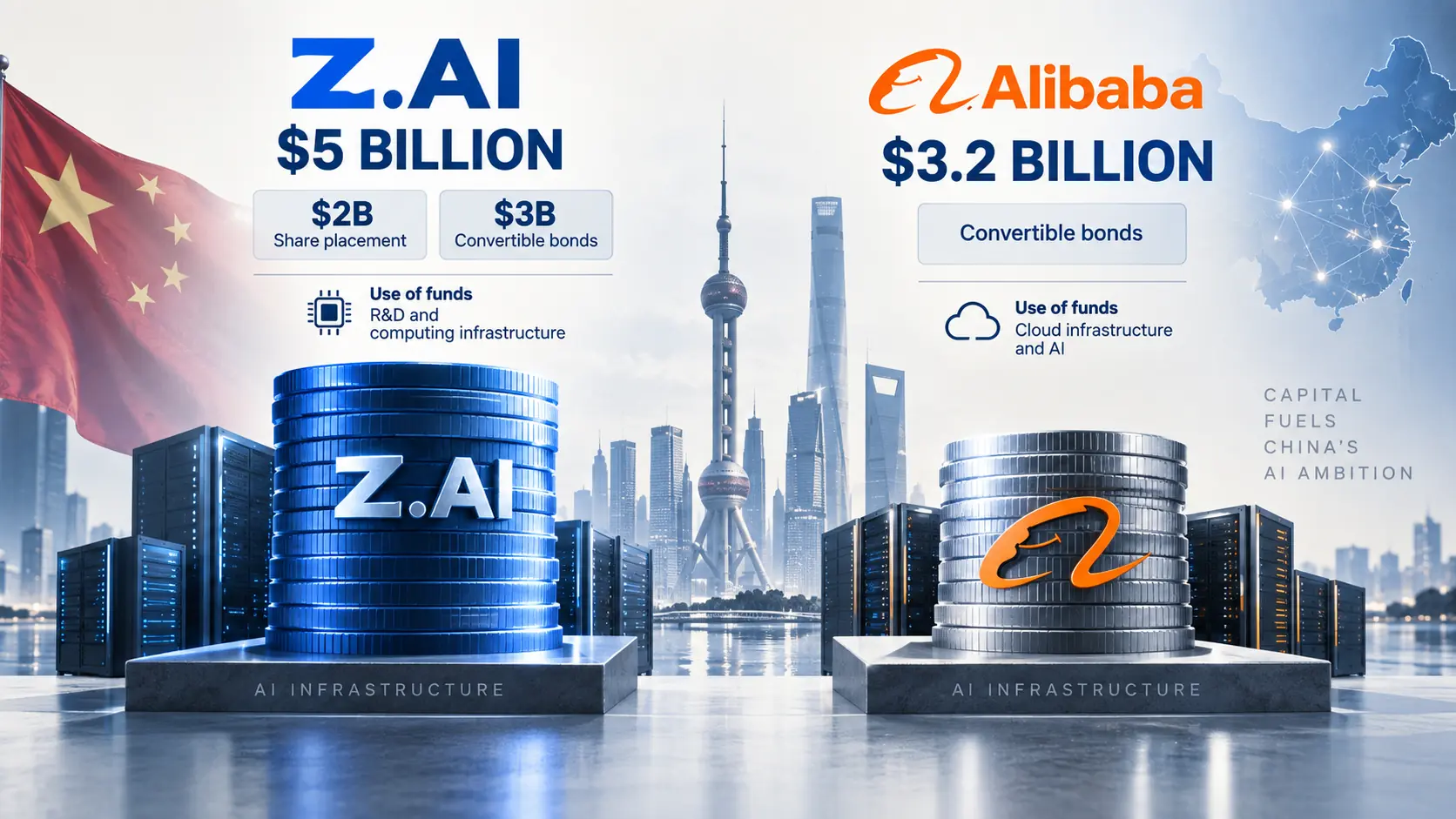
The Hong Kong operation breaks into two distinct parts. The first is a new share placement raising roughly two billion dollars, offered at a ten percent discount to the previous closing price. The second is a zero-coupon convertible bond issuance worth approximately three billion dollars, maturing in September of next year, which investors can convert into shares at a price twenty-five percent above the placement price.
According to the company's own statements, the proceeds will go primarily toward research and development and the acquisition of computational resources and related infrastructure, alongside potential strategic investments and expansion moves. The capital allocation leaves little ambiguity about where AI companies believe they need to put money right now: buying compute, and lots of it.
An Astonishing Return to Markets
What makes this story particularly striking isn't the amount itself, it's the pace. Z.AI, previously known as Zhipu AI, listed on the Hong Kong Stock Exchange in January 2026, becoming the first large language model specialist in the world to go public. Since that IPO, the stock has risen more than ten times its initial value, per Bloomberg market data. By July, the company had already completed a separate raise of roughly four billion dollars. This new operation, arriving just two months later, pushes the total raised in under a year to nearly nine and a half billion dollars.
A company returning to capital markets at this frequency and scale is sending an unmistakable signal: the cost of staying competitive in AI is growing faster than most observers predicted even twelve months ago. The cadence of these fundraises tells its own story.
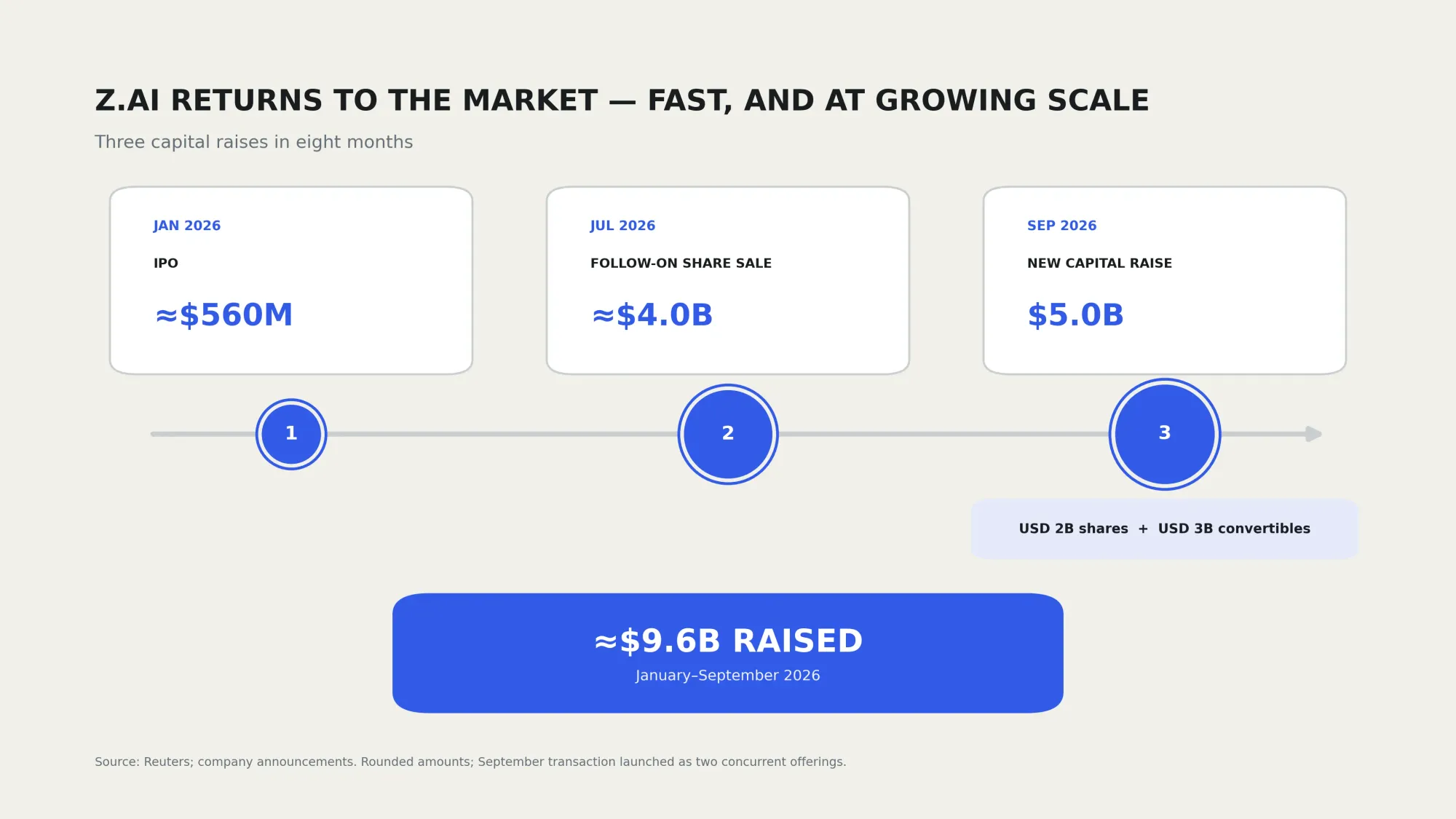
Z.AI Capital Raises: The Full Timeline
Three rounds in under a year. Source: Reuters, 2026
- January 2026: Hong Kong IPO, approximately $560 million raised.
- July 2026: follow-on raise of approximately $4 billion.
- September 2026: additional $5 billion, bringing the total to nearly $9.5 billion in under a year.
The Missing Piece: U.S. Chip Restrictions
One detail makes this capital hunger considerably easier to understand, and it sits squarely in geopolitics. Earlier this year, the company (then still operating as Zhipu) was added to a U.S. government export control list, barring it from procuring advanced American technology components, including the most powerful current-generation graphics processing units. That restriction means Z.AI must build its computational capacity on alternatives that are frequently more expensive, less efficient, or both, compared to what Western competitors can access.
In that context, the relentless need for fresh capital takes on a sharper meaning. Z.AI isn't just buying more compute. It's financing the construction of an alternative technology infrastructure while locked out of the most advanced tools available on the global market. The company isn't alone in this position: Alibaba, one of China's largest e-commerce and cloud conglomerates, launched its own significant capital raise in the same period, targeting more than three billion dollars earmarked for cloud and AI expansion, as reported by Reuters. The pattern echoes what we're watching in the West too, where companies like Google are committing billions to nuclear energy deals in Finland to secure long-term power for their data centers.
What the Z.AI Story Reveals About the AI Race
Read alongside other recent developments, Z.AI's fundraising spree outlines a remarkably clear picture of how global AI competition is evolving. On one side, major Western tech firms are locking in access to enormous, long-duration energy sources, signing contracts stretching twenty years with nuclear plants to guarantee the electricity their data centers require. On the other, Chinese AI companies are hitting capital markets with increasing frequency and scale, buying compute capacity and staying competitive despite the foreign technology restrictions imposed on them.
It's no coincidence that parallel stories are emerging in adjacent sectors. Former Bitcoin miner IREN has pivoted toward AI infrastructure precisely to capture this relentless demand for computational power, reflecting how broadly the capital reallocation toward AI is spreading.
Two lessons stand out from Z.AI's trajectory. First, AI is becoming a capital-intensive business in which the ability to raise large sums quickly is itself a competitive advantage, almost on par with model quality. Second, the geopolitical dimension of AI competition, particularly chip export restrictions, is generating direct and measurable pressure on corporate financial strategy. Companies like Z.AI are raising ever-larger rounds not purely because their models demand it, but because they must overspend on infrastructure to compensate for the tools they can't access. The AI war is being fought in trading rooms as much as in research labs, and the capital ledger is becoming a meaningful proxy for competitive standing. For readers wanting to understand the underlying technology layer driving all of this, SpazioCrypto's guide to cryptocurrencies and AI in the digital world provides a useful starting point.