


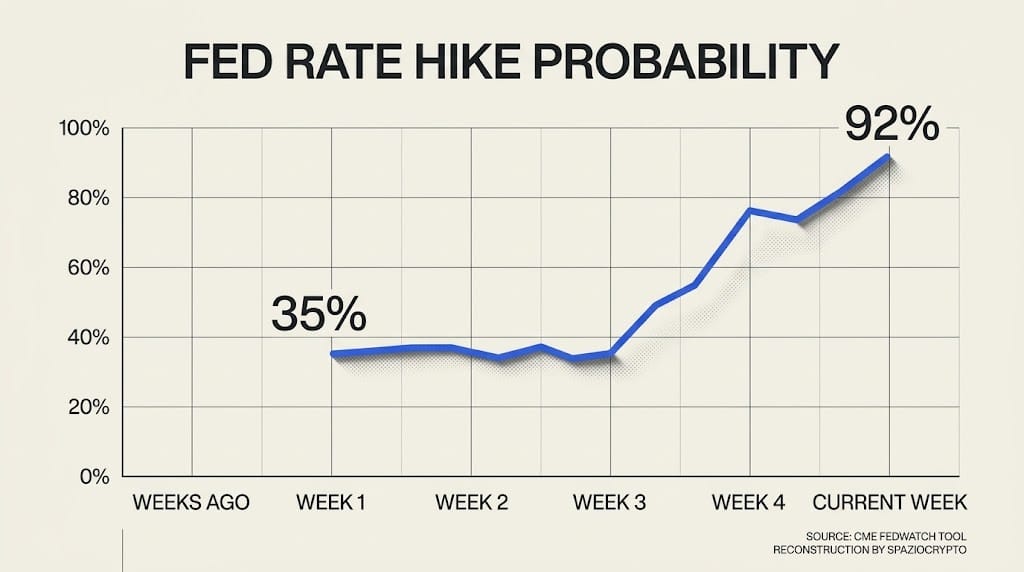
Bitcoin is arriving at one of the most risk-laden days of the year, and it does so having already absorbed a heavy political blow less than twenty-four hours earlier. On Tuesday, the U.S. Senate rejected the procedural vote on the CLARITY Act, the most anticipated crypto market structure bill of 2026. Now comes the Federal Reserve, with markets pricing a roughly 92% probability of an interest rate hike, according to CME FedWatch data. In under a day, Bitcoin and the Fed are colliding precisely as the market confronts the two risks that have dominated crypto in 2026: regulatory uncertainty and the cost of money.
Framing today as a generic “Bitcoin waits for the Fed” misses the real story. The accurate read is sharper: Bitcoin faces the second half of a one-two punch that opened yesterday evening in Washington. Here is the complete macro picture, and why the overlap of these two events makes today's session unusually difficult to interpret.
The Macro Picture, Number by Number
The Federal Reserve's decision is expected this afternoon, at the close of a two-day meeting. The probability of a quarter-point rate hike has climbed to approximately 92%, according to CME FedWatch tools that track market expectations, a level analysts broadly treat as near-certainty. The current target range sits between 3.50% and 3.75%.
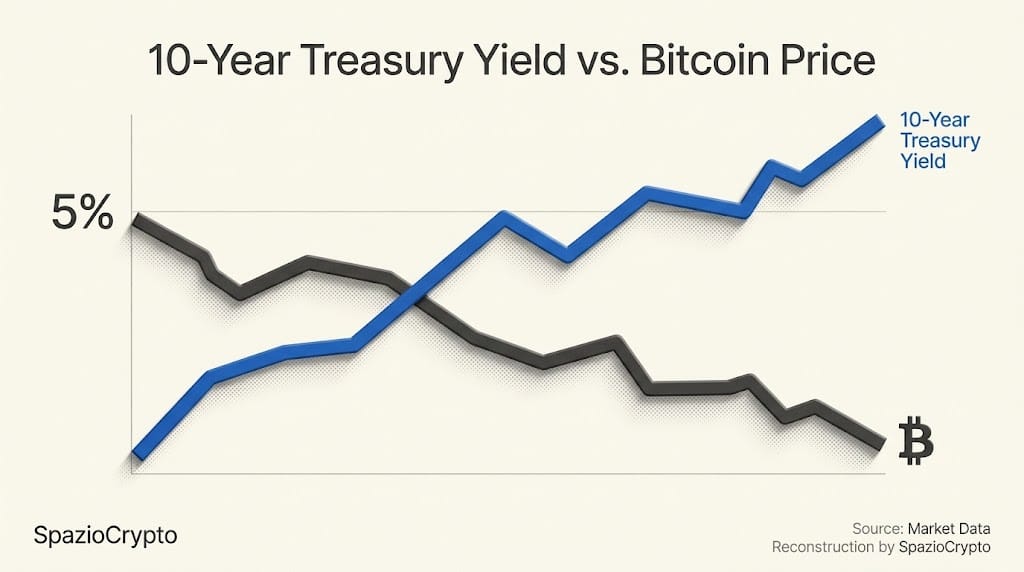
Adding further pressure to the backdrop, the yield on the 10-year U.S. Treasury note crossed the psychologically significant 5% threshold for the first time since 2007, before pulling back slightly below that level. Oil remains elevated, supported by geopolitical tensions linked to attacks on energy infrastructure in the Middle East, in a conflict between the United States and Iran that has dragged on for months. Bitcoin, against this backdrop of stress in bond and energy markets, fell to around $75,300 at the peak of Tuesday's nervousness.
Two Shocks, Not One: The CLARITY Act Connection
This is what sets today apart from a routine monetary policy waiting game. Bitcoin arrives at the Fed decision having already absorbed, just hours earlier, the disappointment of the CLARITY Act's failed procedural vote in the Senate, an event that had already pushed Bitcoin and major crypto-linked equities lower. The interesting question, then, is not simply how the market will react to the Fed, but whether today's reaction will focus primarily on monetary policy, or whether some of the regulatory risk has already been “priced out” yesterday, leaving the field cleaner for a pure read on the rate decision alone.
That's a distinction that matters for anyone tracking crypto markets: knowing whether a decline reflects a single factor or the compounding of two separate shocks helps interpret price action correctly over the coming hours and days, separating a temporary adjustment from a more structural shift in sentiment.
Two Shocks in 24 Hours
What the market has already absorbed. Source: Reuters, 2026
- Yesterday evening: the Senate rejects the CLARITY Act, regulatory uncertainty spikes.
- Today: the Fed decides on rates, with a 92% probability of a hike priced in.
- The question: is political risk already discounted, or does it stack on top of monetary risk?
The Hike That Could (Paradoxically) Support Bitcoin
There's a more sophisticated reading of this situation that deserves attention, because it partly inverts the most immediate intuition: that a rate hike is automatically negative for a risk asset like Bitcoin. Some analysts argue that a hike, if it arrives, could paradoxically act as support rather than headwind. The reasoning is technical but worth unpacking: the move may be designed more to anchor long-term inflation expectations and keep yields on longer-dated Treasuries contained, rather than to genuinely tighten overall financial conditions in the near term.
An analysis from trading firm Bitfinex captures this dynamic well, noting that available market liquidity is providing a floor for prices, while it's the short end of the Treasury yield curve that is effectively capping the upside. A seemingly counterintuitive data point reinforces this read: despite the weight of risk currently priced by markets, spanning war, surging oil, the rate decision itself, and international trade tensions, the equity volatility index remains at surprisingly subdued levels. Some interpret this as excessive complacency; others see it as confidence in the market's capacity to absorb these shocks without breaking.
The Levels to Watch
Beyond macro interpretations, there are concrete technical thresholds that traders are monitoring closely right now. A daily close below a key support level would, according to several analysts, open the path toward a further retreat toward the $71,000 area. On the upside, a ceiling around $82,000 is likely to remain in place for as long as Treasury yields don't decline meaningfully, since lower yields would provide more breathing room for risk assets. It's the same type of technical analysis that emerged around the options expiry near the Jackson Hole summit, another piece of the same ongoing tug-of-war between Bitcoin and U.S. monetary policy that has been running for weeks.
The Bigger Picture
Today's session, with its double load of political and monetary risk compressed into under twenty-four hours, illustrates clearly how Bitcoin has become a fully integrated asset within global finance. It's sensitive to the votes of a legislative chamber just as much as to the decisions of a central bank. Bitcoin is no longer, if it ever truly was, an isolated refuge from the affairs of traditional finance. It's a barometer that reflects global market sentiment with increasing precision, exactly as we observed when analyzing recent institutional capital flows into Bitcoin ETFs.
For observers, today carries a dual lesson. First, this concentration of events underscores how essential it has become for anyone tracking crypto markets to maintain a broad view that covers not just sector-specific news, but the macroeconomic and political context in which crypto now operates as a full participant. Second, the more nuanced read, in which a rate hike could actually support Bitcoin rather than weigh on it, serves as a reminder that market reactions rarely follow the simplest intuition, and that it's worth tracing the reasoning behind a price move before drawing conclusions. In the hours ahead, we'll see how the market actually behaves when confronted with this concentration of risks, and whether the dual shock of regulation and monetary policy translates into a deeper correction or a passing adjustment. For a grounding in the fundamentals, our guide on what cryptocurrencies are remains a useful starting point.