


Italy's Guardia di Finanza has seized over 1.6 million euros in assets from the key promoters of an alleged criminal organization running a large-scale investment fraud in Turin. The preventive seizure, ordered by a preliminary investigating judge at the Turin Tribunal and aimed at confiscation including equivalent assets, follows an investigation coordinated by the Turin Public Prosecutor's Office. According to prosecutors, the scheme collected over six million euros from hundreds of savers across Italy between 2021 and 2023, promising high returns on gold and cryptocurrency investments that, investigators say, were never actually made.
 Marco Bobbio
One point deserves immediate clarity: available sources do not establish that any of the six million euros collected was actually converted or invested in cryptocurrency. On the contrary, according to prosecutors' reconstruction of events, the promised investments in both gold and crypto were never concretely executed. Gold and cryptocurrency served as the commercial hook to attract victims, not as a real destination for the money raised. Here is precisely how the scheme operated.
A Bank That Never Really Existed
Between 2021 and 2023, according to findings by the Turin Economic and Financial Police Unit, hundreds of savers were persuaded by a dense network of self-styled financial advisors to hand over money in exchange for promises of very high returns. The investments were pitched through an entity presenting itself as a London-registered “investment bank,” with declared offices also in Spain and Turin, marketed as a financial intermediary specializing in gold and cryptocurrencies. According to investigators, this supposed bank held no authorization of any kind required to legally operate in the financial investment sector.
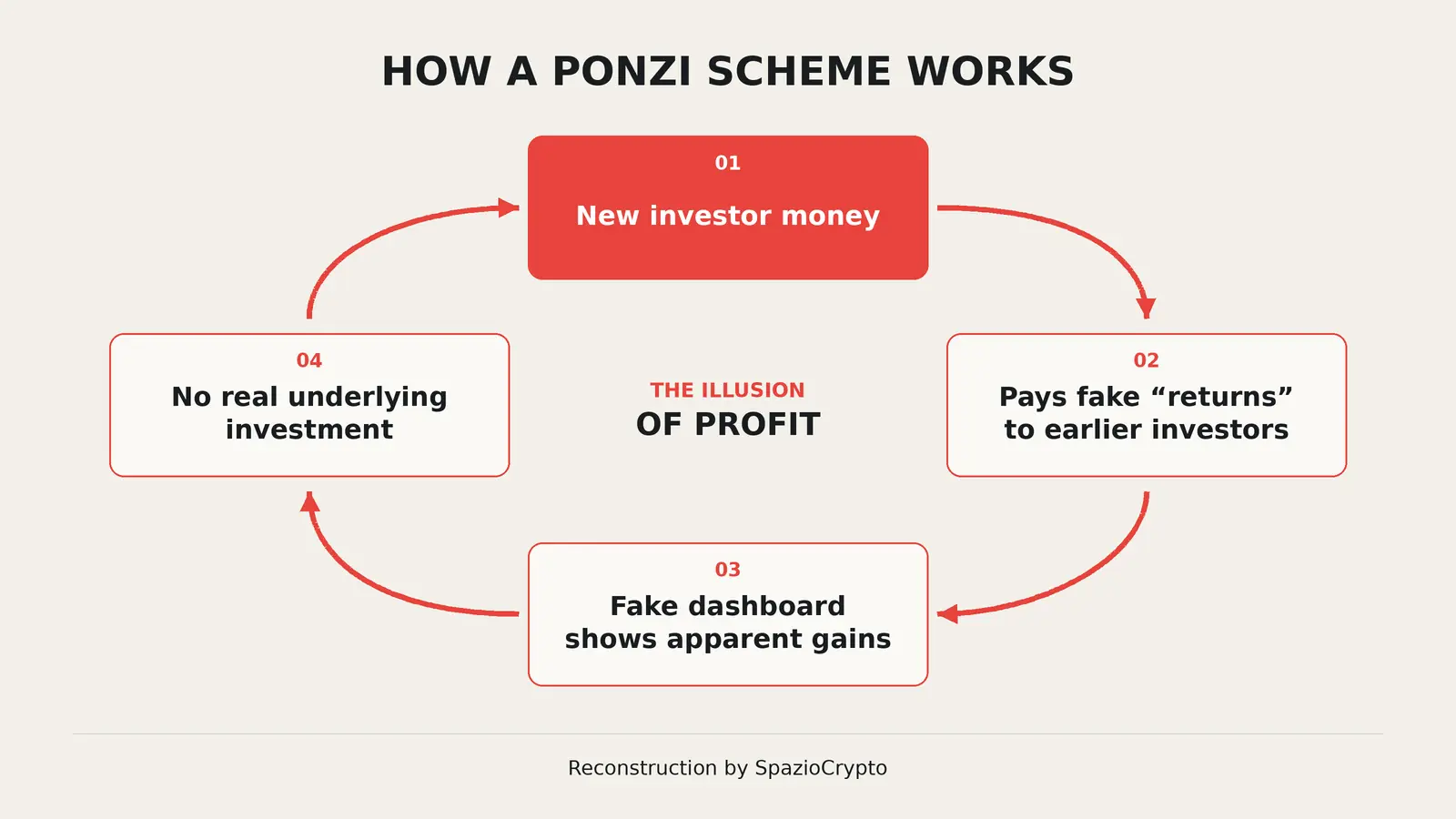
To reinforce the operation's credibility in the eyes of victims, savers were given login credentials for an online platform where they could apparently track the performance of their investments in real time. According to investigators, however, those investments were never actually made. The platform displayed entirely fictitious returns, disconnected from any underlying real investment activity.
The Ponzi Structure Behind the Fake Returns
The financial mechanism used to sustain the deception, at least in its initial phase, matches the classic Ponzi structure. A portion of money deposited by new investors was used to pay back other savers amounts presented as interest or investment returns, creating the illusion of a genuinely functioning and profitable system. This type of structure can hold together only as long as incoming new capital exceeds outgoing payments toward promised returns, a balance that, by definition, cannot last indefinitely.
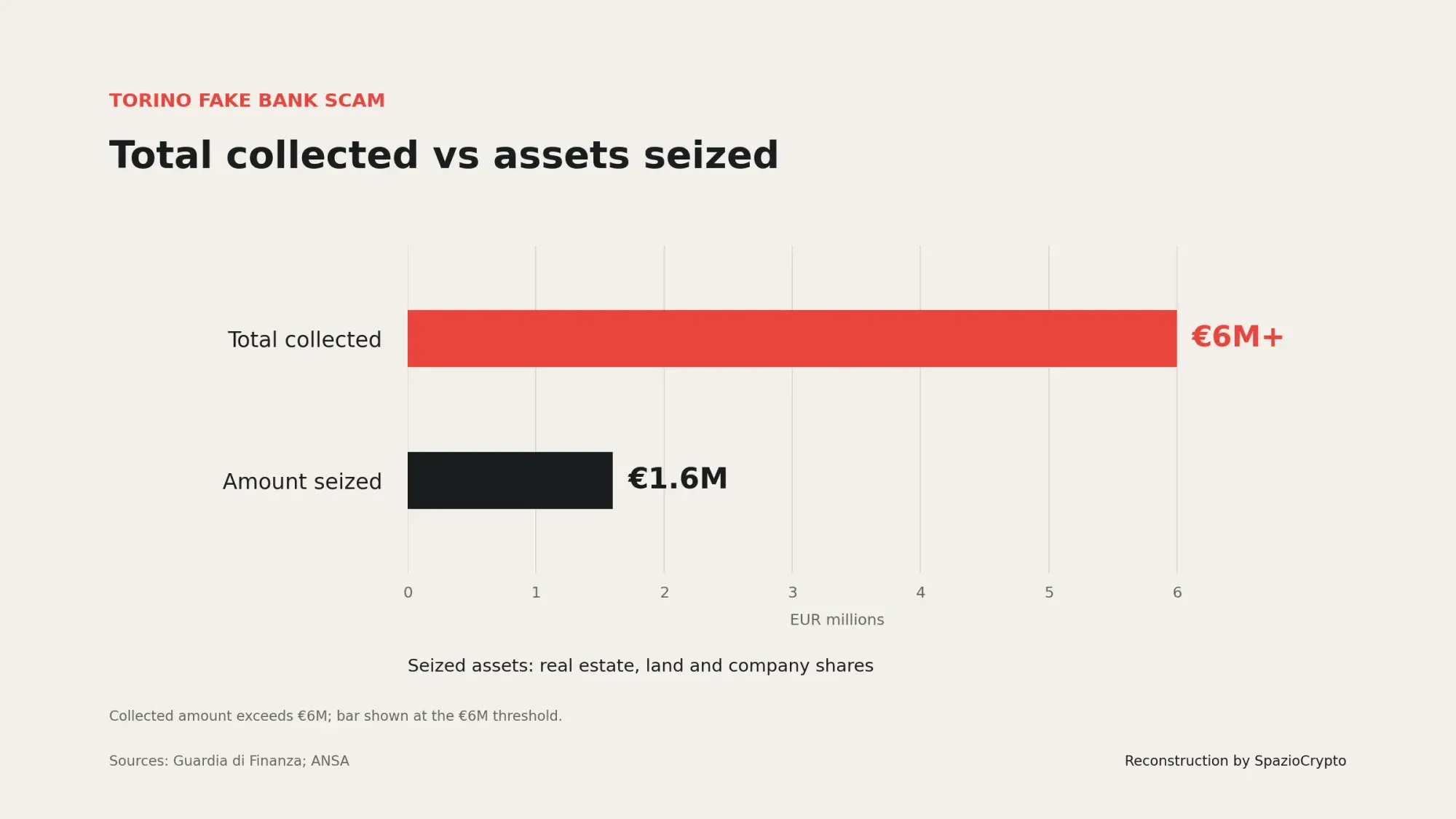
According to a reconstruction reported by Il Sole 24 Ore, over 1.6 million euros of the proceeds were used by some of the suspects to purchase dozens of properties, plots of land, and stakes in Italian companies. That figure corresponds precisely to the amount pocketed by the promoters through money laundering of fraud proceeds. These concrete, traceable assets are exactly what the preventive seizure executed in recent days targeted.
Operation by the Numbers
What we know. Source: Guardia di Finanza, ANSA, October 2, 2026
- Raised: over 6 million euros from hundreds of savers (2021-2023).
- Seized: over 1.6 million euros in real estate, land, and company stakes.
- Key finding: the promised gold and crypto investments were reportedly never actually executed.
Why the Mechanism Matters More Than the Single Case
What makes this case particularly instructive, beyond its specific severity, is the combination of elements assembled to build a veneer of credibility around an entirely fictitious operation. The reference to a foreign-registered investment bank, declared physical offices in multiple European countries, an organized network of advisors presenting themselves as industry professionals, and above all a digital platform capable of simulating live investment performance: all of these were designed specifically to lower the psychological defenses of people who would ordinarily recognize the warning signs of an unclear financial proposal.
Gold and cryptocurrencies, in this context, functioned primarily as a marketing lever. Both are asset categories perceived by the general public as potentially very lucrative, capable of attracting savers seeking returns above those offered by traditional investment channels, regardless of whether any real investment activity existed behind the pitch. This is a pattern worth remembering each time you evaluate any investment proposal that combines promises of high returns with sophisticated financial terminology that can only be verified through channels supplied by the same promoter.
The Bigger Picture
This case fits into a growing pattern of episodes in which the digital asset investment space is used as a credible backdrop for fraudulent schemes that, in substance, have little to do with blockchain technology itself. The actual criminal mechanism, here as in many comparable cases, remains the classic pyramid fraud, simply dressed in digital language and aesthetics capable of appearing more convincing to investors drawn to the real or perceived opportunities of the crypto sector.
The lesson here is twofold. First, this case underscores how essential it is to verify independently, through channels not provided by the same promoter, whether any financial intermediary offering gold or cryptocurrency investments actually holds the authorizations required to operate legally before entrusting it with any money. Second, the fact that the platform used to reassure victims displayed entirely fabricated returns confirms how deceptive a professional-looking digital interface can be on its own. An interface is never, by itself, proof that the underlying investments are real. For investors who want to understand how to evaluate these instruments properly, our guide on what cryptocurrencies are remains a useful starting point.
The FCA's Financial Services Register and the SEC's EDGAR database both offer free public tools to verify whether an entity is genuinely authorized to offer investment products. In the UK and EU post-MiCA, any firm soliciting investment in crypto assets must hold a valid CASP license or national equivalent. When a promoter's credentials can only be checked through the promoter's own platform, that alone is reason to stop and look elsewhere.