


Cosmos Labs knew about the vulnerability for four months before attackers drained $5.7 million from six blockchains in late August 2026. The company admitted in a post-mortem report that it was notified of the flaw as early as April 25, 2026, through its security bug bounty program, but engineers misjudged its severity and treated the patch as a routine update. That single misjudgment opened the door to one of the most instructive security failures in recent blockchain history.
The dollar figure, while not catastrophic by crypto standards, is almost beside the point. What makes this incident worth examining is what it exposes about the structural fragility built into the multi-chain model that much of the crypto industry now depends on.
 cosmos
Four Months of Misjudgment
The timeline is damning. According to Cosmos Labs’ own post-mortem, the vulnerability was correctly reported via the project’s bug bounty program at the end of April. Engineers reviewed it and reached the wrong conclusion: they believed the flaw could only affect a specific technical configuration that differed from the one used by the live, production blockchains. Their assessment was that real user funds were not at risk.
Acting on that belief, the team pushed a “silent” fix in May, deploying the patch without alerting blockchain operators to any serious underlying threat, treating it as a routine maintenance update. Then, in early August, independent researchers re-examined the vulnerability and discovered that the original assessment was wrong. The bug affected far more networks than initially thought. A race to issue a public patch began, but the window was already closing. The fix shipped on August 19. The first attack came within hours.
cosmos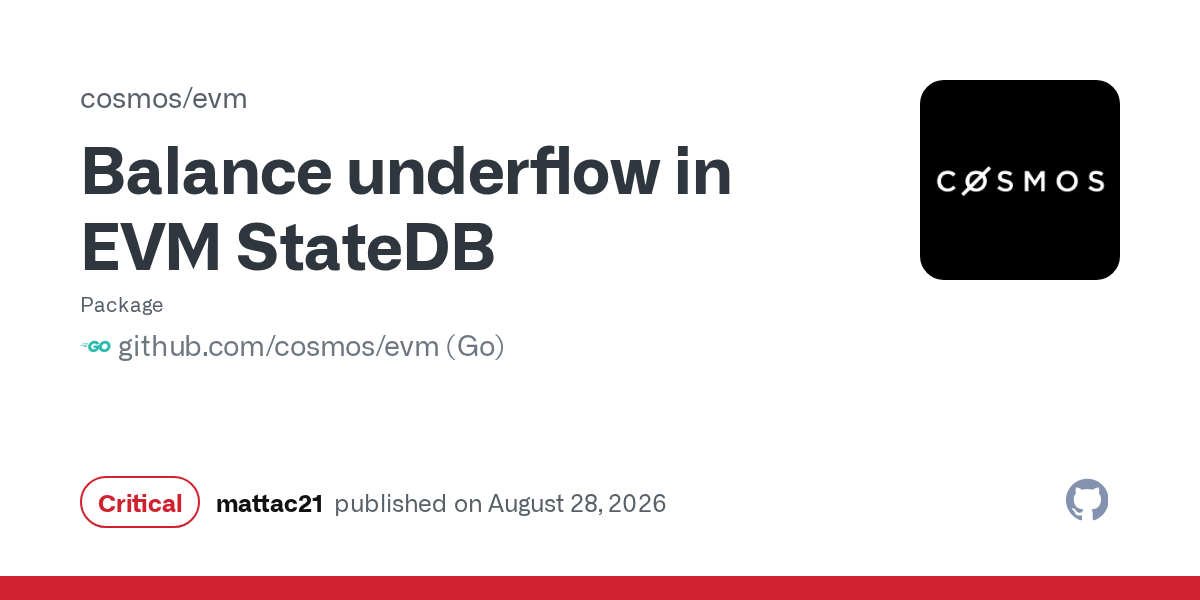
How the Attack Actually Worked
The technical mechanism deserves a clear explanation, partly because it corrects a widespread misconception. Many people assume these exploits work by conjuring tokens from thin air, printing infinite supply. That’s not what happened here. The attacker exploited a mathematical error known as an integer underflow: by manipulating an account balance below zero, the system interpreted that negative value as the largest possible positive number.
From there, the attacker could transfer tokens belonging to other accounts to their own address. One critical distinction, often lost in the noise: the total token supply across affected networks remained essentially unchanged. No new coins were minted. Instead, assets were drained from specific targeted accounts, often dormant addresses or technical wallets. On the hardest-hit network, according to the Cosmos Labs post-mortem, hundreds of millions of tokens were moved from a burn address and an old wallet, with the network’s core security keys left entirely intact. The damage was real, but its nature matters for understanding what actually broke.
The Cosmos Case: What Went Wrong
The timeline of the failure. Source: Cosmos Labs, The Block, 2026
- The error: The bug reported in April was judged non-dangerous for live networks. A wrong call.
- The attack: roughly $5.7 million drained from six blockchains between August 20 and 25, hours after the patch dropped.
- The real problem: dozens of chains share the same software stack, and therefore the same vulnerabilities, but there is no mechanism to update them all at speed.
The Controversy: Twenty Hours Was Not Enough
One of the sharpest criticisms of the incident centers on how the crisis was managed in its final hours. When the patch was published on August 19, it came without any advisory clearly explaining the severity or urgency of the underlying threat. Hours later, an external researcher posted a detailed technical description of how to exploit the flaw, handing attackers a functional roadmap. The first theft followed almost immediately.
KiiChain
Several of the affected blockchains responded with sharp public criticism. One pointed out that the window between the patch release and the attack was realistically too short to coordinate, test, and deploy such a complex update across dozens of independent validators, especially without a specific warning explaining the urgency. Another network went further, arguing that Cosmos Labs should have immediately asked all affected chains to halt block production, the only move that could have prevented the thefts entirely. A separate technical dispute remains unresolved: one of the attacked networks contends that the underlying flaws numbered more than those addressed in the public patch, a claim the post-mortem does not directly engage. The full picture of who bears responsibility is still being contested.
The Real Problem: Multi-Chain Fragility
This is the part of the story that extends well beyond one incident. The Cosmos ecosystem is built on a powerful idea: a shared software framework that lets anyone launch their own blockchain quickly, with all those chains interconnected. It’s a genuinely successful model. But this episode exposed its structural weak point with unusual clarity.
When dozens or hundreds of separate blockchains share the same underlying software, they also share its vulnerabilities. The critical asymmetry is that while the code is shared, there’s no centralized mechanism to push urgent updates to all of them at once. Every chain must apply patches independently, a slow and complex process that requires consensus among its own validators. The most striking detail to emerge from the post-mortem is that Cosmos Labs admitted it does not possess a complete list of all networks running its software: during the emergency response, the team discovered eleven blockchains whose existence it had not previously known. Imagine a component manufacturer that doesn’t know which vehicles carry its faulty part and has no recall system. That’s the scale of the coordination gap exposed here. This isn’t an isolated pattern, either: the theme of hidden vulnerabilities surfaces repeatedly across the industry, as seen with the bug that stayed hidden inside Zcash for four years.

The Wider Lesson
The Cosmos incident is more valuable as a case study than as a horror story. The economic damage, roughly $5.7 million according to Cosmos Labs and The Block, was contained. What wasn’t contained were the process failures: a misread risk assessment in April, a silent patch in May, an unwarned disclosure in August, and a fragmented ecosystem with no shared emergency protocol.
Security in crypto doesn’t reduce to code quality alone. It runs through the human and organizational processes governing how that code is evaluated, patched, and communicated. For anyone building on or investing in multi-chain ecosystems, the lesson is concrete: the convenience of shared infrastructure carries a shared liability surface. The coordination mechanisms needed to manage that surface at scale don’t yet exist at the level the ecosystem’s ambitions require. Cosmos’ candid post-mortem is a step toward accountability. The criticism it received from affected chains shows how far the ecosystem still has to travel before its security practices match its technical promises. Watch whether the community uses this incident to build a formal emergency coordination protocol, and whether Cosmos Labs publishes the complete registry of dependent networks it lacked during the crisis.