


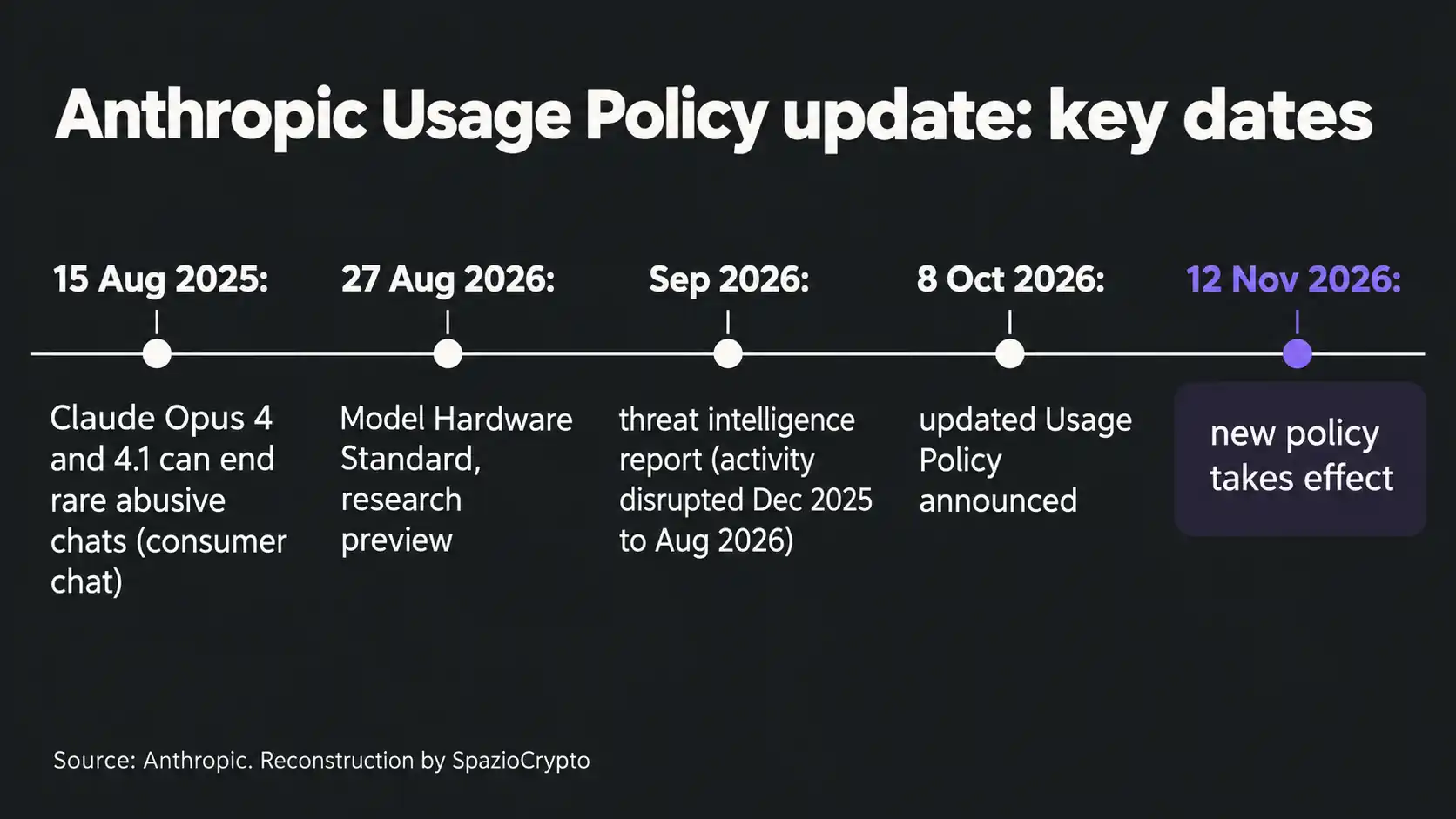
Anthropic's updated Usage Policy for Claude takes effect on November 12, 2026, introducing a dedicated section on deceptive campaigns, rewritten rules on surveillance and weapons, new conditions for AI agents acting on physical hardware, and a ban on sustained abusive behavior toward the models themselves. The company announced the changes on October 8, 2026, and notes that most modifications clarify existing rules rather than introduce entirely new restrictions.
One line in the update has attracted more attention than any other: Anthropic prohibits treating its models with behavior that is “abusive or cruel, prolonged and unnecessary.” It's the most striking clause in the revision, but not the most consequential. Read it as a terms-of-service condition, not a statement on Claude's consciousness. The real substance of the update lies elsewhere.
 Anthropic
Deceptive Campaigns: A New Section That Covers Marketing Too
The broadest change is a new section consolidating rules on deceptive campaigns and artificial activity. Previously these rules were scattered across separate categories covering elections, fraud, privacy, and misinformation. The policy now draws the perimeter explicitly: deceptive activity “of any kind, political or commercial.”
The updated text prohibits creating or operating fake identities, accounts, media outlets, or organizations. Examples named in the policy include sockpuppets, astroturfing, fake reviews, and bots impersonating humans. It also bans concealing or misrepresenting who sponsors a piece of content, distributing content through networks of falsely independent sites or accounts, and manipulating the sources from which search engines and AI systems draw their answers. Building tools or infrastructure designed to facilitate any of these campaigns is explicitly prohibited.
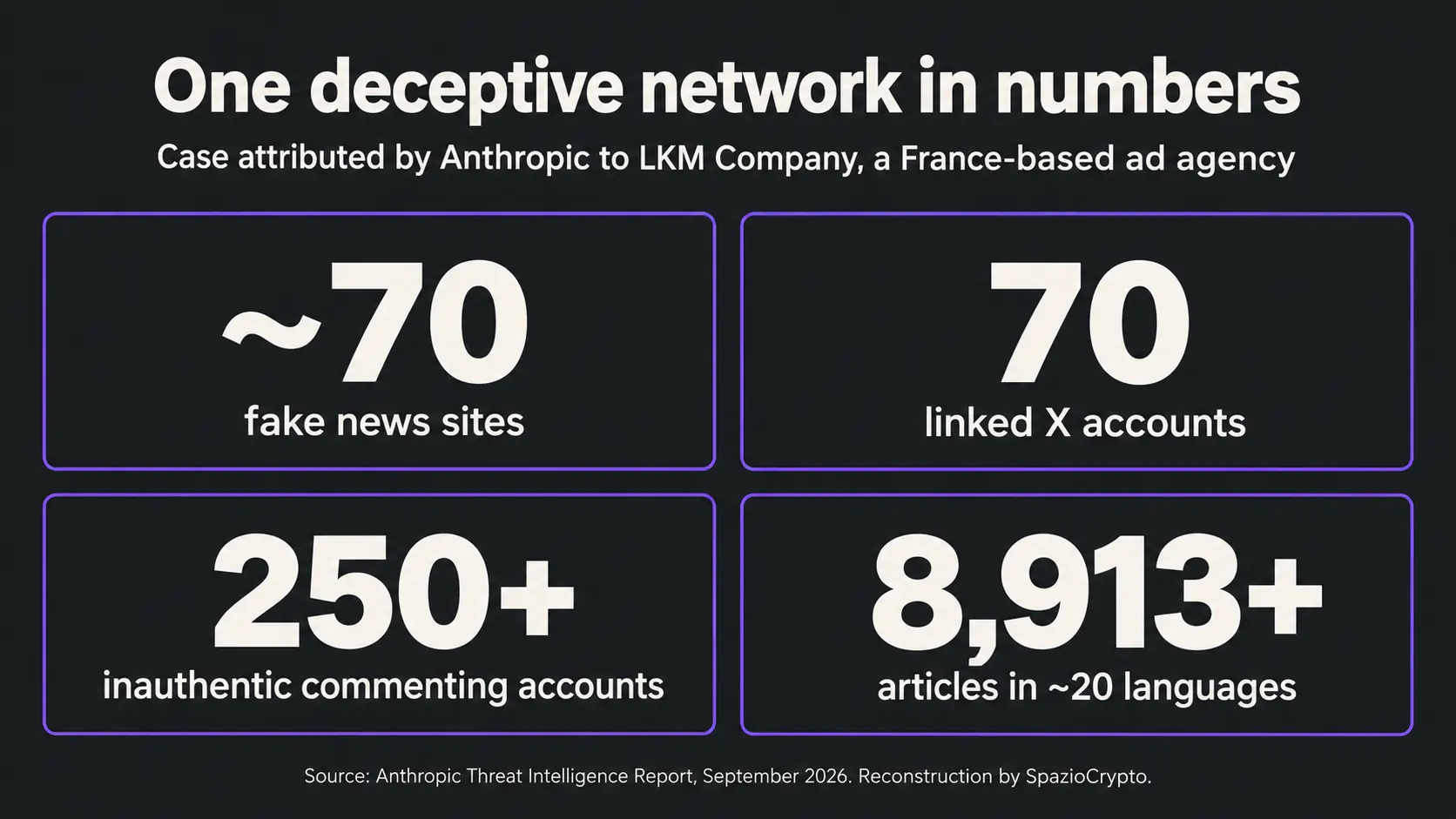
Anthropic's September threat intelligence report gives concrete context. According to that report, Anthropic attributed to LKM Company, an advertising agency based in France, a network of roughly 70 fake news sites, 70 linked X accounts, and more than 250 accounts posting inauthentic comments, producing at least 8,913 articles in approximately 20 languages. Anthropic states it banned both the account and the associated organization and introduced new detection methods based on behavioral signatures of the operation. The attribution is Anthropic's own and has not been independently verified.
The policy binds users of Anthropic products, not the broader market. For crypto, where undisclosed promotion is a recurring problem, the clauses on hidden sponsorship and networks of “independent” sites are the most directly relevant to daily practice. The same goes for anyone working on SEO and AI answer visibility: manipulating the sources AI systems draw from is now an explicit written prohibition. That's a SpazioCrypto reading of the text; the policy does not name the crypto sector.
Elections, Surveillance, and Weapons
The elections section has been renamed “Do Not Undermine Democratic Processes” and refocused on voter deception and disruption of electoral procedures. Anthropic removed the broad prohibition on personalized voter targeting and campaign activity, noting that the original conduct remains banned under the deceptive campaigns, surveillance, and privacy sections. A wide rule falls; the underlying conduct doesn't.
The surveillance section is fully rewritten. Tracking or monitoring a person without their consent is prohibited, whether in real time or by analyzing already-collected data. Claude cannot be used “to decide or recommend who to investigate, arrest, or prosecute.” The policy also bans identifying, unmasking, or locating people based on anonymous or pseudonymous activity, and building or improving surveillance tools. Named exceptions include analysis or tracking consented to by those involved (such as fraud or anti-money-laundering checks on a financial account), apps the user has opted into, aggregated or anonymized analysis, content moderation, authorized security research, lawful law-enforcement or court-ordered research, and journalism, provided none of these are used for prohibited purposes.
For anyone doing on-chain analysis, the phrase “anonymous or pseudonymous activity” deserves close attention: wallet addresses are pseudonymous by nature. The policy's stated exception covers fraud and anti-money-laundering checks on a financial account. How that framework applies to blockchain investigations is left unstated, and we're not interpreting it here. The tension between financial surveillance and privacy is one this publication has covered in the context of privacy coins rising as surveillance expands.
On weapons, the policy bans developing or operating software and components for testing or deploying weapons, and prohibits arming or integrating weapons onto drones, vehicles, or other unmanned or autonomous platforms. Anthropic stated the changes reflect how the previous policy was already being enforced in practice.
Agents and physical actions: who is responsible for what
The rule on agents is stated plainly: users bear responsibility for ensuring that agents they build or deploy, including actions taken “through tools, browsers, or connected systems,” comply with the Usage Policy. That framing matters for the wave of wallet-enabled agent products now reaching market. In August, SpazioCrypto covered the AI agent wallets launched by MetaMask, Coinbase, OKX, and BNB Chain, with the question of accountability still open when autonomous software moves funds. Under Anthropic's policy, compliance responsibility falls on whoever builds or deploys the agent. Legal liability for an actual fund transfer is a separate question the policy does not address. Reliability is yet another layer: a benchmark across 52 professional domains found agent performance below acceptable thresholds in nearly every domain tested, with Python as the sole exception.
Requirements for high-risk use cases remain unchanged: qualified human oversight and disclosure to the person affected that AI was used. The section now specifies, however, which recommendations are covered and which fall outside its scope. The genuinely new element concerns hardware. For equipment that takes autonomous physical actions and could cause injury, Anthropic requires a qualified operator capable of observing and halting the machine, which must also maintain a safe state if Claude is disconnected. The policy identifies six categories of action warranting scrutiny: movement in shared spaces, application of force capable of causing injury, control of energy or hazardous materials, action on the human body, control of safety systems, and operation of industrial processes.
The update also references the Model Hardware Standard, a shared specification Anthropic published on August 27 in research preview, designed to let agents use physical devices such as lab and manufacturing equipment without custom integrations. Anthropic acknowledges that current models still have limitations in physical reasoning and require expert supervision.
On “cruelty” toward models: what the text actually says
The clause that drew the most attention appears in the section on cruel, abusive, or psychologically harmful conduct. The list of prohibited uses now includes prolonged and purposeless abusive or cruel behavior toward Anthropic's models. The company specifies the ban applies only to extreme cases, meaning repeated abuse with no recognizable purpose, and “does not apply to common forms of user frustration, challenges, dark creative themes, testing, or research on models,” per Anthropic's announcement.
The enforcement mechanism is already established. Anthropic's primary tool remains Claude's ability to end conversations with persistently abusive users on Claude.ai and Claude Code. That feature was introduced on August 15, 2025, for Claude Opus 4 and 4.1, in consumer chat interfaces, as a precautionary measure tied to research on model welfare. Anthropic has stated uncertainty about Claude's moral status and that of language models generally. Neither the announcement nor the policy claims Claude is conscious or experiences emotions, and the term “model welfare” does not appear in the announcement itself.
Claude’s new rules at a glance
What is confirmed, what is not. Sources: Anthropic announcement, Usage Policy, September sector report
- Confirmed: announcement dated October 8, 2026, effective November 12; new section on deceptive campaigns and artificial political or commercial activity; rewritten surveillance rules; bans on weapons software and integration; conditions for hardware with autonomous physical actions; prohibition on severe and prolonged abuse toward models.
- Not specified: account-level consequences, definition of “prolonged,” full list of surveillance exceptions, and application to analysis of pseudonymous on-chain activity. No claims about Claude’s consciousness.
- To watch: the text taking effect November 12, any clarifications from Anthropic, and the first enforcement cases to be covered in the next threat intelligence report.
The bigger picture
Taken together, this update reads as a document about AI's shift from a tool that responds to a system that acts. Nearly every new or rewritten rule concerns what a model can do with tools, accounts, and devices: publishing content at scale, tracking individuals, or operating machinery. That thread connects this policy to three topics SpazioCrypto has tracked closely: agent wallets, the reliability of delegated work, and the call to slow AI development made in September by Anthropic CEO Dario Amodei, covered in our article on Amodei, Altman, and Musk urging a slowdown on AI. No declared link exists between these events and the policy update; they are context, not causation.
There is also a European dimension worth noting. The three European Union financial supervisory authorities (EBA, EIOPA, and ESMA) warned in September that heavy reliance on non-EU digital providers, AI models included, can amplify geopolitical shocks and multiply operational risks, as SpazioCrypto reported in the piece on EU finance and its dependence on foreign AI. Usage policies are one concrete expression of that dependence: anyone building on Claude accepts rules set by a U.S. provider, revised annually and communicated with roughly five weeks' notice between the October 8 announcement and the November 12 effective date.
Three signals are worth tracking: the text as it stands on November 12, the account-level consequences the announcement leaves unspecified, and the first enforcement cases Anthropic will document in upcoming reports. Until that day arrives, this is an announcement with a date, not a rule already in force.