


Ledger vs Trezor comes down to eight models, two security philosophies. Prices ranging from around $59 to $399, according to Coin Bureau reviews updated June 2026. Ledger bets on a certified security chip and proprietary software, with more Bluetooth-enabled models and a paid recovery service. Trezor bets on open-source firmware that anyone can audit, lower entry prices, and multi-share backup. In every security incident covered in this guide, no one extracted private keys from a customer’s device. The real, recurring threat for both brands is customer data reaching scammers.
TL;DR: Ledger offers five models ($79-$399) with a certified chip and proprietary firmware; Trezor offers three Safe models ($59-$249) with open-source firmware and an EAL6+ secure element. Neither brand has suffered confirmed key extraction from devices, but both have had customer data breaches used for targeted phishing.
A quick note on sourcing: we did not test these devices in a lab. Model ranges and pricing come from Coin Bureau reviews updated June 2026 and manufacturer announcements reported in the press. The incident timeline is drawn from The Register, BleepingComputer, CoinDesk, and the Trezor security page. Prices should always be verified on each brand’s official store before purchase.
Two Security Philosophies
A hardware wallet keeps private keys off your computer and signs transactions on the device itself. The keys are what need protecting. Ledger and Trezor protect them differently, and that difference matters more than the spec sheet suggests.
Ledger uses a secure element, a chip engineered to resist physical attacks, with CC EAL6+ certification on the Nano Gen5 according to Coin Bureau, running a proprietary operating system whose code is not public. Trezor was born open source and remains so in its firmware. Starting with the Safe series, Trezor added a certified EAL6+ secure element to protect the PIN and secrets. The Safe 7 pairs that chip with the TROPIC01, a secure element whose design, according to hardware-wallets.net, can be reviewed by independent researchers.
The choice is really between two forms of trust: trusting a certified chip and a company that keeps its code closed, or trusting code that anyone can inspect. Neither option is objectively superior. Both have genuine trade-offs.
Models and Prices
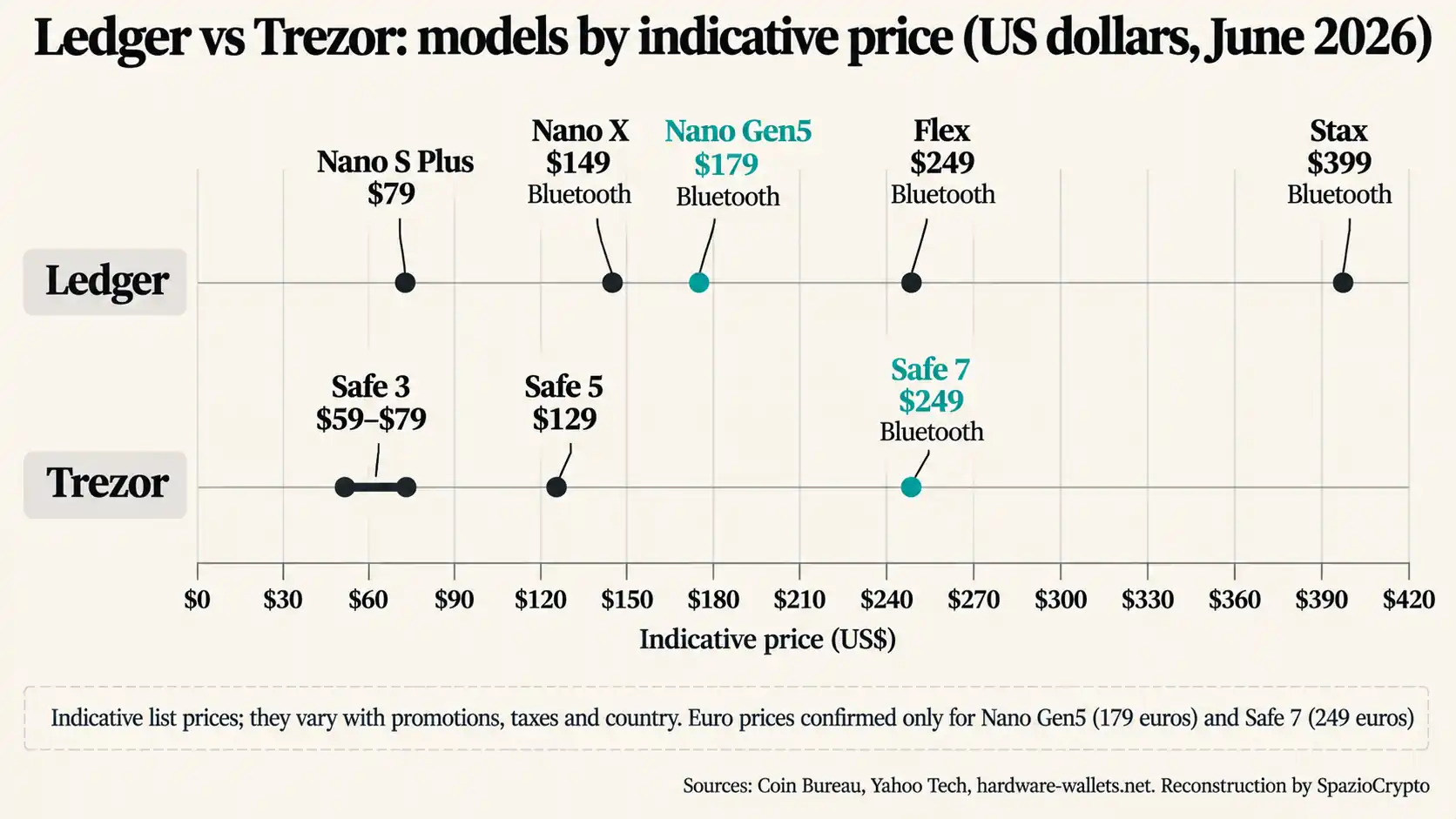
| Model | Approximate Price | Screen | Connectivity |
|---|---|---|---|
| Ledger Nano S Plus | $79 | 1.1” OLED | USB-C |
| Ledger Nano X | $149 | 1.1” OLED | USB-C, Bluetooth |
| Ledger Nano Gen5 | $179 / €179 | 2.8” E Ink touch | USB-C, Bluetooth, NFC |
| Ledger Flex | $249 | 2.8” E Ink touch | USB-C, Bluetooth, NFC |
| Ledger Stax | $399 | 3.7” curved E Ink touch | USB-C, Bluetooth, NFC, wireless charging |
| Trezor Safe 3 | $59-$79 | 0.96” monochrome | USB-C |
| Trezor Safe 5 | $129 | 1.54” color touch | USB-C |
| Trezor Safe 7 | $249 / €249 | 2.5” color touch | USB-C, Bluetooth, Qi2 charging |
Prices in USD per Coin Bureau, June 2026; EUR prices per Yahoo Tech and hardware-wallets.net. Prices vary with promotions and region.
Ledger has the broader lineup: five models from $79 to $399, four of which include Bluetooth. The most recent is the Nano Gen5, launched in October 2025 at $179 (or €179), featuring a touch screen, Bluetooth, and NFC. Trezor has three Safe models ranging from roughly $59 to $249. The Safe 7, also launched in October 2025, is Trezor’s first Bluetooth-enabled device; the Safe 3 and Safe 5 are USB-C only.
Apps and Daily Use
Ledger is managed through Ledger Wallet, the rebranded name for Ledger Live since October 2025. Trezor runs through Trezor Suite, available as both a desktop app and a web interface. Both platforms support Bitcoin, Ethereum, Solana, and a wide range of compatible networks.
One thing worth keeping straight: a hardware wallet protects your keys, not the underlying asset. If you hold stablecoins, the issuer risk remains regardless of which device you use. And before sending any token, always confirm the network, because a token sent to the wrong chain can be very difficult to recover.
Backup and Recovery
This is where the two brands diverge most sharply. Ledger offers Ledger Recover, an optional service launched in October 2023 after significant backlash. The private key is encrypted, split into three fragments, and held by Ledger, Coincover, and EscrowTech, with identity verification via document and video. According to CryptoPotato, the service costs €9.99 per month. For touch-screen models, Ledger also sells a physical Ledger Recovery Key card at $39, or $99 for a pack of three, per Coin Bureau.
Trezor takes the opposite approach. Trezor offers no managed recovery service. On Safe models, it supports multi-share backup: the recovery phrase is split into shares, and only a subset of those shares is needed to reconstruct the original. Ledger Recover is convenient for anyone who fears losing their seed phrase, but it introduces third parties and verified identity into a system designed to avoid exactly that.
Security Incidents
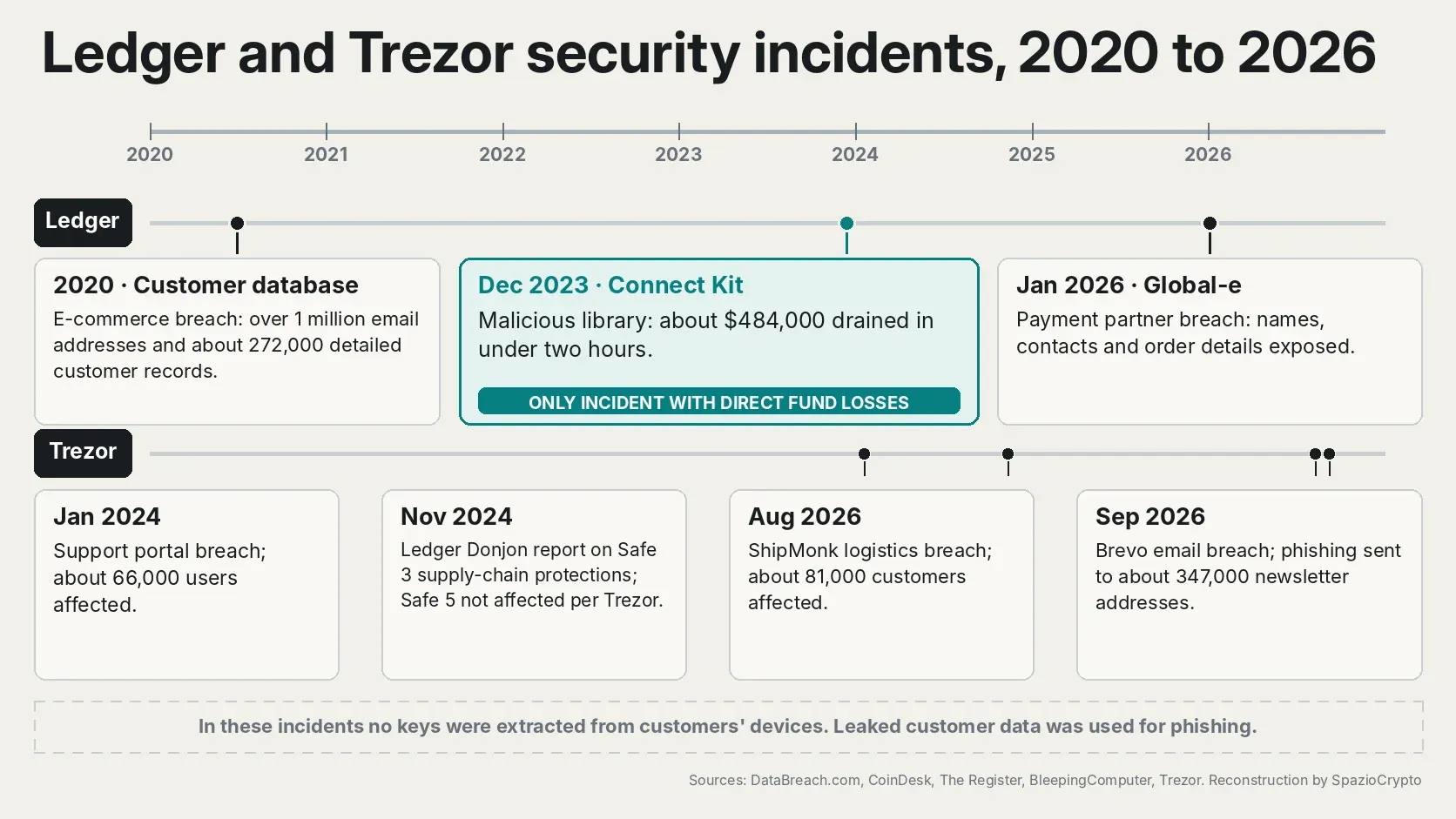
Ledger has had three notable incidents. In 2020, a breach of Ledger’s e-commerce database exposed over one million email addresses and roughly 272,000 full records including names, addresses, and phone numbers; according to DataBreach.com, the data was published online in December 2020 and used for phishing and physical threats. On December 14, 2023, a malicious version of the Connect Kit library allowed attackers to drain approximately $484,000 from users of decentralized applications in under two hours, as reported by CoinDesk. In January 2026, an attack on Global-e, a payments partner, exposed customer names, contact details, and order information, per The Register.
Trezor has also seen repeated third-party exposure. In January 2024, a breach of the support portal affected roughly 66,000 users. Ledger’s Donjon security team reported in November 2024 that certain anti-tamper protections in the Safe 3 during the supply chain phase could be bypassed; Trezor stated the Safe 5 was not affected. In August 2026, a breach at logistics provider ShipMonk exposed data for approximately 81,000 customers. In September, an attack on email service Brevo allowed phishing emails to reach roughly 347,000 newsletter subscribers, according to BleepingComputer.
The pattern is consistent across both brands: in none of these incidents were private keys extracted from customer devices. Every attack targeted customer data first, then used that data to pressure people into revealing their seed phrase via email, phone calls, or physical mail.
What US and UK Buyers Should Know
The ShipMonk breach in August 2026 affected customers worldwide, including buyers who ordered a Trezor device between May 10 and August 8, 2026, according to BleepingComputer. Anyone who purchased during that window should treat unsolicited contacts about their device as a scam attempt. The rule is simple: no hardware wallet manufacturer ever asks for your seed phrase, whether by email, phone, or letter. During our research, we also found pages mimicking official setup guides. Always follow the setup process exclusively from the brand’s official website.
Which One to Choose
For buyers who want to spend less and verify the code themselves, the Trezor Safe 3 or Safe 5 is the more consistent choice. For anyone who relies on a smartphone and wants Bluetooth with a larger screen, Ledger offers the most options, from the Nano Gen5 to the Flex, and the Trezor Safe 7 is also worth considering at the same $249 price point. For those who genuinely worry about losing their seed phrase and accept third-party involvement as a trade-off, Ledger Recover is worth evaluating.
None of that matters much without the right habits. Buying only from official channels, storing the seed phrase entirely offline, and never entering it on any website are the behaviors that actually protect your funds.
Confirmed, Unconfirmed, and What to Watch
What this guide can confirm, what it can’t, and what to monitor going forward:
- Confirmed: Ledger has proprietary firmware and five models from $79 to $399, per Coin Bureau. Trezor has open-source firmware, an EAL6+ secure element in the Safe series, and three models from roughly $59 to $249. All incidents documented here targeted customer data, not device keys.
- Not confirmed: Official EUR pricing for all models, the exact number of supported cryptocurrencies, and chip certification details for every Ledger model.
- To watch: New model releases and price updates, fresh breaches involving third-party logistics or email vendors, and Ledger’s evolving approach to Recover and identity verification.
The Bigger Picture
The contest between Ledger and Trezor has shifted from the device to the perimeter. The chips hold. What gives way are payment processors, shipping providers, and email platforms, and every breach turns a customer list into a targeting list. For buyers, the right question isn’t only which chip is better. It’s how much personal data you leave behind when you place an order.
Trust is the second layer. Anyone holding stablecoins on either device should remember that the hardware doesn’t eliminate issuer risk. The signals worth tracking from here are both brands’ next hardware releases, their data-handling practices with third-party vendors, and the direction Ledger takes with Recover and identity requirements.