

x402 is an open protocol, launched by Coinbase in May 2025, that uses the dormant HTTP 402 status code to charge AI agents, bots, or human visitors for web pages, data, and APIs in stablecoins, often for fractions of a dollar. The Linux Foundation’s x402 Foundation, launched with 40 members in July 2026, now governs the standard. Here’s what it is, how it works in six steps, who runs it, and what a website needs to start collecting micropayments from AI agents.
TL;DR: x402 revives the long-dormant HTTP 402 code to let servers charge AI crawlers fractions of a cent per request, paid in stablecoins like USDC. The x402 Foundation, backed by Visa, Mastercard, Google, and Cloudflare, formally launched in July 2026 with over 75 million transactions recorded in the 30 days to mid-July 2026, according to CoinDesk.
A Code That Sat Unused for Thirty Years
HTTP 402 was written into the web’s earliest specifications as a placeholder: a server could tell a client “payment required” before delivering a resource. For nearly three decades, almost no one used it. According to Wikipedia, the practical reasons were straightforward: online payments were slow, expensive, required user accounts and active sessions, and routed through intermediaries vulnerable to chargebacks. As CoinDesk has noted, card networks cannot profitably process charges of a few cents.
Stablecoins change that arithmetic. A digital dollar moving on-chain, with no account to open and no intermediary to manage, makes a one-cent payment economically viable. That is the wager behind x402: use the grammar the web already speaks, HTTP requests and responses, to move money alongside data.
How x402 Works: Six Steps Inside One Request
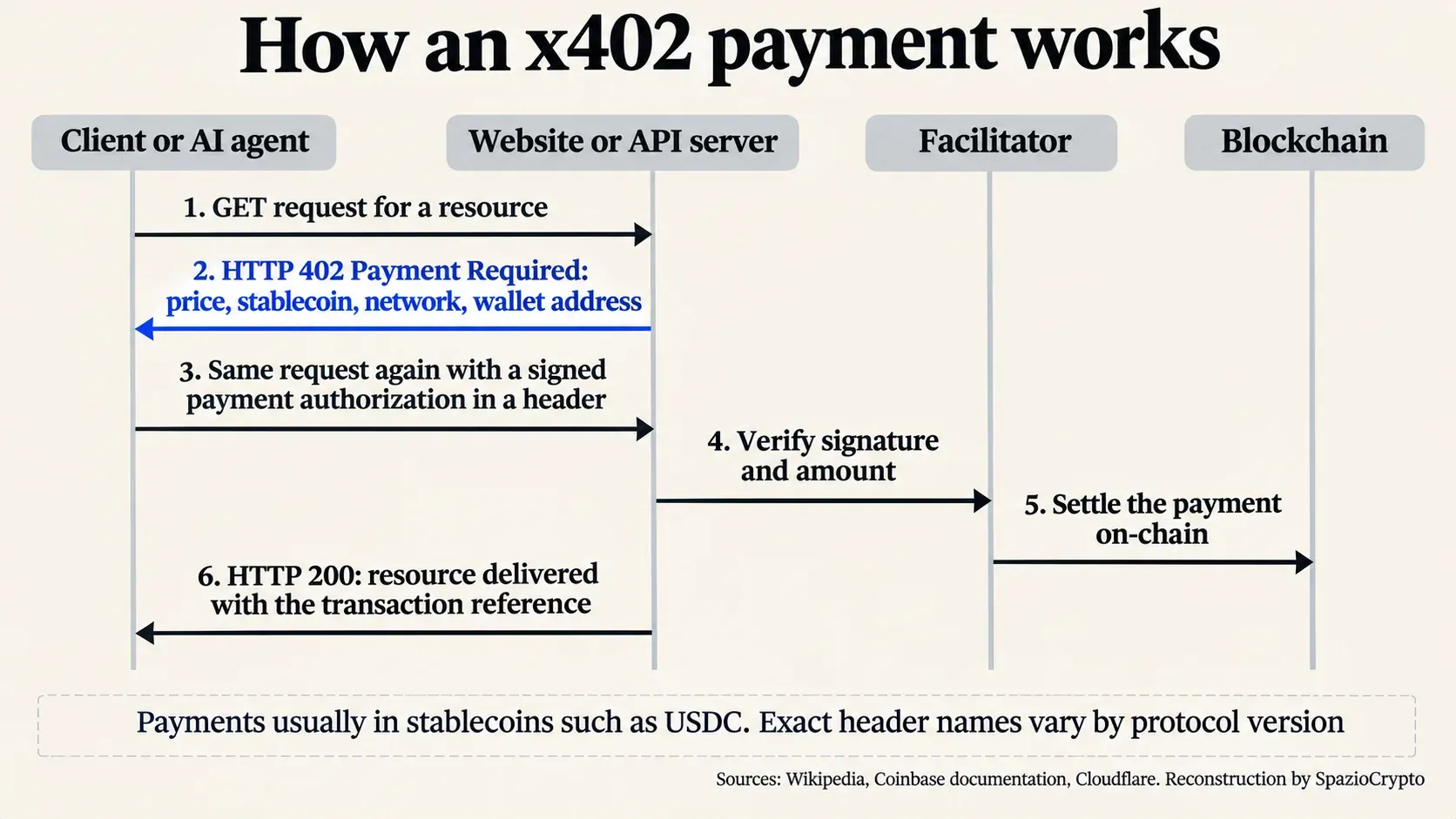
According to Wikipedia’s description, derived from Coinbase’s documentation, the flow runs as follows.
- A client, whether a person, an AI agent, or an automated script, sends a normal HTTP request for a resource.
- If the resource is paywalled, the server responds with a 402 status, specifying the price, the accepted stablecoin, the target network, and the destination wallet address.
- The client’s wallet signs a payment authorization and repeats the request with that authorization attached in a dedicated header.
- A facilitator, or the server itself, validates the signature and confirms the payment matches the declared price.
- The transaction is broadcast to the blockchain for settlement.
- After confirmation, the server returns a 200 response and delivers the resource, along with the transaction identifier.
The facilitator is the practical pivot here: a website does not need to run blockchain nodes or verify signatures itself, because an external service or hosting platform handles that. The payer needs only a wallet holding a stablecoin balance. Version 2 of the protocol, published in December 2025 according to Dwellir, introduced standard network identifiers and support for multiple facilitators.
Per Dwellir’s analysis, x402 currently operates across seven networks including Base, Solana, Polygon, and Ethereum, with stablecoins including USDC and EURC. The protocol itself does not handle card payments, though Wikipedia notes that some individual facilitators do accept traditional payment methods alongside crypto.
Why Websites Want to Charge AI Agents
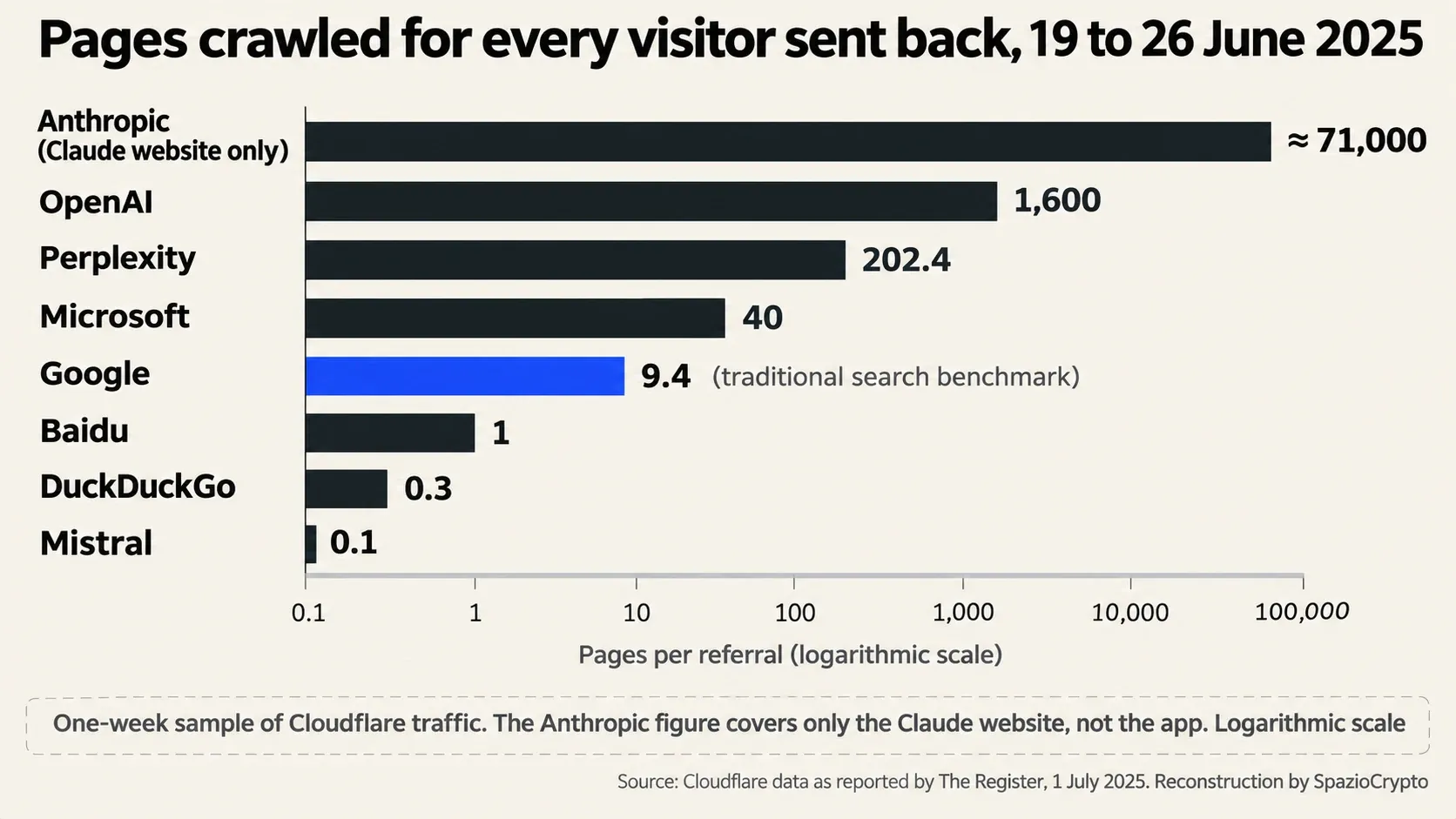
For two decades, the implicit deal between websites and search engines was symmetrical enough: a crawler reads the page, the engine sends human visitors back. AI agents have broken that symmetry. Cloudflare data for the week of June 19 to 26, 2025, as reported by The Register, makes the gap vivid. Google generated roughly 9.4 page requests per referred visit. OpenAI generated around 1,600 requests per referred visit. Anthropic, counting only the Claude.ai domain, generated close to 71,000 requests per referred visit.
Cloudflare CEO Matthew Prince stated publicly that the old arrangement in which Google took content in exchange for traffic “no longer makes sense.” On July 1, 2025, Cloudflare began blocking AI crawlers by default and launched a private beta of Pay Per Crawl: a crawler declares its intent to pay, receives the page, or receives a 402 with a price attached.
On July 1, 2026, Cloudflare announced its Monetization Gateway, extending the x402 scheme to any resource: pages, APIs, and agent-specific tools. According to Intelligent CIO, the service was in closed beta as of October 2026, with payments in USDC on the Base network. Early users include the Ceramic.ai search engine, Stocktwits, and API2PDF. Publishers choose which requests to monetize and at what price; Cloudflare’s own example is one cent per call to a premium section.
Who Governs the Standard
x402 no longer belongs to Coinbase alone. In September 2025, Coinbase and Cloudflare announced plans for a dedicated foundation. That same month, according to Decrypt, Google unveiled AP2, its own agent-payment protocol, with an x402 extension for stablecoin transactions. On July 14, 2026, the Linux Foundation announced the operational launch of the x402 Foundation with 40 founding members. According to CoinDesk, key members include Visa, Mastercard, American Express, Stripe, Adyen, Fiserv, Shopify, Google, Amazon Web Services, Cloudflare, Ripple, Circle, and the Solana and Stellar foundations.
Competition exists even within the foundation. Stripe has also backed a separate standard called MPP, launched on March 18, 2026 according to Dwellir. MPP uses authentication headers already defined in HTTP and accepts cards and Lightning Network payments alongside stablecoins. That gives Stripe a foot in two camps simultaneously.
Many Transactions, Modest Dollars
Transaction counts are growing fast; total value is still modest. According to CoinDesk, citing x402.org data, the protocol recorded roughly 75 million transactions totaling about $24 million in the 30 days to mid-July 2026. The average payment was approximately $0.32, with around 94,000 buyers and 22,000 sellers active. For scale, CoinDesk notes that Visa processes around $40 billion per day.
Chainalysis, in figures cited by AI Weekly on the basis of Fortune reporting, counts over 138 million cumulative x402 payments on the Base network alone through the third quarter of 2026, compared with roughly 1,500 payments at mid-2025. More than 87% of those transactions were under $0.10. AI Weekly cautions that the data does not separate genuine commerce from developer tests and automated scripts, so the real commercial volume is lower than the raw count suggests.
The Limits Worth Knowing
The first friction point is the wallet requirement. Anyone paying via x402 needs a compatible wallet, and for an AI agent that means entrusting private keys and a balance to software. A dedicated agent wallet with a capped balance is a reasonable precaution, keeping exposure limited if the agent behaves unexpectedly or is compromised.
Wikipedia flags two structural concerns: dependence on the availability and speed of the underlying blockchain network, and regulatory uncertainty around crypto-asset payments across multiple jurisdictions. MiCA, the EU’s crypto framework, provides some clarity for European publishers and users, but cross-border stablecoin settlement still sits in a patchwork of rules. The choice of stablecoin also matters: USDC and EURC differ in issuer, reserve transparency, and redemption mechanics, and picking the wrong one can create compliance headaches.
There is also a behavioral limit. According to an independent analysis by Godberry Studios, some bots that received a 402 response from Stack Overflow simply stopped making requests rather than paying. If large AI developers decide the cost of compliance outweighs the benefit of access, the protocol’s adoption curve stalls.
What a Website Needs to Get Started
The simplest path today runs through Cloudflare, but Monetization Gateway remains in closed beta, and certain features, including payments for AI inference, are currently restricted to U.S. customers according to Intelligent CIO. The alternative is integrating x402 directly via open-source libraries paired with an external facilitator. Either way, revenue arrives in stablecoin on a wallet, and any publisher activating this needs to clarify the tax and accounting treatment with their own advisers before going live. In the U.S., IRS guidance on crypto as property means each micro-settlement could technically be a taxable event; in the EU, MiCA and national VAT rules add further layers to consider.
Confirmed, Uncertain, and Worth Watching
What the record shows:
- Confirmed: x402 uses HTTP 402 with stablecoin payments. Since July 2026, governance sits with the x402 Foundation under the Linux Foundation, with 40 members. Cloudflare uses it for Monetization Gateway, currently in closed beta with USDC on Base.
- Not established: what share of transaction volume reflects genuine commerce versus developer tests; how many websites are actually collecting revenue; when Pay Per Crawl and Monetization Gateway will open to all publishers.
- Worth watching: how MPP and AP2 coexist or compete with x402; data from early publisher adopters; whether major AI developers choose to pay rather than withdraw from paywalled content.
The Bigger Picture
x402 does not change how money moves so much as it puts a price on something that was previously given away. For two decades, the value of web content flowed through advertising and traffic metrics. When an AI agent reads a page without generating a visit, that revenue model breaks down, and HTTP 402 becomes the mechanism for repricing the read itself.
The standard is built on digital dollars. USDC remains the dominant stablecoin within x402, and its continued expansion, including into emerging markets, means the protocol’s default currency is a U.S.-dollar instrument governed by U.S. rules. For European publishers and policymakers, that is a structural dependency worth tracking, especially as the EU has already flagged concerns about reliance on non-European AI and financial infrastructure.
Three signals are worth monitoring. First, whether major AI developers, OpenAI, Anthropic, Google, accept the cost of paying for content rather than simply retreating from paywalls. Second, whether Cloudflare moves Monetization Gateway out of closed beta and makes it available to non-U.S. publishers. Third, whether the real commercial payment volume, stripped of developer tests and scripts, grows at anything like the rate that raw transaction counts suggest. If all three move in the right direction, x402 could become the invisible toll booth of the AI web. If they don’t, it remains an elegant idea waiting for adoption.