
Bitcoin-backed loans face a barrier in Italy that is not technical but legal: the Civil Code says nothing about what a crypto-asset is, nor how one can be delivered to a creditor. That is the core issue raised by attorney Antonio Di Giorgio, partner at Annunziata & Conso, on September 24 at the Chamber of Deputies during the parliamentary Intergroup event on “Digital Assets, Blockchain and Bitcoin.” His address, titled “Bitcoin as an asset subject to collateral,” is now available with video and transcript alongside 63 other contributions from the day. This is not a law or a bill: it is a technical proposal presented at a parliamentary event.
We reviewed the transcript of the speech, which runs 3 minutes and 36 seconds. For this portion of the event, the transcript consists of automatic subtitles, which the hosting site itself warns may contain errors, so all quotations should be read with that caveat in mind. The summary page does not indicate a publication date for the materials: October 10 is the date our editorial team recorded. We were not able to access Di Giorgio's LinkedIn posts or those of his firm, as our tools could not reach them.


What Di Giorgio Proposed
Di Giorgio opened with a real-world case from recent years: a crypto-asset-backed financing transaction in the real economy, the details of which he did not disclose. The question he drew from it is straightforward: the European MiCA regulation defines what a crypto-asset is, but “under the Civil Code, what is a crypto-asset? Is it a thing?” Legal scholarship and case law, he noted, already treat it as a property right, and he cited a June ruling by the criminal division of the Court of Cassation without specifying the case number. That is not enough for him, because the classification must come from statute: “Because the Civil Code tells me, not the interpreter of the moment.”
The proposal has two steps. First, recognise in the Civil Code that a crypto-asset, and Bitcoin specifically, is an asset that can be the object of security rights. Second, establish a rule clarifying how an asset that is intangible by nature can be dispossessed, delivered, or encumbered with a right of priority. With that foundation, he argues, intermediaries could offer a new product, a Bitcoin-backed loan, without having to navigate prudential requirements, the nature of the institution, or contractual arrangements from scratch, and Italy would gain international competitiveness.
On the ruling he cited, some caution is warranted. We cannot confirm it is the same decision, but one judgment from that month shows how much the classification depends on context: ruling n. 20740, filed on June 5, in a false declaration proceeding, is reported by Brocardi and Edotto to classify Bitcoin held for investment purposes as financial instruments or products, for tax purposes.
Why Traditional Pledge Law Does Not Fit Bitcoin
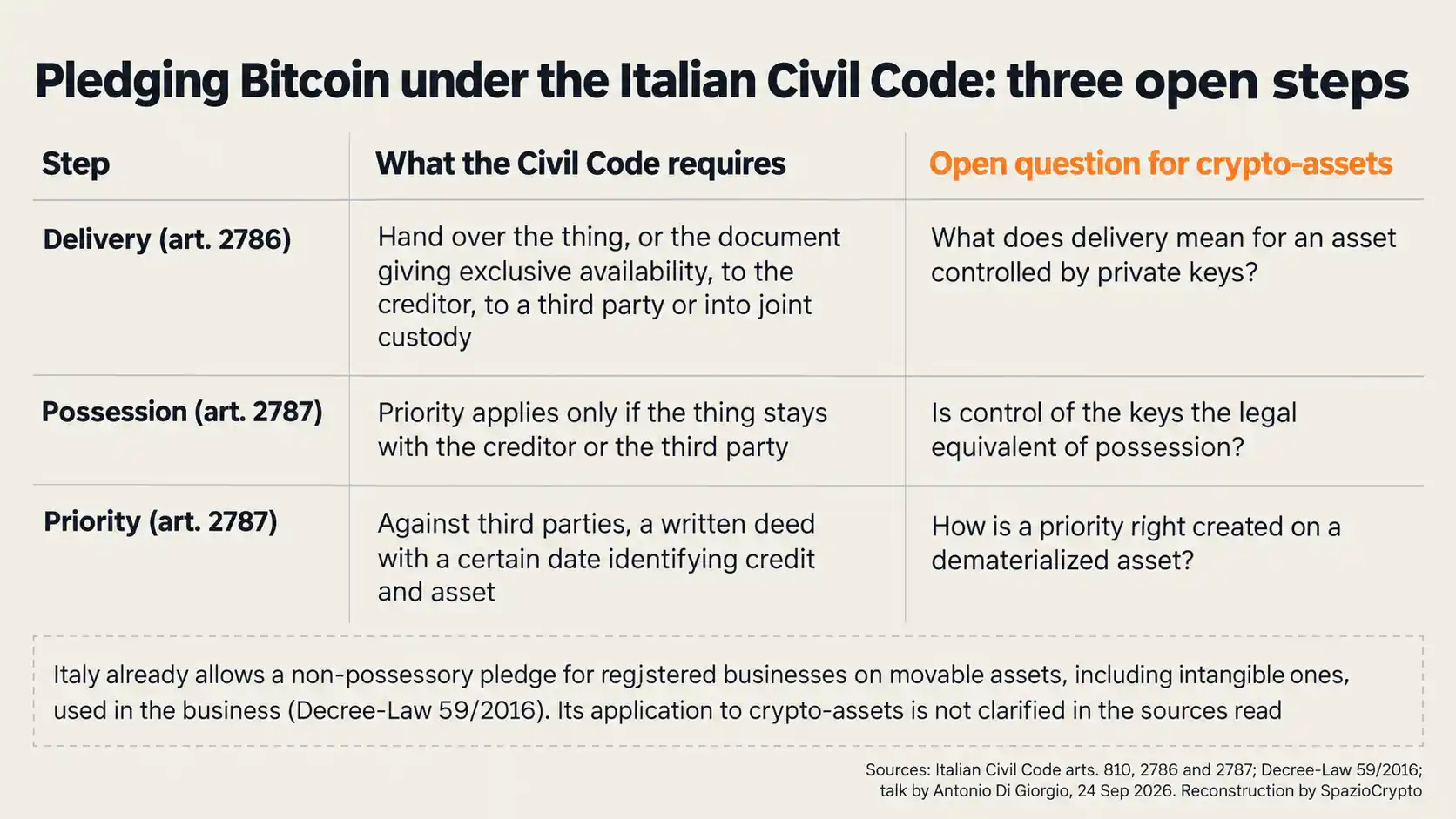
To understand the problem, you need to start with the Italian Civil Code of 1942, and what follows is our own explanation, not part of Di Giorgio's address. Article 810 defines assets as “things that can be the object of rights.” A pledge, the standard security over movable property, is constituted under Article 2786 by delivering the thing, or the document conferring exclusive control over it, to the creditor. Alternatively, the thing may go to a third party chosen by both sides, or remain in joint custody, such that the pledgor cannot dispose of it without the creditor's cooperation. Article 2787 adds that priority, meaning the creditor's right to be paid first from that asset, is valid only if the thing has remained in the possession of the creditor or the third party, and as against other parties requires a written instrument with a certain date identifying both the debt and the asset.
With Bitcoin there is no thing to deliver: there is control over the private keys that allow it to be moved, as we explain in our guide to cryptocurrency custody. The joint custody arrangement under Article 2786, which prevents either party from disposing of the asset without the other, closely resembles a wallet requiring multiple signatures to move funds. That parallel is our own reading, and it is precisely the kind of equivalence that no existing statute currently provides.
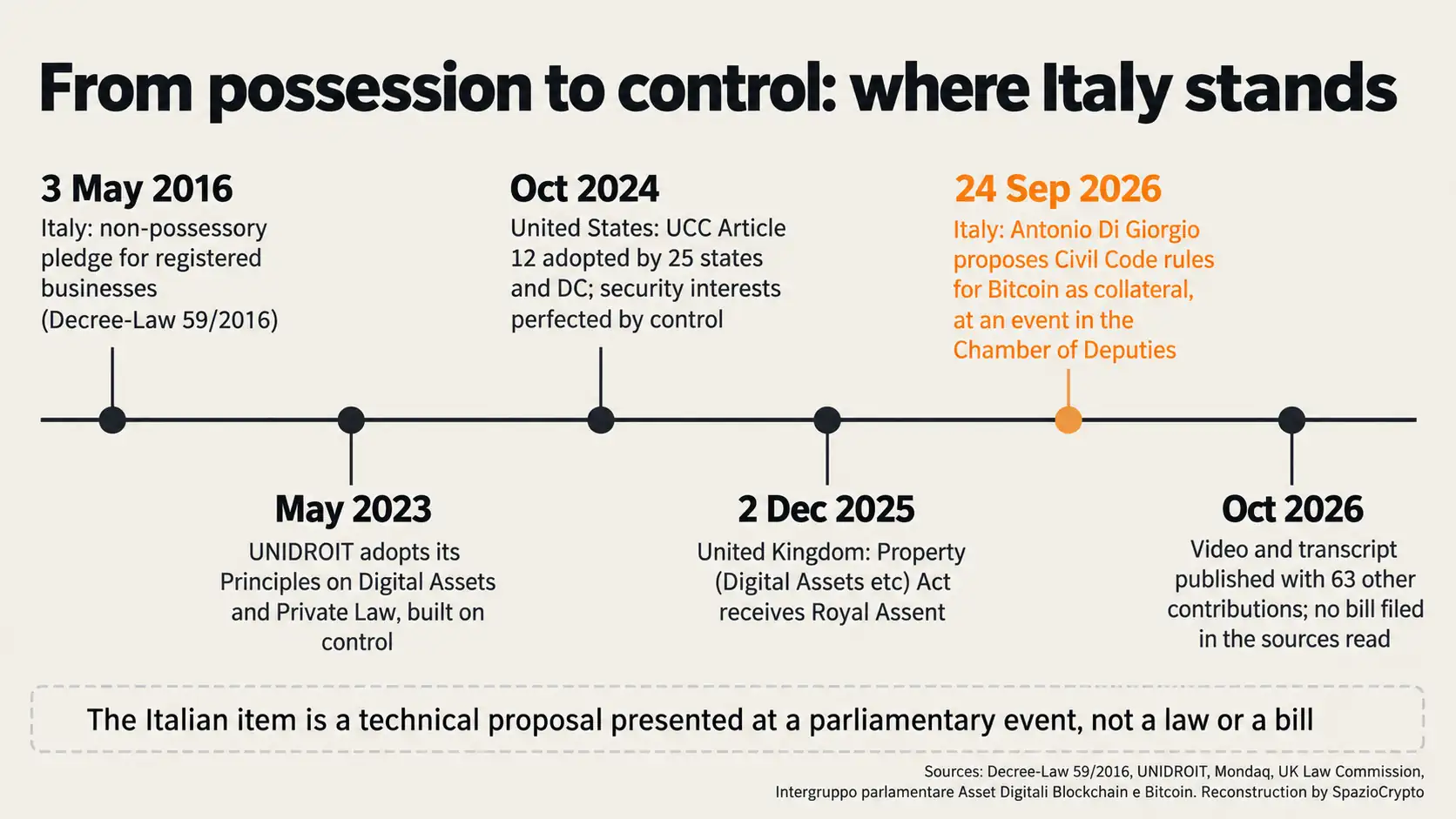
A useful precedent already exists. The non-possessory movable pledge, introduced by Decree-Law 59 of May 3, 2016, allows registered businesses to pledge movable assets, including intangible ones, used in business operations without transferring physical possession, through registration in a computerized register held by the Italian Revenue Agency. That shows that dispossession is not a legal dogma. The mechanism applies only to businesses and to assets tied to their operations; in the sources we reviewed, we found no clarification on whether it extends to crypto-assets.
How Other Jurisdictions Handle It
The problem is not uniquely Italian, and elsewhere the answer revolves around a single concept: control. The UNIDROIT Principles on Digital Assets and Private Law, adopted in May 2023, define a digital asset as an electronic record “that is capable of being subject to control”: the person who has control is the one who can obtain substantially all of the benefit, exclusively prevent others from obtaining it, and exclusively transfer those capabilities. The same Principles include dedicated rules on custody and security rights. In the United States, Article 12 of the Uniform Commercial Code, as revised in 2022, allows a creditor to perfect a security interest in so-called controllable electronic records, of which Bitcoin is the paradigm case, by obtaining control. A secured party with control takes priority over one that has merely filed a financing statement; according to Mondaq, by October 2024 the revised Article 12 had been adopted by 25 states and the District of Columbia. In the United Kingdom, the Property (Digital Assets etc) Act received Royal Assent on December 2, 2025, confirming a third category of personal property, while the Law Commission's recommendations on security interests in crypto-tokens were still under consideration at the time of enactment.
The common thread, in our reading, is that control takes the place of possession. That is precisely what Di Giorgio is asking Italy to define when he speaks of how to dispossess, deliver, and encumber an intangible asset with a right of priority.
What Would Change, and What Would Not
For Bitcoin holders, the appeal is straightforward: access liquidity without selling. Selling triggers a taxable event, and any capital gain realized in 2026 is taxed at 33% under Italian law, as outlined in our guide to crypto taxes in Italy. For banks and intermediaries, a statutory definition of crypto collateral would make the enforceability of security interests far more predictable. Our reading is that this debate is arriving precisely as Italy's largest banks move onto on-chain terrain, illustrated by the Qivalis euro stablecoin project involving UniCredit, Intesa and BPER.
 View Profile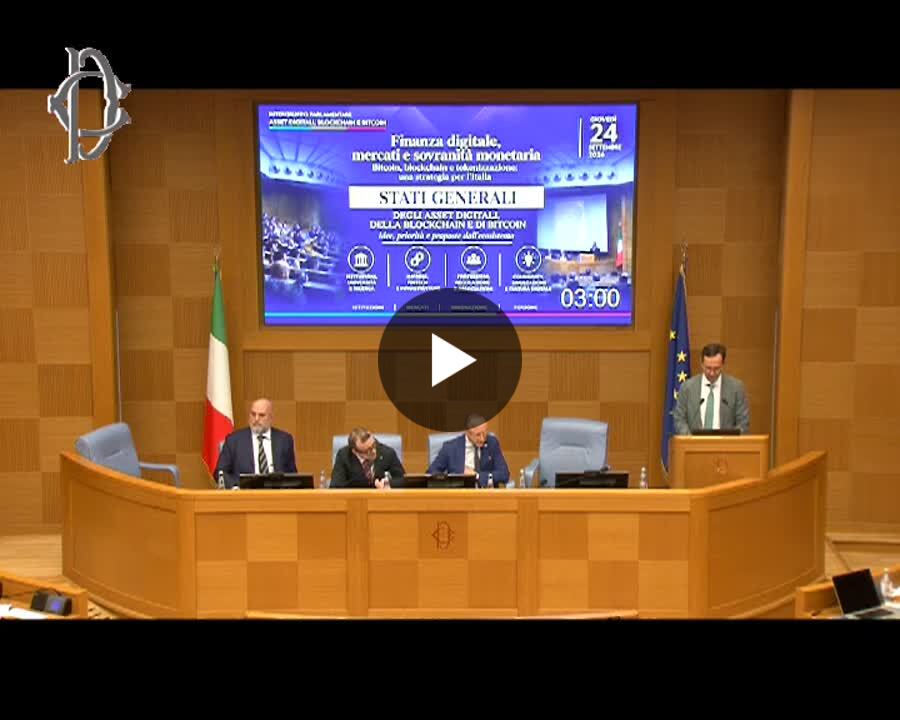
Three things, though, would remain unchanged. First: a euro-denominated loan secured by Bitcoin is legally distinct from crypto-asset lending, a category that MiCA leaves outside its scope. ESMA clarified in a June 18 response that the regulation “does not address” the lending and borrowing of crypto-assets, and set out expectations for service providers offering such products, covering everything from explicit client consent to risk disclosure. Second: collateral value fluctuates with the Bitcoin price, and managing that volatility stays a matter for contract. Third: the licensing framework remains unchanged, and as we explained in our piece on why MiCA alone is not enough to enter the Italian market, bank prudential requirements, which Di Giorgio himself references, remain a European-level matter. Tighter linkages between crypto and traditional finance also mean more transmission channels for stress, the very risk ESMA recently flagged.
Bitcoin as Collateral: At a Glance
What is confirmed, what is not
- Confirmed: Di Giorgio’s address on September 24 at the Chamber of Deputies, available online with video and transcript alongside 63 other contributions; a proposal to classify crypto-assets as property under the Italian Civil Code, and to regulate delivery, dispossession, and priority of claims.
- Not disclosed: any draft legislative text or bill; the details of the practical case cited; the citation for the Court of Cassation ruling referenced; the publication date of the official proceedings summary.
- To watch: the Intergroup’s forthcoming dossier and the phase planned for 2027, any bills introduced, the response from banks and intermediaries, and how European rules on crypto-asset lending evolve.
Where Things Stand
The Intergroup, chaired by Fratelli d’Italia MP Marcello Coppo and supported by a technical working table coordinated by Antonio Annino, billed the September 24 event as “the first major public presentation” of the work done so far. Mature proposals will be brought progressively into institutional dialogue, others will be developed further, and a new phase is scheduled for 2027. We had previewed the 14 working groups and the strategy taking shape before the event.
The collateral proposal belongs to Di Giorgio personally, not to the Intergroup as a body. Within the legislation and regulatory simplification working group, Stefano Capaccioli explained that an early draft document proposes amending the Civil Code with a positive definition of crypto-assets, but the group had not yet reached a shared position. The working group dedicated to banks, banking foundations, and pension funds made no mention of collateral in its contribution. None of the sources reviewed showed any text formally filed in Parliament.
Annunziata&ConsoThe Bigger Picture
The underlying tension is as old as credit itself: any lender wants certainty about what it can seize if a borrower defaults, and in what order relative to other creditors. Italy’s Civil Code answers with delivery and possession, categories built for physical objects, while Bitcoin is an asset controlled by a cryptographic key that nobody can hold in their hand. Legal systems such as those of the United States and the United Kingdom, along with the Unidroit principles, have opted to write a control-based rule explicitly. In Italy, the answer is still left to judicial interpretation. Our reading is that ambiguity carries a price: a lender unsure whether its security interest will hold tends to lend less, or at higher cost.
That is why Di Giorgio’s proposal, though delivered as a few minutes of remarks at a policy event rather than a parliamentary act, touches a nerve for banks, businesses, and Bitcoin holders alike. The concrete signals worth tracking: whether the Intergroup includes the proposal in its dossier, whether the legislation working group reaches a shared position on a Civil Code definition, whether any text is formally filed, and whether banks and intermediaries signal commercial appetite for the product. Until those signals arrive, this remains a well-argued idea, not a rule.