


Monte dei Paschi di Siena's board has judged Intesa Sanpaolo's takeover bid financially fair, accepting the terms of 1.25 euros in cash plus 1.664 new Intesa shares per MPS share. At the same time, the board contends the offer fails to capture the bank's full prospective value. On November 20, the board approved the issuer's statement on the Intesa MPS offer, declaring the consideration fair as of November 18, while formally contesting the premium level and the share of synergies allocated to MPS shareholders. The acceptance window opens November 24.
- On November 20, MPS's board unanimously judged Intesa Sanpaolo's consideration financially fair, using November 18 as the reference date.
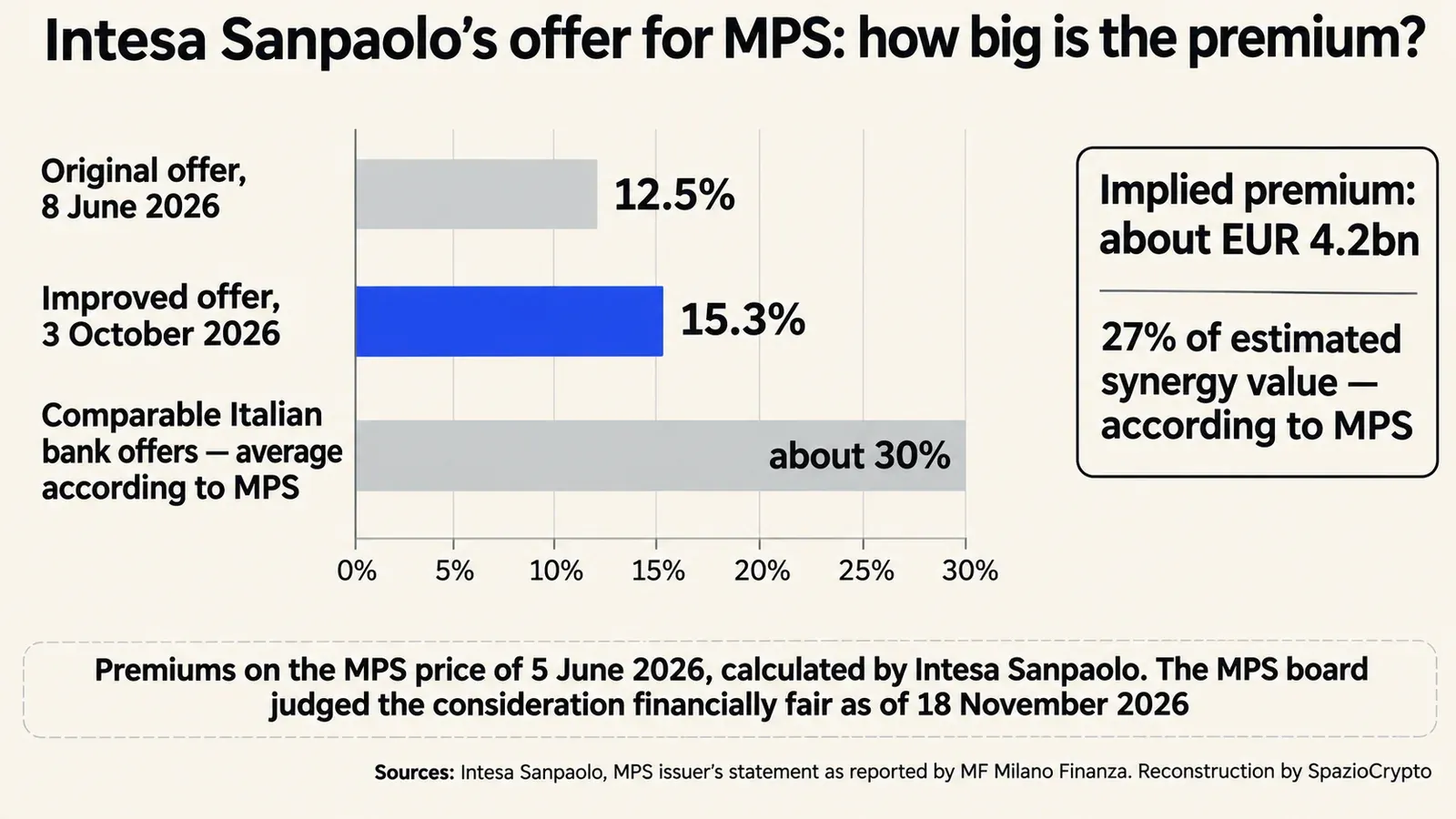
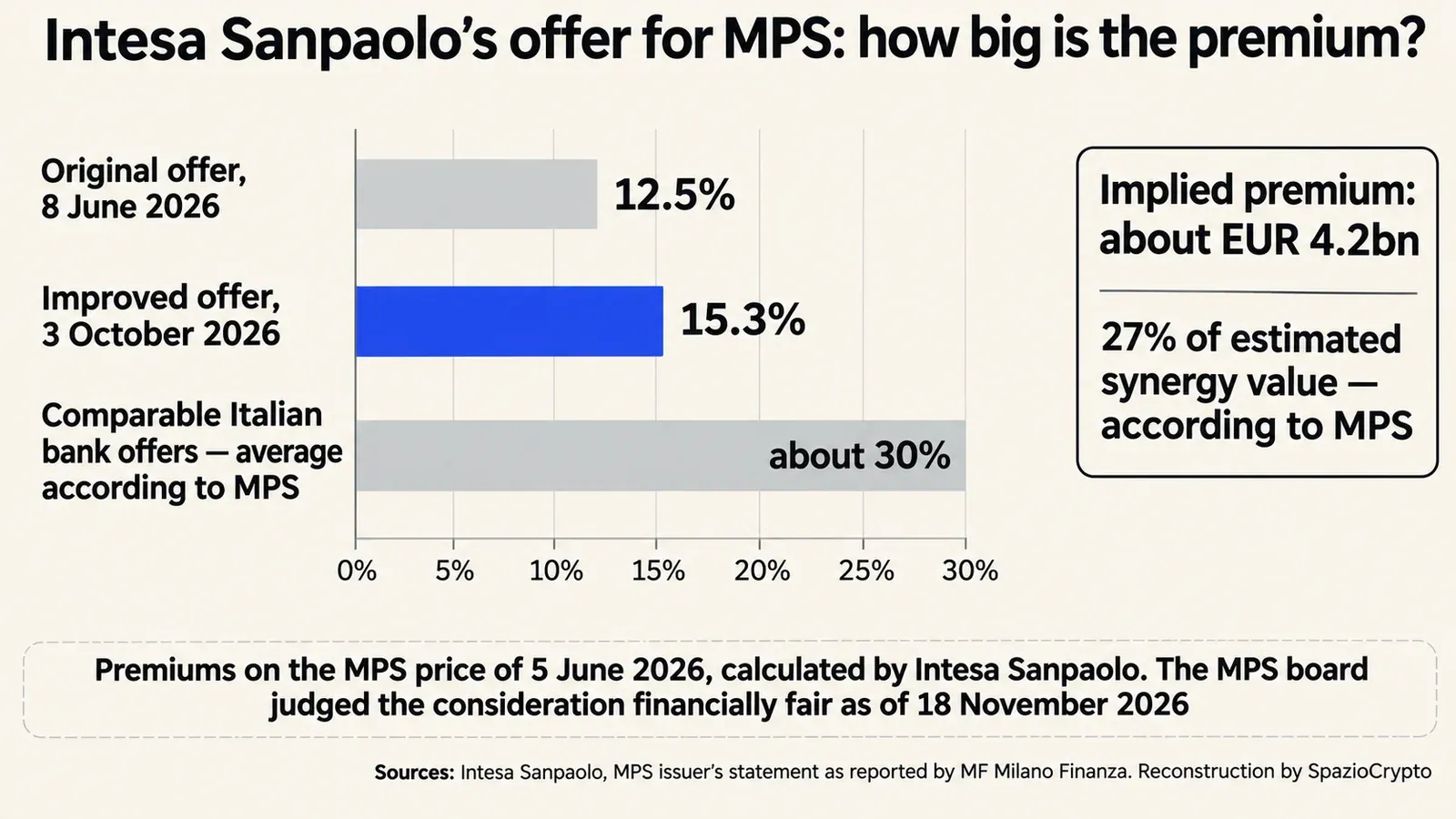
- MPS argues the offer does not fully reflect forward value: the implied premium stands at 15.3%, against an average of roughly 30% in comparable Italian banking deals, according to MPS's own analysis.
- The board statement neither recommends acceptance nor rejection. Corrado Passera resigned during the meeting.
- The acceptance period runs from November 24 to January 22, 2027; deal completion requires 66.67% of share capital.
What Did the MPS Board Decide?
Every director present voted in favor. Corrado Passera, former Intesa CEO elected on the minority shareholder slate, resigned with immediate effect during the session, citing “profound disagreement” with the offer, and did not cast a vote. The fairness determination rests on opinions from two financial advisors: according to Milano Finanza, these are UBS and Bank of America. The finding covers the financial profile only.
The board's conclusions are unambiguous. The document “does not in any way constitute” a recommendation to accept or to reject. The decision remains with individual shareholders. The tone marks a clear shift from the summer, when CEO Luigi Lovaglio was openly seeking alternatives and warning of the offer's “disaggregating” effects, as reported by ANSA.
What Is the Offer Worth?
Intesa Sanpaolo launched its cash-and-stock public exchange offer on June 8: 1 euro in cash plus 1.6 Intesa shares per MPS share, implying a 12.5% premium. On October 3 the cash component rose to 1.25 euros. On November 3 the exchange ratio was lifted to 1.664 to compensate for Intesa's interim dividend of 0.22 euros per share. The full terms are set out in the offer document approved by Consob on November 8.
| Item | June 8 Announcement | Acceptance Offer |
|---|---|---|
| Cash per MPS share | 1.00 euro | 1.25 euros |
| Intesa shares per MPS share | 1.6 | 1.664 (adjusted for dividend) |
| Implied value, Intesa calculation based on June 5 prices | 10.091 euros | 10.341 euros |
| Premium over MPS June 5 price | 12.5% | 15.3% |
| Total value at full acceptance | 30.6 billion euros | approx. 31.4 billion, of which 27.6 billion in shares |
At current market prices the picture shifts. According to ANSA calculations, the consideration is worth roughly 10.7 euros per MPS share, while MPS closed at 10.78 euros. The board itself notes that on the reference date the implied value was below the prevailing market price. Around 88% of the consideration is in shares: shareholders who tender will become, for the most part, Intesa shareholders.
Why Does MPS Dispute the Valuation?
The core issue is how the value created by the deal gets divided. Intesa estimates run-rate synergies of roughly 2.9 billion euros per year before tax, split between 1.5 billion in cost savings and 1.4 billion in revenue gains. According to MPS's board statement, as reported by Milano Finanza, the implied premium represents roughly 4.2 billion euros, just 27% of the estimated synergy value. The board considers that share insufficient for MPS shareholders.
The board's specific objections, in summary:
- The 15.3% premium falls short of the roughly 30% average seen in comparable Italian banking transactions, per MPS's own analysis.
- The 2026-2030 industrial plan, which features a 100% dividend payout, and the combination with Mediobanca are not fully reflected in the price.
- Synergy information is limited, integration costs appear low relative to precedents, and potential dis-synergies are not adequately addressed.
- Execution is complex: the perimeter destined for Unipol must be ring-fenced, and below the 66.67% threshold the merger remains uncertain.
- Commitments to Siena and Tuscany have yet to be detailed.
Intesa, for now, is not moving. Per ANSA, CEO Carlo Messina has ruled out a further sweetener after the October revision. The contest shifts to the acceptance tally and to the week-by-week comparison between the offer's implied value and MPS's market price.
How Did the Offer Reach the Acceptance Stage?
The path cleared on October 29. MPS's shareholder meeting rejected the exchange bids for Banco BPM and Banca Generali proposed by management, with 91.1% and 90.9% of votes cast against, respectively. The assembly also voted down the proposed merger with Mediobanca. Intesa had previously warned that approving those transactions would render its own offer ineffective. Delfin, MPS's largest shareholder with a 17.6% stake, had already committed to tendering.
Regulatory clearances followed in late October: on October 27 the ECB authorized the acquisition of control, and on October 28 Intesa completed all required sector pre-approvals. Consob approved the offer document on November 8. According to ANSA, two clearances remain outstanding: a ruling from Italy's antitrust authority, which per Milano Finanza opened a formal inquiry on September 14, and the government's decision on golden power provisions.
The acceptance period runs from 8:30 a.m. on November 24 to 5:30 p.m. on January 22, 2027, with settlement on January 29. Intesa has committed to a voluntary reopening of the acceptance window from February 1 to 5, should the conditions for it be met. The deal requires 66.67% of share capital; Intesa retains the right to waive that threshold.
What Changes for Branches, Siena, and Staff?
The plan splits MPS in two. Around 635 branches, the MPS brand, and the bulk of central functions would form a standalone bank to be sold to Unipol for 3 to 3.5 billion euros in cash, targeted for the second half of 2027. Intesa would retain roughly 625 branches, Mediobanca, and through it approximately 13% of Generali: a perimeter representing about 80% of the combined net profit of MPS and Mediobanca.
On staffing, Intesa envisages around 6,800 voluntary departures offset by an equal number of new hires, with no forced redundancy costs. For Siena, the bank promises a technology hub, central functions, and expanded local lending. Per ANSA, Unipol would fold the transferred branches into Bper in 2028, with the combined entity taking the MPS name and headquartered in Siena. MPS's board acknowledges the stated commitments but calls for greater detail on content, responsibilities, and resources.
Why Does This Matter for Digital Finance?
The combined group, per Intesa Sanpaolo's own projections, would rank as the second-largest listed banking group in the Eurozone by market capitalization, serving more than 27 million customers. Intesa has earmarked €4.6 billion in technology spending between 2026 and 2029, part of the broader race among banks and insurers investing in artificial intelligence. The same institution purchased 11 bitcoin in January 2025 for roughly one million euros, a move CEO Carlo Messina described publicly as “a test,” according to Forbes Italia.
Scale matters enormously in the projects reshaping modern banking. Tokenized deposits are already being piloted by major UK banks, while euro-denominated stablecoins are being promoted by banking consortia. Institutions with larger customer bases, deeper deposit pools, and bigger technology budgets start with a structural advantage once these infrastructures graduate from the pilot phase.
Intesa’s Bid for MPS: At a Glance
What is confirmed, what is not
- Confirmed: board opinion approved on 20 November by directors present; consideration deemed fair on financial terms as of 18 November; €1.25 cash plus 1.664 Intesa shares per MPS share; acceptance window running from 24 November to 22 January 2027; green light from both the ECB and Consob.
- Not specified: the detailed assumptions underpinning the €2.9 billion in projected synergies; final commitments for Siena and the Tuscany region; how many acceptances will come beyond Delfin’s existing 17.6% stake.
- To watch: the Italian Antitrust Authority ruling and any golden power decision; acceptance levels relative to the 66.67% threshold; MPS’s market price versus the implied offer value; the perimeter separation earmarked for Unipol.
The Bigger Picture
Our reading, stated as such: the MPS board opted for a two-stage formula. The word “fair” removes technical objections about pricing, while “not fully” gives shareholders a reason to hold out. With the share price just above the implied offer value, the market appears to be pricing in either high acceptance rates or a sweetener that Intesa, for now, rules out.
The systemic implications are significant. If the offer succeeds, Italian banking consolidates further: Intesa on one side, Unipol and Bper carrying the MPS brand on the other. That scale will count in the digital savings arena too, where competition between stablecoins and bank deposits and the digital euro are redrawing the role of traditional banks. The next figure to watch: the acceptance percentage at the 22 January deadline.
Sources
- Offer terms, consideration, and dates: Intesa Sanpaolo, offer presentation (8 June 2026), increase in cash component (3 October), interim dividend and revised exchange ratio (3 November), approval of offer document (8 November), and publication of offer document (10 November).
- Regulatory approvals: Intesa Sanpaolo, ECB authorization (27 October) and preliminary authorizations completed (28 October); MF Milano Finanza on the Antitrust Authority inquiry (21 October).
- MPS board opinion: MF Milano Finanza on board remarks (21 November), MF Milano Finanza on the vote (20 November), Antenna Radio Esse on the issuer statement conclusions (21 November), and ANSA (20 November).
- Shareholder meeting and shareholders: Teleborsa via Borsa Italiana (29 October) and We Wealth on Delfin (5 October).
- Intesa and bitcoin: Forbes Italia (14 January 2025).