


What if paying for a bus ticket, a motorway toll, or a parking spot with Bitcoin were no longer a futurist fantasy? An Italian company near Florence has just received an official patent for a blockchain-based system that makes exactly this technically possible, supporting both Bitcoin and Dogecoin. The patent represents one of the rare concrete attempts to pull crypto out of the exchange ecosystem and embed it into everyday urban mobility.
The story comes from Tuscany, from a company that has specialized in electronic ticketing systems for public transport for decades. Before the excitement builds too far: holding a patent is not the same as running a live service. No Italian transport operator has activated this system for passengers yet. With that clarity established, let's look at what was actually invented and what it could realistically mean.
What the Italian Patent Actually Covers
AEP Ticketing Solutions, based near Florence, received the patent from Italy's Ministry of Enterprises and Made in Italy for a technology covering a wide range of mobility-related payments: public transport tickets and season passes, motorway tolls, parking fees, and access to restricted traffic zones (ZTL) in city centers. The international filing, published as WO2025233853A1, was submitted more than two years before the grant, according to Google Patents, indicating sustained development work rather than a quick filing.

What makes this more than a marketing exercise is its technical depth. Developed by two engineers at AEP, the system is protected both in Italy and internationally. This isn't a “pay with crypto” button layered on top of a conventional payment gateway. It's a ground-up architecture designed to settle transactions directly on a public blockchain.


How the System Works: No Banks, No Intermediaries
The mechanism cuts out the middlemen. When you pay by credit card, banks and card networks all take a slice. This system connects the passenger's digital wallet directly to the transport operator's wallet. Both parties hold a blockchain address, and when a ticket is purchased, a transaction moves the exact fare from one address to the other without any intermediary touching the funds.
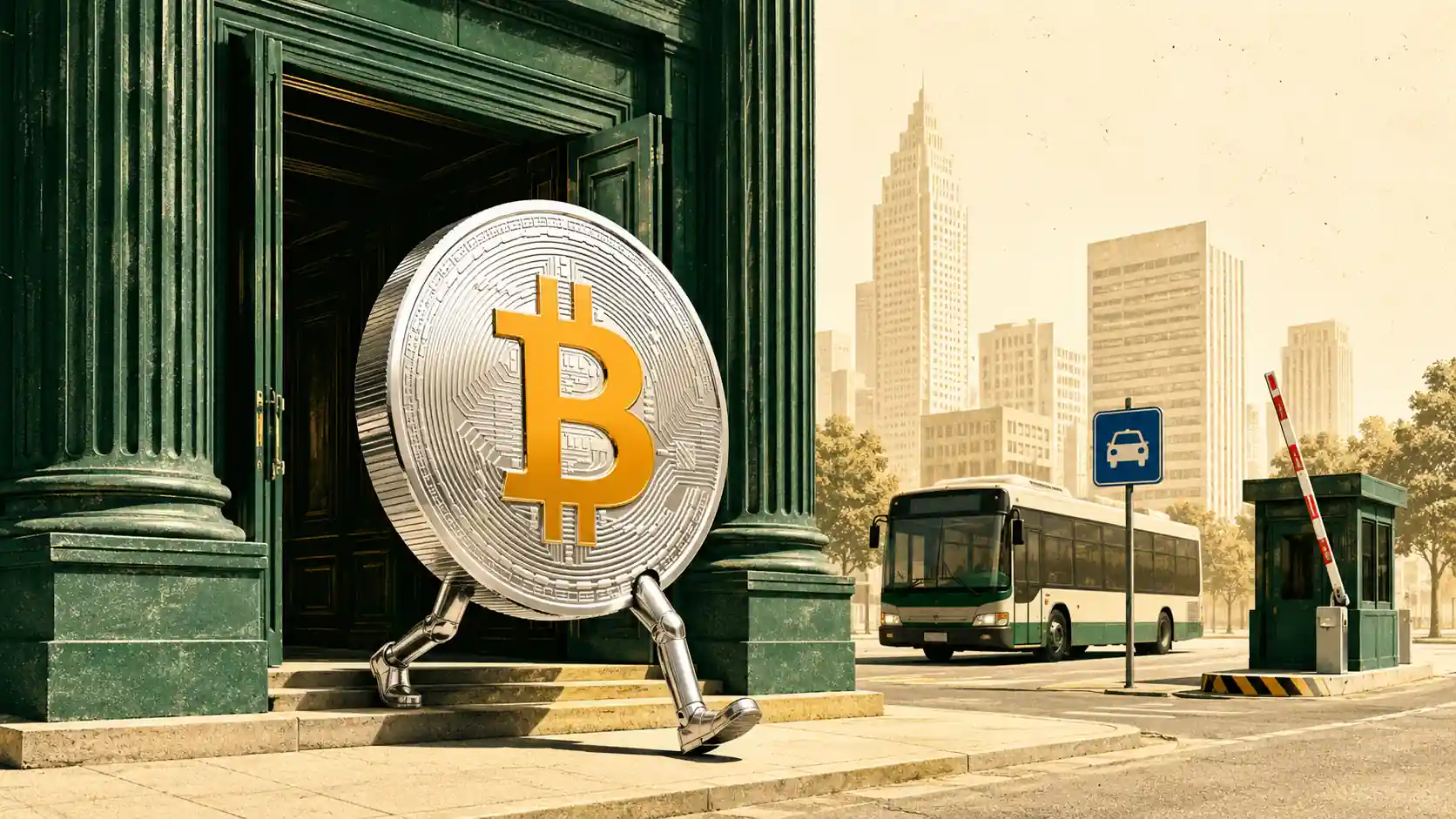
Technically, the system rests on three components that communicate in real time: a ticketing server, a node connected directly to a public blockchain such as Bitcoin or Dogecoin, and an app on the user's smartphone. The use cases are concrete and varied. A bus ticket can be validated with a simple Bluetooth gesture through the app. For motorways, the patent describes what functions as a digital-currency equivalent of a transponder: an app that reads the vehicle's licence plate at the toll plaza and settles the fee on-chain. Critically, the technology is designed to plug into ticketing infrastructure already deployed by several Italian transport companies, which lowers the adoption barrier compared to building from scratch.
Crypto in Mobility: the Italian Patent at a Glance
Key facts. Source: ANSA, AEP, 2026
- What: a patent covering crypto payments for bus tickets, season passes, motorway tolls, parking, and ZTL city-zone access.
- How: direct wallet-to-wallet settlement on a public blockchain, with no banks or payment networks involved.
- Caution: this is a patented technology, not an active service. No transport operator has launched it publicly.
Why This Patent Matters for Crypto Adoption
The real significance here goes beyond a single Italian filing. For anyone tracking crypto's trajectory, this represents one of the rare moments when blockchain technology connects to tangible, daily-life infrastructure rather than staying confined to trading and asset custody. The underlying question is whether cryptocurrencies can move off exchanges and into genuine utility.
That's the adoption question, and it's the one that actually determines the long-term value of the technology. A cryptocurrency that only enables speculation remains a niche financial instrument. One that settles everyday transactions becomes, at least potentially, a real-world medium of exchange. Initiatives like this one, focused on urban mobility, sit alongside other signals of growing institutional curiosity, such as blockchain's gradual entry into the real-estate training sector. Taken together, they map a slow but steady normalization.
The Obstacles Standing Between Patent and Reality
Realism is warranted here. The existence of a patent does not mean the service is deployable tomorrow, and several hard problems remain unsolved.
Volatility is the most obvious. Bitcoin and Dogecoin prices can move sharply within minutes. For a micropayment like a bus fare, someone has to absorb the exchange-rate risk between the moment of payment and the moment the operator converts or uses those funds. That's a structural problem with no clean solution yet, at least not without introducing a conversion layer that partially defeats the purpose of going direct.
Regulation is the second obstacle. Under MiCA, which entered into full force across the EU on December 30, 2024, crypto-asset payments involve compliance obligations that transport operators were never built to handle. Tax treatment adds another layer: in many EU jurisdictions, spending crypto triggers a taxable disposal event for the user, which makes paying a £2 bus fare a reportable transaction. Consumer readiness is the third challenge. How many commuters today actually hold crypto in a self-custody wallet and would choose to use it over a contactless card? That number is small, though it's growing.
These are open questions. Their answers will decide whether this invention stays a patent on paper or becomes a live service. For readers new to the underlying technology, our guide on what cryptocurrencies are offers a solid foundation.
The Bigger Picture: Crypto Leaving the Exchange
Whatever its commercial outcome, this Italian patent says something meaningful about where the industry stands in 2026. The idea of using crypto for everyday payments is no longer confined to enthusiast forums. It's being worked on in real engineering labs, by companies operating in traditional industries, with real capital and multi-year development timelines. That a decades-old Italian ticketing firm chose to file an international blockchain patent is itself a signal worth noting.
The lesson is double-sided. Measured enthusiasm is appropriate: a patent is a starting point, not a finished product, and the distance from filing to deployment is long and full of practical obstacles. At the same time, the underlying signal is real. Applied, practical research on crypto payments is alive and active in Europe, including in sectors far removed from finance. The road to paying a bus fare in Bitcoin is still long. But in a workshop near Florence, someone has started drawing the map.