

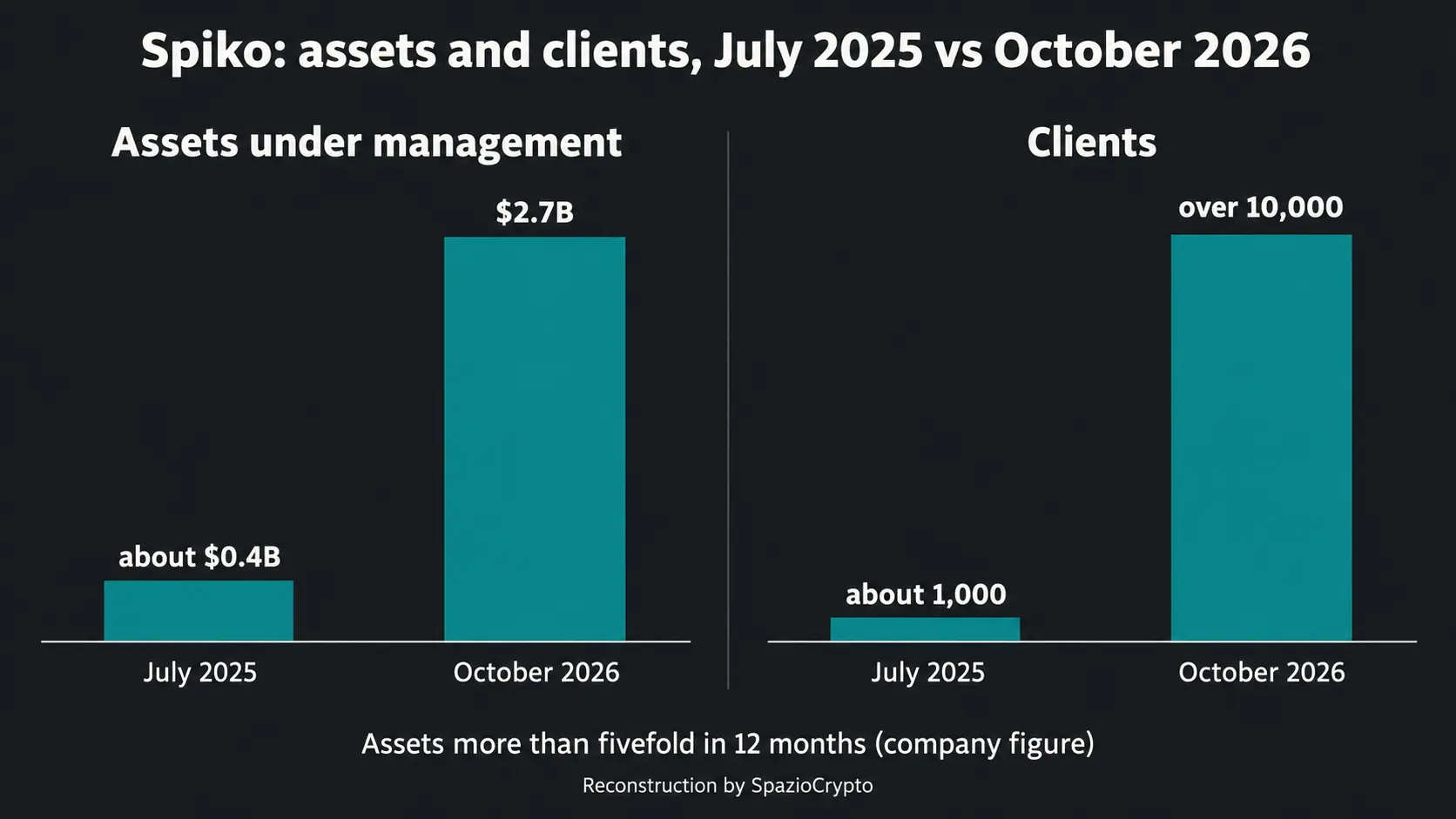
Tokenized money market funds are a different animal from crypto trading: they manage corporate liquidity rather than chase speculative gains. French fintech Spiko closed a $90 million Series B on October 6, led by New Enterprise Associates (NEA), bringing total funding to $120 million, according to the company announcement. Spiko reports approximately $2.7 billion in assets under management, more than 10,000 clients across 25-plus countries, and funds denominated in euros, dollars, sterling, and Swiss francs. The Italian connection is real but limited: Spiko says it is building local teams across several European markets, Italy included, but has announced neither an Italian office nor a commercial launch date. Spiko is a French company, not an Italian one.
TL;DR: Spiko closed a $90 million Series B led by NEA, reaching $120 million in total funding and roughly $2.7 billion in assets. Italy is named as a future hiring market, but no office, launch date, or local distribution model has been confirmed.
What Spiko Actually Announced
The $90 million round includes NEA alongside Index Ventures, Bpifrance, Speedinvest, Flourish Ventures, Shapers, White Star Capital, Blockwall, Frst, EQNX, Mirana Ventures, and Wintermute Ventures. Business angels include Axel Weber, former president of the Bundesbank, and the founders of Qonto. Spiko lists three priorities for the capital: new product launches, new markets, and team expansion. The company has not disclosed how the $90 million will be allocated across those three areas.
On growth, the company claims assets more than quintupled in twelve months. The English-language press release, as reported by The Block, cites $2.7 billion; the French version of the same announcement refers to 2.4 billion euros. According to FinTech Futures, assets stood at roughly $400 million in July 2025, while the client base grew from 1,000 to more than 10,000, spanning startups, research institutions, public bodies, venture capital funds, and medical practices. FinTech Futures also reported an $800 million valuation, citing Bloomberg, a figure Spiko has not confirmed in its own announcement.
Paul-Adrien Hyppolite, co-founder and CEO and previously deputy head of the French Treasury's financial markets division, frames the company's thesis as:
yield should be universal.
Philip Chopin, NEA's head of Europe, stated in the announcement that Spiko is “the only one to have solved the regulatory and product challenges at the same time.” Both statements come from people with a direct financial stake in the company, not independent analysts.


What Spiko Actually Sells
This is not a trading product. Spiko issues shares in money market funds recorded on-chain, accessible via web and mobile apps and integrable through an API, positioned as yield-bearing liquidity. The announcement describes “programmable treasury”: automated rules for paying salaries, settling supplier invoices, or sweeping excess cash into a term fund, all configurable via API, treasury management software, or an AI agent. The term fund is an illustrative example, not a live product; instant withdrawals are already available, and real-time interest calculation is flagged as the next step, without a delivery date attached.
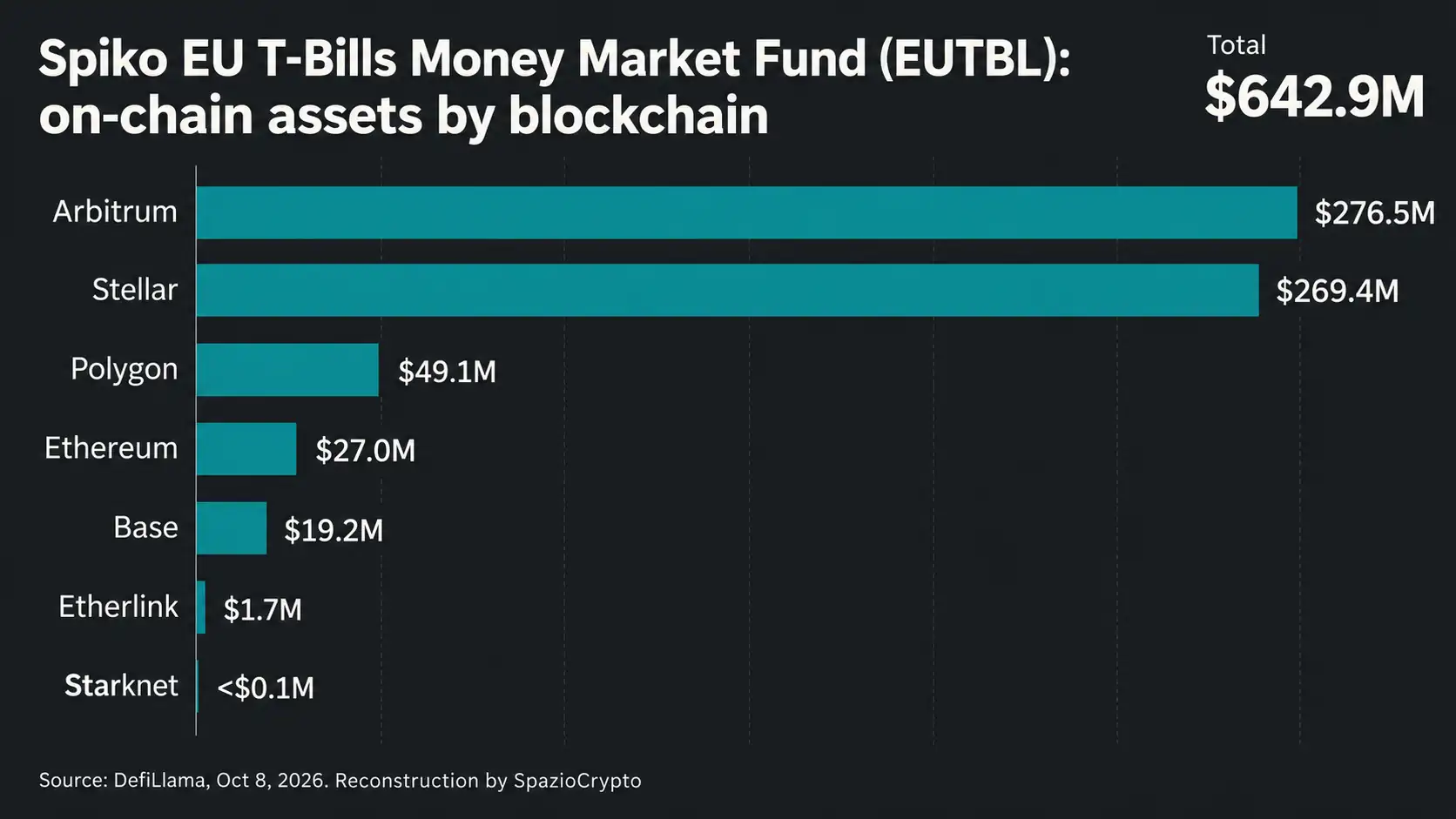
The announcement is thin on regulatory specifics. It does not name any regulator or frameworks such as UCITS, and does not identify which blockchains the funds run on. The Block describes only “multiple public blockchains” and calls the funds “regulated” without naming the regulator or jurisdiction. Spiko's own website identifies the company as an investment firm authorized by France's ACPR. Public data on DefiLlama adds detail: the EUTBL fund, which invests in short-dated eurozone government bonds, is domiciled in France, falls under the UCITS directive, and is deployed across seven networks including Arbitrum, Stellar, Polygon, and Ethereum, with according to DefiLlama approximately $643 million in assets.
According to Crypto Briefing, which counted $2.55 billion in mid-September, Spiko operates nine funds tied to eurozone, U.S., and UK government securities. The largest is the Spiko Amundi Overnight Swap Fund, managed by Amundi with CACEIS and BNY Mellon as custodians. Management fees sit at 0.25% on T-bill and money market products. The funds are supervised by France's AMF and restricted to users who have completed identity verification and received approval.
The Italy Angle: What Exists and What Doesn't
Spiko already operates out of London and Paris. The announcement says the company is building local teams in Germany, the Nordic countries, Italy, Spain, and the Netherlands. That is the entirety of what has been said about Italy: The Block and FinTech Futures repeat the same line without elaboration. There is no Italian office, no opening date, no headcount figure, no named Italian clients, no timeline for new products, and no description of how the funds will be distributed in Italy, including which licenses, banks, or local partners would be involved.
Corporate treasury teams are the most plausible target audience, consistent with the client categories Spiko already serves, but the announcement doesn't spell that out for Italy specifically. The market Spiko would be entering is not empty. Tokenization in Italy has so far been predominantly institutional: doValue and Weltix tokenized a €10 million NPL securitization on a Consob-authorized DLT register; the BlockInvest platform, with UniCredit among its shareholders, is described as the first operational case of tokenized bond issuance and settlement in central bank money through Banca d'Italia systems; and six Italian institutions, from ABI to Intesa Sanpaolo, are participating in the ECB's Appia project contact group. In parliament, a dedicated working group on tokenized real-world assets is operating within the broader set of 14 working groups on bitcoin and tokenization.
Spiko would be targeting a different audience from issuers and banks. If the fund shares qualify as UCITS instruments, they remain financial products governed by the funds directive rather than MiCA's crypto-asset rules. That's our reading of the regulatory picture, not something the announcement clarifies.
The Market Spiko Is Entering
Spiko claims to offer the broadest range of tokenized cash funds in the world, ahead of BlackRock and Franklin Templeton, citing RWA.xyz. The Block notes that the comparison refers to positioning among issuers of these specific products, not total assets under management, and there is no independent verification. As of mid-September, Crypto Briefing ranked Spiko sixth among tokenized real-world asset issuers, just behind Securitize and Ondo.
BlackRock is playing the same game in Europe. The asset manager tokenized twelve share classes across six European money market funds in its Institutional Cash Series, deployed on Ethereum with JPMorgan's Kinexys as technology partner. That series holds assets worth around $311 billion in total, though the figure represents the full series value, not the tokenized portion. More broadly, according to CoinShares and Token Terminal, real-world asset deposits in DeFi protocols more than tripled over twelve months to $7.4 billion, with tokenized Treasuries among the primary growth drivers.
Spiko and Italy: The Scorecard
What is confirmed, what is not. Sources: Spiko announcement, The Block, FinTech Futures
- Confirmed: $90 million Series B led by NEA ($120 million total raised), approximately $2.7 billion in assets, more than 10,000 clients in 25-plus countries, local team hiring underway across Europe including Italy.
- Not disclosed: Italian office, launch date, Italian clients, licenses and distribution model for Italy. Spiko is a French company. The $800 million valuation has not been confirmed by the company.
- Watch for: Italian hires or office announcements, partnerships with Italian banks or fintechs, new product launches, and real-time interest calculation going live.
The Bigger Picture
Yield-bearing liquidity is probably the easiest pitch to a corporate treasurer: you don't have to believe in crypto, you just need a money market fund with a different interface. For that reason, Spiko's Italian chapter will ultimately be judged on three things that aren't yet public: which licenses and partners it will use to distribute in Italy, what the cost looks like relative to a traditional money market fund or a term deposit account, and how well the product integrates with the treasury and ERP software Italian businesses already run. The announcement offers no cost or yield comparison, and we won't fabricate one.
The concrete signals worth tracking are straightforward: Italian job postings or an office announcement, partnerships with Italian banks or fintech firms, the debut of new products, and the delivery of real-time interest calculation. Until those materialize, this story is a capital raise with a stated ambition, not an Italian launch.