


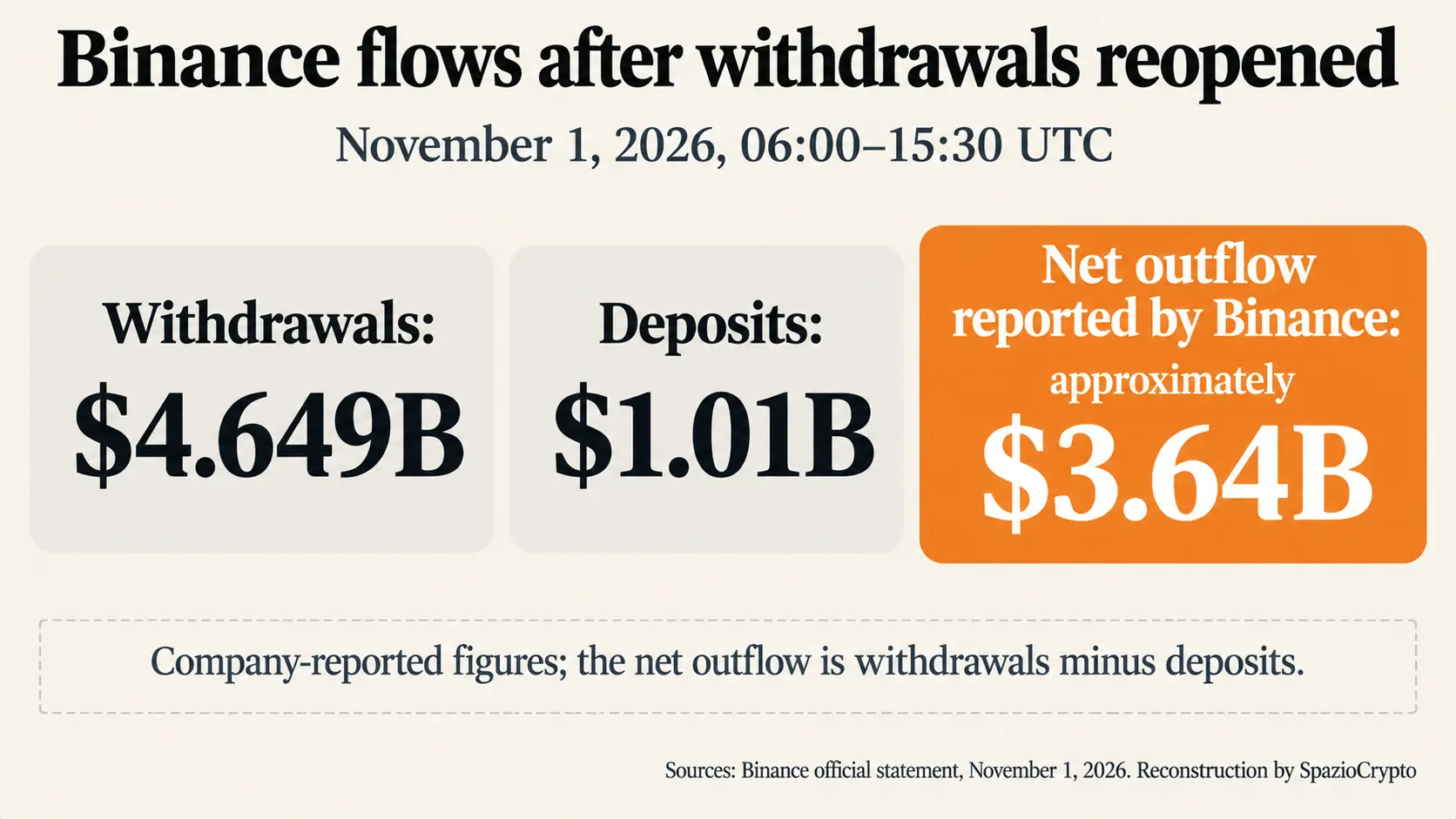
Binance reported net outflows of approximately $3.64 billion in the first nine and a half hours after resuming withdrawals on November 1. The exchange calculated that figure by subtracting $1.01 billion in deposits from $4.649 billion in withdrawals processed between 06:00 and 15:30 UTC. According to Binance, that net figure represents roughly 2.1% of the $171 billion in assets the company reported holding as of October 28.
The phased reopening followed a suspension of withdrawals tied to a $6.3 billion hack. By 12:36 UTC, Binance had re-enabled withdrawals across the 15 networks included in the first phase. The company stated that outflow volumes were declining and stabilizing after an initial spike, while deposits remained substantial.
The $3.64B Is Binance’s Own Figure
The number Binance published measures withdrawals and deposits processed by the platform within a specific time window. It is not an independent estimate of all movements recorded across every blockchain address associated with the exchange. That distinction matters: a transfer between wallets controlled by the same company can appear in on-chain data without representing a customer pulling funds out.
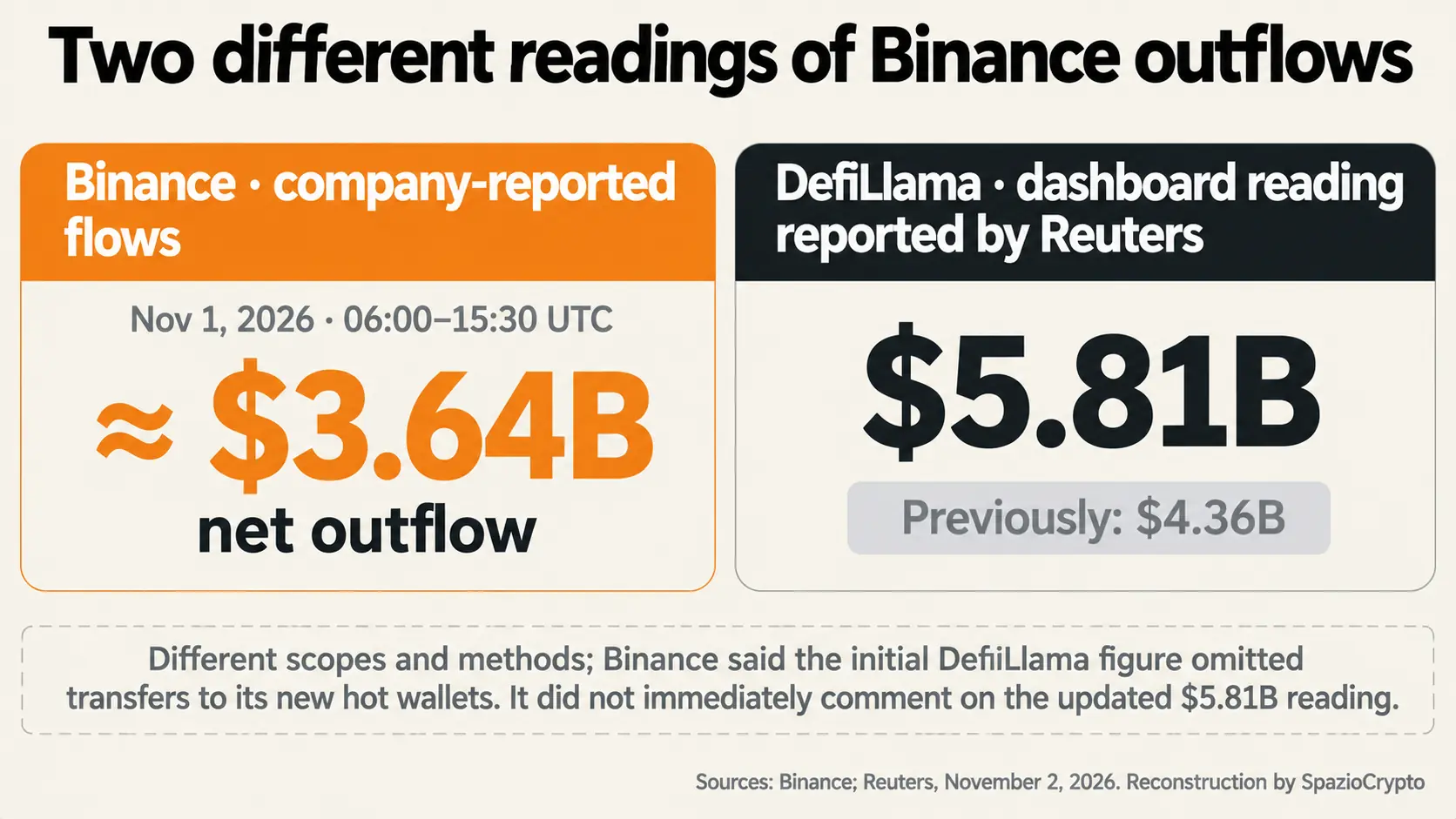
Reuters reported a higher reading from DefiLlama: $5.81 billion in outflows, up from a prior $4.36 billion shown by the service. Binance had disputed the earlier figure, arguing it failed to account for funds moved to new exchange hot wallets. Reuters noted that Binance had not responded to a request for comment on the revised number. The two figures aren’t directly comparable: Binance describes platform-processed flows over a defined interval. DefiLlama tracks movements on the addresses it monitors.
To properly interpret the gap between wallet transfers and customer withdrawals, you need both the set of addresses being observed and the time window applied. Binance’s figure covers nine and a half hours. On-chain readings depend on which addresses are attributed to Binance and can include internal transfers. No single independent measure of net customer withdrawals for the full period exists yet.
The Reopening Happened in Phases
Binance’s official announcement described a gradual resumption, contingent on security and operational checks. The first phase covered 15 networks: Bitcoin, Ethereum, BNB Chain, Tron, Solana, XRP, Dogecoin, TON, Polygon, Avalanche, Arbitrum, Base, Optimism, and Sui. Binance reported all were live again by 12:36 UTC on November 1.
Restarting withdrawals didn’t mean every supported asset and network was instantly available. Binance explained it would continue verifying other services before reactivating them, and that the choice of which networks came first was driven by user demand from the prior week. The announcement also flagged the possibility of temporary delays during the initial phase.
The 2.1% Uses the Exchange’s Own Declared Assets
The 2.1% ratio divides Binance’s self-reported net outflows by the $171 billion in assets the company declared as of October 28. It’s a ratio built entirely on exchange-reported data, not an independent gauge of customer confidence or platform solvency. Reuters described the customer reaction as an early trust test following the hack. The outlet reported that Binance said outflows were stabilizing and deposits remained healthy, without drawing a direct conclusion about overall confidence. Even a relatively contained net movement against declared assets can mask far larger gross flows, as the gap between raw withdrawals and deposits in this window clearly shows.
What Still Needs Answering
The available data covers different time windows and different sets of addresses. It doesn’t allow a precise determination of how much was withdrawn by customers across the entire post-incident period, or what share of on-chain movements consisted of internal transfers. Binance declared $3.64 billion in net outflows through 15:30 UTC on November 1. DefiLlama showed an estimate of $5.81 billion, and Reuters reported that Binance had not clarified the revised figure.
A clearer picture will require follow-up reserve updates and flow data with explicit methodologies and time windows. Binance announced a new Proof of Reserves snapshot would be taken, but as of the announcement the cryptographic proof calculation was still in progress.
The Bigger Picture
The reopening converted a withdrawal-suspension alarm into a visible operational stress test: Binance processed requests again, but the public numbers don’t align because they measure different things. The most useful question at this stage isn’t which figure to trust between $3.64 billion and $5.81 billion; it’s asking what each figure actually includes.
Upcoming reserve updates and withdrawal data from the days that follow should clarify whether outflows stayed contained or whether the first window understated broader movements. For now, Binance’s number is a company-reported metric, and DefiLlama’s is an estimate derived from monitored addresses. Both deserve scrutiny before any conclusion about exchange health is drawn.